Poli Alert Politics & Civics
Related Articles



A federal court ruling out of Idaho has potential implications for exceptions in abortion bans nationwide and could eventually end up before the U.S. Supreme Court to decide.
U.S. District Judge B. Lynn Winmill ruled earlier this month that the 14th Amendment of the U.S. Constitution provides a narrow right for a pregnant patient to obtain an abortion if the pregnancy could be a risk to their health, including their mental health. It’s the first ruling since the U.S. Supreme Court’s decision in Dobbs v. Jackson Women’s Health in 2022 to find that the U.S. Constitution includes a right to abortion access in certain situations.
Mary Ziegler, a legal historian and law professor at the University of California, Davis School of Law, said Winmill’s ruling could be the beginning of a “slow erosion” of the Dobbs decision, similar to the way that anti-abortion advocates used lawsuits and legislation to chip away at the law established by Roe v. Wade after it was decided in 1973.
“They kind of worked over the course of decades to do a death by a thousand cuts, chipping away at its breadth,” Ziegler said. “This may be kind of a funhouse mirror version of that.”
For years, anti-abortion state officials and advocacy groups used various legal tactics to diminish access to abortion nationwide after Roe v. Wade determined that the procedure was a constitutional right. Over time, state legislatures passed procedural laws that made it more difficult for providers to offer abortion services, as well as so-called “fetal pain” laws, and worked up to passing the six-week and 15-week abortion bans that eventually led to Dobbs.
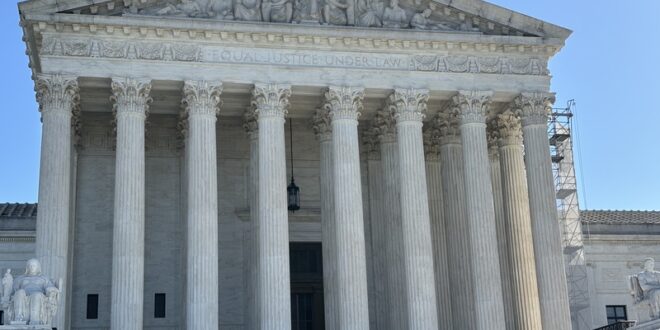
Two years ago, U.S. Supreme Court justices were asked to consider whether Idaho could set aside federal law mandating stabilizing care in an emergency if that stabilizing care, in a doctor’s opinion, was to terminate a pregnancy. Now the question could be whether any pregnancy scenario where a patient’s physical or mental health is threatened is something that all states can regulate under Dobbs.
Health exceptions
Out of the 13 states that have near-total abortion bans, five have no exception for preserving a pregnant patient’s health, including Idaho, Arkansas, Mississippi, Oklahoma and South Dakota.
All 13 have an exception to save a pregnant person’s life, but doctors say there most often is no clear moment when they can easily say a person will die without an immediate abortion. Instead, doctors are left to guess whether terminating a pregnancy to save a patient would cost them their license to practice or land them in prison.
Even in states with health exceptions, some doctors hesitate to act because of the ban, opting for delays that can cause medical complications such as organ damage or fertility loss. An Arkansas woman said she was denied an abortion during a miscarriage in 2024, resulting in a days-long ordeal that eventually led to her being transferred out of state to Kansas, where abortion is legal.
A pregnant woman’s health is not a state resource to be allocated at the legislature’s whim. The Fourteenth Amendment exists precisely to prevent subjugation like this.
– U.S. District Judge B. Lynn Winmill
Winmill’s legal decision blocks enforcement of Idaho’s near-total abortion ban when a pregnancy is terminated under those circumstances. Idaho Attorney General Raúl Labrador, a Republican, appealed the decision to the 9th U.S. Circuit Court of Appeals on Wednesday, and also asked Winmill to pause that injunction while the decision is appealed.
“The state’s interest in protecting unborn children from unjustified abortion is irreparably harmed by the order, and public interest and equity support a stay for that same reason,” Idaho Assistant Solicitor General Aaron Green wrote in the request for a stay.
The attorney general and leadership at the Idaho Family Policy Center, a religious organization that helped craft the legislation that established the state’s ban, have expressed confidence that Winmill’s decision will be reversed quickly.
“The Fourteenth Amendment protects the basic rights that are part of the historical fabric of our nation, not a right to take the life of an innocent child in the womb, an act that was a crime at the time that the Fourteenth Amendment was ratified,” said Caleb Pirc, general counsel for the Idaho Family Policy Center, in a statement. “We fully expect Judge Winmill’s attempt to shoehorn a right to abortion into the Constitution to be swiftly rejected on appeal.”
Supreme Court watch
Dr. Stacy Seyb, a maternal-fetal medicine specialist for Idaho’s largest health system, St. Luke’s, sued state officials and the Idaho Board of Medicine in 2024, arguing that the state’s near-total ban prevented him from providing appropriate care to all of his patients. Maternal-fetal medicine specialists handle the most high-risk pregnancies, including patients carrying multiples and those with conditions such as high blood pressure and gestational diabetes.
In his ruling, Winmill wrote that although Dobbs allowed states to regulate abortion access, that case was about elective abortions, and that his ruling was about a pregnant woman’s ability to seek care under “the most difficult and tragic circumstances,” almost always when the woman wanted the pregnancy.
“By banning health-preserving abortion, Idaho attempts to deny this fundamental right on the basis that the threat of harm comes from a fetus, which depends on the woman for survival,” Winmill wrote. “But a pregnant woman’s health is not a state resource to be allocated at the legislature’s whim. The Fourteenth Amendment exists precisely to prevent subjugation like this.”
Winmill discussed the history of abortion bans in his opinion, writing that when the 14th Amendment was ratified in 1868, the states and territories that restricted abortion also included exceptions for therapeutic purposes when a doctor was acting in good faith.
But Winmill went further than many judges have gone by including a pregnancy’s threats to mental health, something that only Alabama has recognized as an explicit healthcare exception for abortions among states with bans, according to KFF. There, a psychiatrist is required to diagnose a pregnant patient with a serious mental illness that could result in their death or the death of the fetus in order to qualify for that exception.
“The brain is an organ of the body, and healthcare providers use empirical tools to reliably assess the risk of suicidality and the most effective treatments,” Winmill wrote. “It is an affront to human dignity to bar pregnant women from receiving life-saving care on the basis that the threat comes from a mental health condition rather than a physical health condition.”
Idaho’s role
Idaho has been at the center of the national debate about when health conditions take priority over an abortion ban since the first year after the Dobbs decision.
The U.S. Department of Justice under former President Joe Biden sued Idaho to require that it acknowledge a federal law known as the Emergency Medical Treatment and Active Labor Act — better known as EMTALA — in the context of patients who come to the emergency room with pregnancies that may need to be terminated to prevent infection or other adverse health outcomes.
The U.S. Supreme Court heard that case in late April 2024, but sent it back to the lower appellate court in June, saying it was too early in the process for justices to have considered ruling on it. The case was later dropped by the DOJ under President Donald Trump, but St. Luke’s filed its own lawsuit against the state that is still ongoing. That case is also before Winmill in federal court.
At the time of the EMTALA arguments, Idaho officials had argued that if it allowed women to get a legal abortion in an emergency room, anyone could come to a hospital’s emergency department and threaten to harm themselves.
Tanya Pellegrini, co-director of litigation at The Lawyering Project and one of the attorneys who represented Seyb in this month’s case, said that wasn’t true under EMTALA, and it won’t be true following Winmill’s ruling.
“I think the order really speaks for itself in terms of why mental health should not be treated differently from physical health,” Pellegrini said.
Ziegler said she won’t be surprised if Seyb’s case ends up before the Supreme Court in the near future, because it strikes at the heart of questions about the Dobbs decision that have yet to be fully resolved.
“It’s a really important question that they’ll have to address sooner or later,” Ziegler said.
by Kelcie Moseley-Morris, Stateline
Stateline reporter Kelcie Moseley-Morris can be reached at [email protected].
Stateline is part of States Newsroom, a nonprofit news network supported by grants and a coalition of donors as a 501c(3) public charity. Stateline maintains editorial independence. Contact Editor Scott S. Greenberger for questions: [email protected].