Poli Alert Politics & Civics
Related Articles



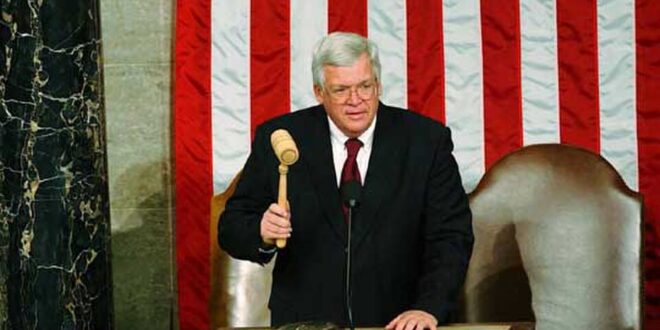
Dennis Hastert rose from an Illinois high school wrestling coach to become the longest-serving Republican speaker of the U.S. House, wielding enormous power in Washington and helping advance President George W. Bush’s agenda.
He ultimately became the highest-ranking elected U.S. official to serve a prison sentence.
Hastert died at 84 over the weekend at his home in Illinois from natural causes, according to Kendall County Coroner Jacquie Purcell. His death closes the life of a politician whose career was defined by one of the most dramatic falls from power in modern Washington history.
Hastert served in Congress from 1987 until his resignation in 2007 and was speaker from 1999 to 2007. He presided over the House during the impeachment of President Bill Clinton and became a key ally of Bush as Republicans pushed through tax cuts, the Iraq War and the Medicare prescription drug expansion.
But years after leaving Congress, Hastert’s carefully maintained public image collapsed.
From Illinois wrestling coach to House speaker
Before entering politics, Hastert taught history and coached wrestling at Yorkville High School in Illinois. He later served in the Illinois House before winning a seat in Congress in 1986.
He became speaker after a period of turmoil among House Republicans following Newt Gingrich’s resignation and the withdrawal of Bob Livingston, who had been expected to succeed him.
Hastert was viewed as a low-key, disciplined leader who helped consolidate Republican control of the House. His tenure also produced what became known as the “Hastert Rule,” an informal practice of generally refusing to bring legislation to the floor unless it had the support of a majority of the majority party.
For years, Hastert’s influence extended well beyond the House. He became one of the most powerful Republicans in Washington and later worked as a lobbyist after leaving Congress.
A secret that eventually destroyed his career
That legacy unraveled in 2015, when federal investigators began examining large cash withdrawals Hastert had made over several years.
Prosecutors said Hastert had been withdrawing money to make payments intended to conceal his past sexual abuse of teenage boys while he was a teacher and wrestling coach.
Hastert pleaded guilty to violating federal banking laws by structuring withdrawals to avoid reporting requirements and to lying to the FBI. The underlying sexual abuse was too old to prosecute under the applicable statutes of limitations.
At his 2016 sentencing, Hastert acknowledged sexually abusing students he had coached decades earlier.
Federal prosecutors identified multiple victims, and testimony in court detailed the lasting effects of the abuse. One former athlete, Scott Cross, publicly described being abused by Hastert while he was a high school student.
U.S. District Judge Thomas Durkin called Hastert a “serial child molester” and sentenced him to 15 months in federal prison, a $250,000 fine and sex-offender treatment.
Hastert ultimately served his sentence at a federal medical facility in Minnesota before being released in 2017.
The fall of a former speaker
The scandal transformed Hastert’s public legacy.
The man who had once occupied the most powerful office in the House was now a convicted felon whose criminal case centered on efforts to conceal sexual abuse.
Institutions that had once honored Hastert distanced themselves from him. His portrait was removed from the Capitol, and organizations associated with his political and wrestling careers stripped his name or honors.
His downfall also cast his political career in a different light. Hastert had built his reputation as a cautious institutional leader who preferred to avoid the spotlight. But the revelations that emerged after his retirement made his private conduct the defining part of his legacy.
A complicated political legacy
Hastert nevertheless left a lasting mark on Congress.
As speaker, he helped steer major pieces of the Bush administration’s domestic and foreign-policy agenda through the House. He also presided over a period of increasingly partisan congressional politics and helped strengthen the majority party’s control over the legislative process.
But his career ultimately became inseparable from the abuse he committed and the subsequent effort to conceal it.
Hastert’s death comes more than a decade after his criminal case exposed the gap between the public image he cultivated as a powerful political leader and the conduct he had concealed for decades.
He is survived by his wife, Jean, and two adult sons.