Poli Alert Politics & Civics
Related Articles


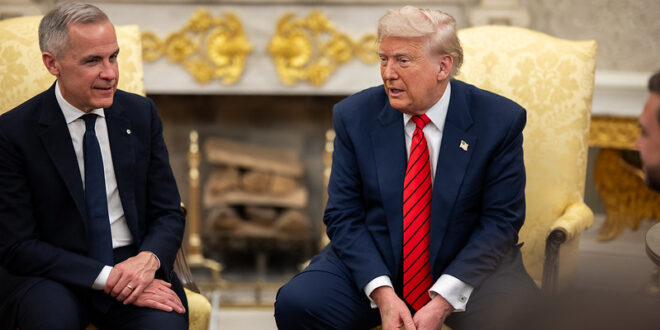
President Donald Trump on Tuesday delayed plans to impose 50% tariffs on about $20 billion worth of Canadian imports after the United States and Canada reached a last-minute agreement to continue negotiations.
Trump announced the three-day pause on Truth Social less than two hours before the tariffs were scheduled to take effect at 12:01 a.m. Wednesday. The delay gives the two countries additional time to finalize what Trump described as a deal while temporarily easing the threat of another escalation between two longtime allies.
“I have paused the 50% Tariffs against Canada,” Trump said in his post, citing a “DEAL” that remains subject to the finalization of documents.
The tariffs would have applied to Canadian products ranging from hockey sticks to medical supplies and other goods. Canada had threatened to retaliate, raising the prospect of a broader trade dispute between countries whose economies are deeply intertwined.
Last-minute agreement averts tariff escalation
A White House proclamation said Canada had agreed to remove measures the Trump administration considers discriminatory against U.S. exports, including alcohol, dairy products and motor vehicles.
Canadian Prime Minister Mark Carney did not immediately confirm all of those commitments but said the two countries had made “substantial progress” in negotiations. He confirmed that Canada had agreed to the three-day delay while talks continue.
Trump and Carney spoke twice by phone over the previous two days, including a conversation Tuesday afternoon, as officials on both sides pushed to reach an agreement before the tariffs took effect.
The temporary reprieve provides relief to businesses that had been preparing for significantly higher costs.
Candace Laing, president and CEO of the Canadian Chamber of Commerce, said the delay offered businesses some relief but warned that uncertainty would remain until the countries sign an agreement.
“This limbo state is not anyone’s preferred outcome,” Laing said.
Tariffs carry political and economic risks
The proposed tariffs threatened to further strain an already tense relationship between the United States and Canada.
Nearly 72% of Canada’s goods exports went to the United States last year, according to Statistics Canada. The two countries exchanged roughly $880 billion in goods and services during the same period.
Economists and trade experts have warned that tariffs are ultimately paid by U.S. importers, who may pass some or all of the additional costs on to consumers through higher prices.
The timing also carries political significance for Trump. The administration is facing continued voter concerns over the cost of living ahead of the 2026 midterm elections, making another round of tariffs potentially politically risky if they contribute to higher consumer prices.
Trump continues aggressive trade strategy
The confrontation with Canada is part of Trump’s broader effort to make tariffs a centerpiece of his second-term economic agenda.
Trump has imposed or threatened tariffs on trading partners around the world as he seeks to encourage domestic manufacturing and extract concessions from foreign governments. His approach has marked a sharp departure from the traditionally cooperative economic relationship between Washington and Ottawa.
Trump has also repeatedly suggested that Canada could become the 51st U.S. state, comments that have further aggravated relations between the neighboring countries.
The administration’s latest tariff threat relies on a rarely used provision of federal law. Trump invoked Section 338 of the Tariff Act of 1930, which allows the president to impose tariffs of as much as 50% on countries determined to have discriminated against U.S. businesses.
The provision has never previously been used to impose tariffs.
The administration turned to Section 338 after the Supreme Court ruled in February that Trump had exceeded his authority when imposing an earlier set of broad tariffs under a different law. The ruling also opened the door to potentially large refunds for importers that paid those tariffs.
What happens next
The three-day pause does not eliminate the threat of tariffs. Instead, it gives U.S. and Canadian officials a narrow window to complete the agreement announced by Trump and determine whether the threatened levies will ultimately be imposed.
The United States and Canada are also negotiating changes to the United States-Mexico-Canada Agreement, the North American trade pact Trump pushed through during his first term.
For now, the latest agreement gives both governments an opportunity to step back from another tariff escalation. But unless the two sides finalize their deal, Canadian exports could again face the threat of sharply higher U.S. import taxes within days.