

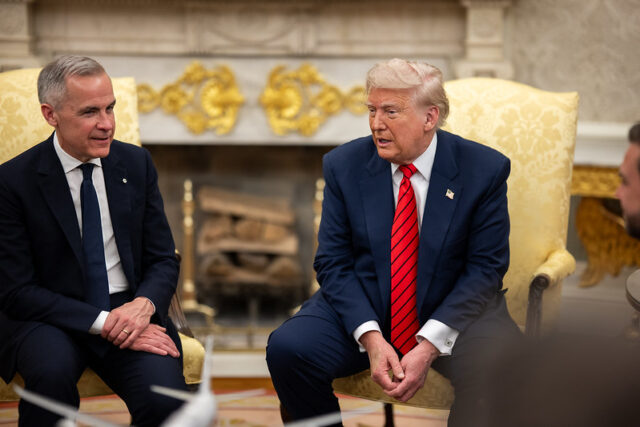
President Donald Trump announced a new round of 50% tariffs on a broad range of Canadian imports Monday, significantly escalating trade tensions between the United States and one of its largest trading partners.
The new tariffs, outlined in a series of presidential proclamations, are scheduled to take effect Aug. 19 and target products including hockey equipment, electronics, plywood, honey, jewelry, flower bulbs, down feathers, cowhides and alcoholic beverages such as beer, wine and liquor.
The White House said the action responds to what it called Canada’s “unreasonable, unequal, and discriminatory actions,” including retaliatory tariffs and import restrictions imposed after the Trump administration’s earlier trade measures.
Unlike previous tariff rounds, goods covered under the U.S.-Mexico-Canada Agreement (USMCA) will not be exempt, according to a senior administration official. The USMCA was negotiated during Trump’s first term and governs most trade between the three North American countries.
Administration officials said the tariffs were imposed under Section 338 of the Tariff Act of 1930, which authorizes the president to levy duties of up to 50% against countries deemed to discriminate against U.S. commerce. Officials acknowledged the provision has rarely been used in this manner but argued it provides sufficient legal authority after courts limited Trump’s ability to rely on broader emergency powers for tariffs.
U.S. Trade Representative Jamieson Greer said Canada has continued to retaliate against American trade actions despite ongoing negotiations.
“While the Administration continues to secure fair and reciprocal trade deals with our trading partners, Canada, unlike other partners and allies, continues to retaliate against the United States for its efforts to rebalance trade and protect U.S. industry in national-security sensitive sectors,” Greer said in a statement.
Canadian Prime Minister Mark Carney rejected the administration’s characterization, arguing Canada’s previous tariffs simply mirrored U.S. measures that Ottawa believes violated the USMCA.
“This trade dispute has raised costs for families, particularly in the U.S.,” Carney said. “Canada stands ready to engage intensively to address outstanding issues with the U.S. to the mutual benefit of our citizens.”
Carney added that Canada remains willing to negotiate and modernize the USMCA.
Industry groups on both sides of the border warned the latest tariffs could further strain businesses and consumers.
The Distilled Spirits Council of the United States said the new duties increase the risk of additional retaliation after American spirits were removed from store shelves across much of Canada following earlier trade disputes.
“We had hoped this issue could be resolved without further escalation,” said Chris Swonger, the organization’s president and CEO.
The Canadian Chamber of Commerce likewise called the tariffs a “regrettable escalation” while urging both governments to use the coming weeks to reach a negotiated settlement before the tariffs take effect.
Canada is the United States’ second-largest trading partner after Mexico. More than $300 billion in goods crossed the U.S.-Canada border during the first five months of 2026, according to federal trade data.
Trade relations between the two countries have remained tense throughout Trump’s second term. Earlier disputes centered on immigration, fentanyl enforcement, NATO spending and Trump’s repeated suggestions that Canada should become the 51st U.S. state. Last week, Trump also threatened additional tariffs tied to wildfire smoke drifting into the United States, although administration officials said Monday’s announcement was unrelated to that proposal.