

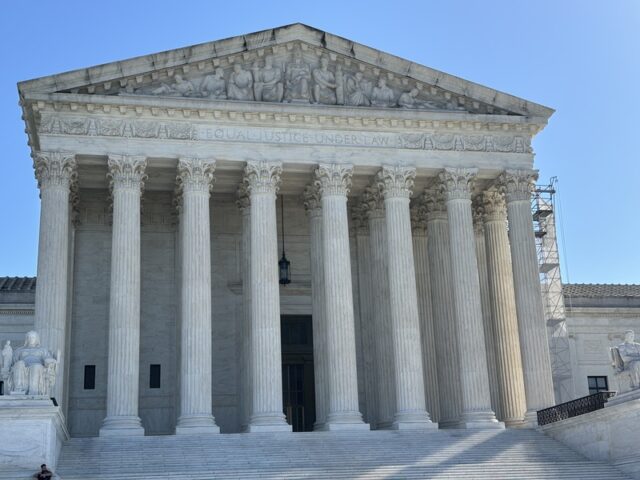
The Supreme Court on Tuesday allowed Alabama to use a congressional map that eliminates one of the state’s two majority-Black districts, handing Republicans a significant victory as they seek to protect their narrow U.S. House majority ahead of the 2026 midterm elections.
In a 6-3 decision split along ideological lines, the court granted an emergency request from Alabama Republican officials seeking permission to implement a congressional map enacted in 2023 but never before used in an election.
The unsigned three-page order signaled that the conservative majority believes Alabama is likely to prevail in its broader legal challenge over the map’s legality.
Liberal Justice Sonia Sotomayor sharply criticized the ruling in a dissent joined by the court’s other liberal justices, arguing that the majority had ignored established legal principles and undermined voting rights protections.
“This Court disregards both democratic values and the rule of law,” Sotomayor wrote.
Decision Reverses Lower Court Findings
The ruling temporarily overturns a lower court order that found Alabama’s map intentionally discriminated against Black voters in violation of the 14th Amendment.
A three-judge federal panel had concluded that Alabama lawmakers unlawfully drew the map with only one majority-Black district despite earlier court findings that the state should create a second district to comply with the Voting Rights Act.
That dispute traces back to Alabama’s 2021 congressional map, which was struck down after courts determined it diluted Black voting strength. The Supreme Court upheld that decision in 2023, forcing Alabama to redraw its districts.
The state subsequently adopted a new map in 2023, but challengers argued it still failed to adequately represent Black voters. Federal judges agreed, finding that state lawmakers had intentionally ignored court guidance by maintaining only one majority-Black district.
The latest Supreme Court order effectively allows Alabama to use that map while litigation continues.
Impact on House Control
The ruling could reshape Alabama’s congressional delegation and strengthen Republican efforts to hold onto control of the House.
Under the challenged map, Democratic Rep. Shomari Figures would likely face a significantly more difficult political environment, while Republicans stand to gain an additional advantage in the state’s congressional delegation.
The decision comes as both parties intensify redistricting battles nationwide. Republicans currently hold a narrow House majority and have pursued aggressive efforts to redraw congressional boundaries in several states before November’s elections.
Court Cites Recent Louisiana Decision
The Supreme Court directed lower courts to reconsider Alabama’s case after its recent ruling involving Louisiana redistricting, a decision that significantly weakened the reach of Section 2 of the Voting Rights Act.
That ruling instructed courts to give greater deference to states when they draw maps that reflect partisan political objectives, even when those maps affect minority voting power.
In Tuesday’s order, the court said the lower court failed to adequately account for that precedent.
The majority also criticized federal judges for intervening too close to an election.
“Here, the District Court interposed itself into Alabama’s ongoing efforts to conduct its imminent 2026 congressional elections under maps that its elected representatives selected,” the court wrote.
The justices added that a court’s belief that alternative maps might be more convenient was not sufficient justification for overriding the state’s chosen plan.
Alabama Officials Celebrate Victory
Alabama Attorney General Steve Marshall praised the ruling as a major win for the state.
“Tonight’s decision is a major victory for Alabama and for the principle of self-governance,” Marshall said in a statement. “The United States Supreme Court confirmed what we always knew: that Alabama’s congressional maps are constitutional and lawful under the Voting Rights Act.”
Sotomayor Warns of Election Chaos
Sotomayor argued the Supreme Court itself contributed to the confusion now surrounding Alabama’s elections by issuing major redistricting decisions close to election deadlines.
She said the court could have allowed Alabama to conduct an orderly election under existing district lines but instead chose to permit elections under what she described as a discriminatory map.
“The Court instead chooses a chaotic election, held under a never-before-used congressional map that intentionally discriminates against Black Alabamians,” Sotomayor wrote.
She further accused Alabama officials of defying prior court rulings and said the decision rewards that behavior.
“The ruling corrodes the rule of law by rewarding Alabama’s gamesmanship and outright defiance of court orders,” she added.
Civil Rights Groups Condemn Decision
Civil rights advocates immediately condemned the ruling.
Kristen Clarke, general counsel for the NAACP, said the decision continues a broader trend of weakening protections for minority voters.
“The Supreme Court continues to unleash chaos in our democratic process, and with this latest action, gives Alabama approval to use a congressional map that had previously been found to be intentionally discriminatory,” Clarke said.
She argued the court is stripping Black voters of political power at an alarming pace and urged voters to respond at the ballot box.
Part of Broader Redistricting Fight
The Alabama case is the latest chapter in an unprecedented national redistricting battle unfolding ahead of the midterms.
The conflict intensified after President Donald Trump encouraged Texas Republicans to redraw congressional districts to create additional GOP-leaning seats. That move sparked similar efforts across several states.
Following the Supreme Court’s Louisiana ruling, Republican-led states across the South have moved to redraw maps in ways that reduce the number of majority-Black districts, many of which are represented by Democrats.
Alabama officials postponed the state’s congressional primaries while lawmakers rushed to respond to the court’s decisions. The primaries, originally scheduled for May, are now set for Aug. 11.
The outcome of the ongoing litigation could ultimately influence the balance of power in Congress, where Republicans are seeking to limit losses and Democrats are fighting to preserve districts that have historically helped boost minority representation.