 Poli Alert Politics & Civics
Related Articles



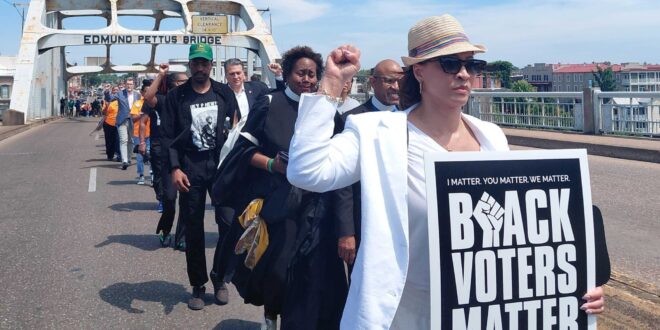
A three-judge federal panel on Monday blocked Alabama from using congressional district maps that the court said intentionally discriminated against Black voters, setting up another likely showdown before the Supreme Court of the United States.
The ruling from the U.S. District Court in Birmingham found that the congressional maps proposed by Alabama lawmakers in 2023 would unlawfully dilute Black voting power in violation of the Constitution and the Voting Rights Act.
The judges wrote that the maps “intentionally discriminated based on race,” reaffirming earlier findings that the state’s redistricting plan violated protections guaranteed under the Voting Rights Act of 1965 and the Fourteenth Amendment.
“As we see it, the irreducible minimum is that federal law requires that all Alabamians have an opportunity to vote under districting plans untainted by intentional race-based discrimination,” the panel wrote in its decision.
The ruling is a significant development in the broader national battle over congressional redistricting ahead of November’s elections, as Republicans work to preserve their narrow House majority through new district maps in several states.
The Alabama panel’s decision came after the Supreme Court instructed lower courts to reconsider redistricting disputes following its recent ruling in Louisiana v. Callais, which determined that Louisiana’s congressional map constituted an unconstitutional racial gerrymander.
Despite revisiting the issue under that new legal framework, the Alabama judges said they reached the same conclusion.
“We again cannot understand the 2023 Plan as anything other than intentionally discriminatory,” the panel wrote.
Two members of the panel — Judges Anna Manasco and Terry Moorer — were appointed by President Donald Trump. The third judge, Stanley Marcus, was appointed to the federal bench by Presidents Ronald Reagan and Bill Clinton.
The decision was hailed by voting rights advocates and Democrats, who argue that Republican-led states are attempting to redraw congressional boundaries to weaken minority representation.
Davin Rosborough, deputy director of the American Civil Liberties Union Voting Rights Project and lead attorney in the case, said the ruling confirmed that Alabama lawmakers repeatedly refused to provide Black residents fair representation in Congress.
“Black voters deserve a voice and a seat at the table,” Rosborough said.
House Minority Leader Hakeem Jeffries called the ruling a setback for what he described as Republican efforts to manipulate congressional districts ahead of the election cycle.
The Alabama case is part of a wider redistricting fight unfolding across the South and other battleground states. Hours after the ruling, the South Carolina Senate declined to advance a proposed congressional map that would have eliminated the state’s only majority-Black district, currently represented by Rep. James Clyburn.
Meanwhile, the Supreme Court of Virginia recently blocked new Democratic-leaning congressional maps approved earlier this year in a statewide referendum.
Republicans have aggressively pursued new maps in several states since 2025. In Florida, Gov. Ron DeSantis signed legislation in May establishing congressional districts projected to strengthen Republican control over four additional House seats..

