Poli Alert Politics & Civics
Related Articles


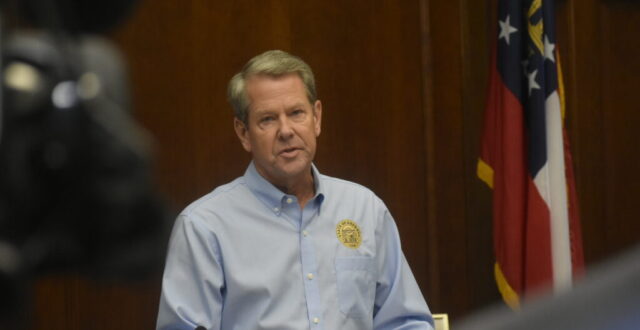
Gov. Brian Kemp announced Wednesday that Georgia lawmakers will return to the Capitol next month for a special legislative session focused on redrawing the state’s political maps following a recent U.S. Supreme Court decision that weakened key protections under the Voting Rights Act.
The session, scheduled to begin June 17, will also address looming changes to Georgia’s election system tied to a 2024 state law banning the use of ballot QR codes for official vote tabulation after July 1.
Kemp’s decision places Georgia at the center of a growing political and legal battle across the South after the Supreme Court’s ruling in Louisiana v. Callais significantly raised the legal standard for challenging racially discriminatory district maps.
In Callais, the Supreme Court ruled that plaintiffs challenging congressional or legislative maps under Section 2 of the Voting Rights Act must prove intentional racial discrimination rather than merely demonstrating discriminatory effects.
Voting rights advocates warned the ruling could open the door for states to dismantle Black-majority districts that were previously protected under federal law.
Several Republican-led Southern states, including Alabama and Tennessee, have already moved to redraw maps following the decision.
Kemp initially signaled earlier this month that Georgia would not pursue immediate redistricting ahead of the 2026 general election because voting for the cycle was already underway. However, he said the ruling made it clear the state would likely need to adopt new maps before the 2028 elections.
“Voting is already underway for the 2026 elections, but it’s clear that Callais requires Georgia to adopt new electoral maps before the 2028 election cycle,” Kemp said previously.
In Wednesday’s formal proclamation, Kemp directed lawmakers to consider new maps for Georgia’s congressional districts, state House, state Senate and any other offices elected by district.
Georgia Democrats sharply criticized the move, accusing Republicans of attempting to entrench political power by weakening minority voting influence.
Senate Minority Leader Harold Jones said Republicans were using redistricting to preserve their legislative majorities.
“If Republicans ever used their power to help Georgians, they wouldn’t have to waste time and money redrawing the maps every few years to keep their majorities,” Jones said in a statement.
House Minority Leader Carolyn Hugley said she plans to introduce a constitutional amendment during the special session that would ban partisan gerrymandering in Georgia.
“Nobody has said our maps are illegal, and the speed and urgency that Republicans have moved to redraw maps to lock-in single-party rule, indefinitely, shows why the Voting Rights Act was needed in the first place,” Hugley said.
Republican officials argued the special session offers an opportunity to eliminate what they describe as race-based gerrymandering and instead draw districts based on geographic and political considerations.
Josh McKoon said the state should adopt maps rooted in “race-neutral principles,” including compactness and respect for local boundaries.
“Georgians deserve fair districts that reflect the will of the voters, not artificial racial quotas or outdated mandates that divide our state along racial lines,” McKoon said.
Voting rights advocates raise alarms
Civil rights groups and voting rights advocates condemned the redistricting effort, warning the new legal framework could make it significantly harder to challenge maps that dilute Black voting strength.
ACLU of Georgia policy director Christopher Bruce said his organization had pushed for a special session focused on election technology changes but opposed adding redistricting to the agenda.
“This is not something that’s new, but this is something that is nefarious beyond belief,” Bruce said. “We do not need new maps. We need fair maps.”
Georgia lawmakers last redrew the state’s political maps during a 2023 special session after a federal judge ordered the creation of additional Black-majority districts, including one new congressional district, two state Senate districts and five state House districts.
That case remains pending before the United States Court of Appeals for the Eleventh Circuit.
Under the new Supreme Court precedent, however, plaintiffs challenging future maps would need to prove intentional racial discrimination — a substantially higher legal hurdle.
Political analysts say the ruling may encourage Republican-led states to redraw maps under the justification of partisan advantage rather than race.
Carol Anderson, a professor of African American studies at Emory University, said the distinction between partisan and racial gerrymandering is often blurred in Southern states because Black voters overwhelmingly support Democratic candidates.
“It allows these states to use ‘partisan’ as the fig leaf to cover racial gerrymandering,” Anderson said.
Meanwhile, Charles Bullock said Republicans could attempt to break apart heavily Democratic districts by spreading Black voters across neighboring Republican-leaning districts.
Bullock identified Georgia’s 2nd Congressional District, represented by Democratic Rep. Sanford Bishop, as a likely target for redistricting changes.
He noted that altering the district too aggressively could also make nearby Republican-held districts more politically competitive.
Election system changes also on agenda
In addition to redistricting, lawmakers must address the state’s transition away from QR-code ballot tabulation systems.
Under legislation passed in 2024, Georgia can no longer use QR codes for official ballot counting after July 1, forcing election officials to implement updates before future statewide elections.
Bullock said combining election system updates with redistricting in a single special session likely reflects an effort to save time and money while allowing Republicans to finalize maps before the 2026 midterm elections potentially shift political power.
The special session will begin June 17, one day after Georgia’s primary runoff elections.