Poli Alert Politics & Civics
Related Articles


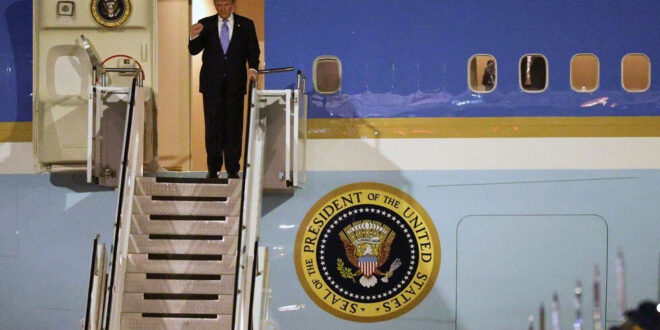
Donald Trump arrived in Beijing on Wednesday for a closely watched summit with Chinese President Xi Jinping, as the two leaders prepare to discuss the Iran war, trade disputes, Taiwan and nuclear arms control during a pivotal moment in U.S.-China relations.
Chinese officials staged a lavish welcome ceremony for Trump after Air Force One landed in the Chinese capital, complete with a military honor guard, a marching band and hundreds of Chinese youths waving American and Chinese flags.
Trump was greeted on the tarmac by Chinese Vice President Han Zheng, Chinese Ambassador to Washington Xie Feng, Vice Foreign Minister Ma Zhaoxu and U.S. Ambassador to China David Perdue.
As Trump walked toward his limousine, crowds of young greeters dressed in coordinated white and blue outfits chanted, “Welcome, welcome! Warm welcome!”
Before departing Washington on Tuesday, Trump signaled that trade would be his top priority during the visit.
“We’re the two superpowers,” Trump told reporters. “We’re the strongest nation on Earth in terms of military. China’s considered second.”
The president said he planned to focus “more than anything else” on economic agreements that could increase Chinese purchases of American soybeans, beef and aircraft.
Administration officials are also hoping to establish a formal U.S.-China Board of Trade aimed at managing disputes between the world’s two largest economies and preventing a renewed escalation in trade tensions.
The talks come after the United States and China reached a one-year trade truce last October following a bitter tariff conflict that disrupted global supply chains and led China to leverage its dominance over rare earth mineral exports.
Trump traveled to Beijing accompanied by several prominent business leaders, including Jensen Huang and Elon Musk.
During the flight, Trump posted on social media that his “first request” to Xi would be for China to expand opportunities for American companies operating in the country.
“I will be asking President Xi, a Leader of extraordinary distinction, to ‘open up’ China,” Trump wrote.
Iran war casts shadow over summit
Although Trump publicly downplayed Iran as a major discussion topic, the ongoing conflict in the Middle East has become a central challenge for his administration and a major source of global economic instability.
Since joint U.S. and Israeli strikes against Iranian targets earlier this year, Iran has effectively shut down access through the Strait of Hormuz, disrupting a critical route for global oil shipments and contributing to soaring energy prices.
The resulting spike in fuel costs has fueled inflation concerns worldwide and intensified pressure on Trump domestically as U.S. gas prices and consumer costs continue rising.
Still, Trump insisted Tuesday that Iran was largely under control.
“We have a lot of things to discuss. I wouldn’t say Iran is one of them, to be honest with you, because we have Iran very much under control,” Trump told reporters.
Iranian Foreign Minister Abbas Araghchi visited Beijing last week, raising speculation that China could play a larger diplomatic role in efforts to de-escalate the conflict.
Taiwan and security tensions remain flashpoints
Taiwan is also expected to feature prominently in discussions between Trump and Xi.
China has sharply criticized a planned $11 billion U.S. weapons package for Taiwan that the Trump administration approved late last year but has not yet delivered.
Beijing views the self-governing island as part of its territory and considers U.S. military support for Taiwan a major provocation.
Ahead of Trump’s arrival, the Chinese Communist Party newspaper People’s Daily published a strongly worded editorial calling Taiwan “the first red line that cannot be crossed in China-U.S. relations.”
Trump’s own stance on Taiwan has at times appeared less certain than previous administrations, fueling questions about whether he could eventually scale back U.S. support for the island.
At the same time, Taiwan’s dominant role in semiconductor manufacturing has made the island strategically critical for artificial intelligence development and global technology supply chains.
Nuclear arms deal proposal resurfaces
Trump also plans to revive discussions about a possible trilateral nuclear arms agreement involving the United States, China and Russia, according to a senior administration official.
The proposal would seek limits on nuclear arsenals maintained by the three countries following the expiration earlier this year of the New START treaty between Washington and Moscow.
China has historically resisted participating in such agreements, arguing its nuclear arsenal remains significantly smaller than those of the United States and Russia.
According to Pentagon estimates, China currently possesses more than 600 operational nuclear warheads and could exceed 1,000 by 2030. The U.S. and Russia each maintain stockpiles estimated at more than 5,000 warheads.
Trump arrived in China facing mounting political pressure at home as inflation tied to the Iran conflict weighs on consumer confidence and public approval of his economic leadership.
Despite projecting confidence ahead of the summit, analysts said China may hold greater leverage entering the talks because Beijing can afford to avoid major concessions while benefiting from relative stability.
Scott Kennedy, a senior adviser at the Center for Strategic and International Studies, said China would likely emerge stronger from the summit so long as the meeting avoided a major breakdown.
“Even if they don’t get much on any of those things, as long as there’s not a blow-up in the meeting and President Trump doesn’t go away and look to re-escalate, China basically comes out stronger,” Kennedy said.
Trump and Xi are scheduled to begin formal bilateral meetings Thursday in Beijing, with trade, Taiwan, energy markets and global security expected to dominate discussions.
Officials from both countries are also continuing lower-level economic negotiations. Earlier Wednesday, Treasury Secretary Scott Bessent met with Chinese Vice Premier He Lifeng in South Korea to discuss trade and financial issues.
The outcome of the summit could shape the direction of U.S.-China relations for years as both countries navigate mounting geopolitical and economic tensions.