Poli Alert Politics & Civics
Related Articles


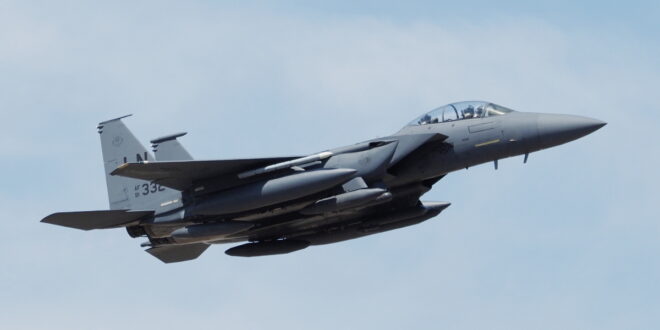
The U.S. military lost a fighter jet to enemy fire for the first time in the escalating conflict with Iran, officials said Friday, as search-and-rescue teams continued efforts to locate a missing crew member a day later.
The aircraft, an F-15E Strike Eagle, was shot down over southwestern Iran, marking a significant setback for the Trump administration as it seeks to maintain air superiority in the region.
Crew status and rescue operation
Two crew members aboard the jet ejected before the aircraft went down, according to U.S. officials.
One was recovered shortly after the incident, but the second remained missing as of early Saturday, prompting an urgent and high-risk recovery effort.
Search operations involved multiple aircraft, including a C-130 Hercules and helicopters conducting low-altitude sweeps over hostile territory.
During the mission, a UH-60 Black Hawk helicopter came under Iranian ground fire but was able to escape to neighboring Iraq, U.S. and Israeli officials said.
Second aircraft incident reported
In a separate development, an A-10 Thunderbolt II crashed in the Persian Gulf region on Friday.
The pilot of that aircraft was rescued, according to U.S. officials, though details about the cause of the crash were not immediately released.
Where the jet was downed
Iranian state media reported that the F-15E was shot down over the country’s southwestern region and broadcast images it claimed showed wreckage from the aircraft.
Military analysts said debris visible in the images appeared consistent with components from an F-15E, including markings linked to a U.S. Air Force unit based at RAF Lakenheath in the United Kingdom.
Risks of combat search-and-rescue
Recovering downed aircrew in contested territory is among the most dangerous military operations.
Pilots typically carry emergency radios and locator beacons to aid recovery teams, but those signals can also expose their position to enemy forces.
Such missions have historically carried high risk. During the war in Afghanistan, a 2005 rescue operation following a Taliban ambush resulted in the deaths of 16 U.S. service members when their helicopter was shot down.
Friday’s operation underscored similar dangers, with U.S. aircraft operating under threat of ground fire inside Iranian territory.
Iran response and U.S. silence
Iranian authorities said they are seeking to capture the missing pilot, with state media reporting that a reward has been offered for turning over any “enemy” personnel.
The White House confirmed that Donald Trump had been briefed on the situation.
Press secretary Karoline Leavitt said the administration was monitoring developments, but officials have released few additional details.
The U.S. Department of Defense has not publicly commented on the incident, and Defense Secretary Pete Hegseth has not issued a statement.
Strategic implications
The downing of the aircraft represents a rare loss for the U.S. military in direct conflict with a state adversary and raises questions about the risks facing American forces operating in Iranian airspace.
The incident could also escalate tensions further, particularly if the missing crew member is captured or killed.
Military analysts say the outcome of the rescue effort — and the broader response from Washington — could shape the next phase of the conflict.