Poli Alert Politics & Civics

Related Articles

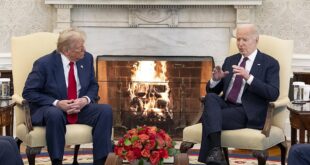

Donald Trump said Wednesday that the federal government cannot sustain funding for major social programs including child care, Medicare and Medicaid, suggesting states should take primary responsibility while Washington focuses on national defense.
The remarks, delivered during a private Easter luncheon at the White House, signal a potential shift in federal spending priorities and drew swift backlash from Democrats, who accused the president of undermining core elements of the U.S. safety net.
Trump calls for state control of social programs
Speaking to attendees, Trump said it is “not possible” for the federal government to fund a wide range of domestic programs, arguing that responsibilities should fall to individual states.
“We can’t take care of day care,” Trump said, recounting instructions he gave to Russell Vought, director of the Office of Management and Budget. “That has to be up to a state … and they should pay for it too.”
He extended the argument to major entitlement programs.
“It’s not possible for us to take care of day care, Medicaid, Medicare,” Trump said. “We have to take care of one thing: military protection.”
View this post on Instagram
Policy implications and feasibility
The proposal would represent a fundamental restructuring of federal-state responsibilities.
Programs like Medicare and Medicaid are cornerstone federal entitlements, jointly funded (in Medicaid’s case) and administered through a federal-state partnership established by Congress.
Child care funding, while more decentralized, is also supported by federal programs such as the Child Care and Development Block Grant and Temporary Assistance for Needy Families.
Shifting these costs entirely to states would likely require major legislative changes and could force states to significantly raise taxes or reduce benefits.
White House walks back remarks
After the comments drew attention, the White House said Trump was referring to eliminating fraud — not cutting support.
Spokesperson Olivia Wales said the president remains committed to protecting entitlement programs and pointed to past efforts targeting improper payments and ineligible recipients.
The administration has increasingly framed cost-cutting efforts through the lens of fraud prevention, though critics say evidence of widespread abuse is limited.
Democrats seize on war spending comparison
Democrats quickly criticized Trump’s remarks, contrasting domestic spending proposals with the cost of U.S. military operations abroad.
Rep. Ro Khanna said funding used for recent military operations could instead support nationwide child care.
Sen. Andy Kim argued similar resources could expand health benefits for seniors under Medicare.
The criticism reflects a broader partisan divide over budget priorities, particularly as defense spending rises alongside renewed military engagement in Iran.
Fraud claims and state tensions
Trump also accused both Democratic- and Republican-led states of fraud in administering child care programs, though he provided no evidence to support specific claims.
The administration has previously targeted states including California, Colorado, Illinois, Minnesota and New York by freezing access to certain child care and family assistance funds earlier this year.
In one case, allegations of widespread fraud in Minnesota child care centers — amplified on social media — were later reviewed by state officials, who found the facilities in question were operating normally.
Despite that, Trump repeated claims that some areas had “more day care centers than they have children,” asserting federal inspections found widespread irregularities.
Expanded anti-fraud push
The administration has elevated fraud enforcement as a central policy focus, with JD Vance leading a new interagency task force.
Last week, Vance convened its first meeting, and on Wednesday swore in Colin McDonald as assistant attorney general for national fraud enforcement.
Officials say the effort will target misuse of federal funds across multiple programs, including health care and social services.
Broader fiscal debate ahead
Trump’s comments come as policymakers face mounting pressure over federal spending, deficits and long-term sustainability of entitlement programs.
Any attempt to shift responsibility for Medicare, Medicaid or child care to states would likely face steep political and legal hurdles in Congress, where such programs have historically enjoyed bipartisan support.
The remarks nonetheless offer a window into the administration’s fiscal priorities — emphasizing defense spending while questioning the federal role in domestic social programs.