Poli Alert Politics & Civics
Related Articles


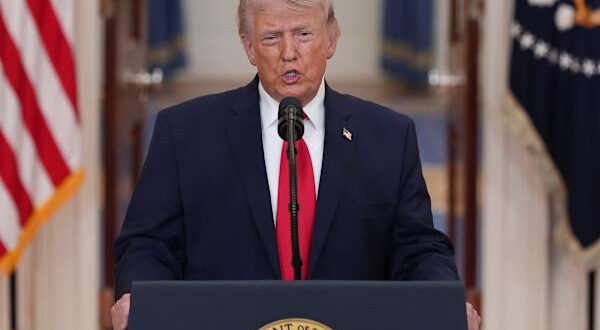
Donald Trump told Americans Wednesday night that the U.S. military campaign against Iran is “on track” to end soon, even as he pledged an escalation in strikes and offered no definitive timeline for concluding the conflict.
In a prime-time address marking the 32nd day of the war, Trump described Iran as “essentially … no longer a threat” after weeks of U.S. air and naval operations, while emphasizing that military action would continue until objectives are fully met.
“We’re going to hit them extremely hard over the next two to three weeks,” Trump said. “We’re going to bring them back to the Stone Ages.”
Escalation paired with claims of progress
Trump framed the conflict as a necessary step to counter Iran’s nuclear ambitions and broader regional influence, arguing the campaign is vital to global security.
He claimed Iran had been advancing its nuclear program at a new site and warned of further strikes if Tehran does not agree to U.S. demands.
“If they don’t make a deal, we are going to hit each and every one of their electric generating plants,” he said.
The address marked his most formal attempt to explain the war to the American public, after weeks of more informal remarks to reporters.
Unclear endgame despite confidence
Despite projecting confidence, Trump declined to define clear benchmarks for victory or a firm timeline for ending the war.
He has repeatedly suggested the conflict would conclude quickly — at times saying within “two weeks” or “very soon” — while also describing his personal judgment as a determining factor.
At one point, he said the war would end “when I feel it in my bones.”
Military analysts say that ambiguity underscores a broader uncertainty about U.S. strategy beyond initial battlefield gains.
Economic and domestic pressures mount
The conflict has contributed to rising energy prices and market volatility, increasing pressure on the administration at home.
Trump acknowledged public concern over higher gas prices but blamed Iran, while highlighting efforts to boost U.S. oil production and coordinate with countries such as Venezuela.
Meanwhile, polling shows a divided public. Majorities oppose the conflict overall, though Republican voters — particularly Trump’s political base — remain strongly supportive.
Military gains vs. strategic questions
According to Defense Department figures, U.S. forces have struck more than 12,000 targets and destroyed or damaged over 150 Iranian vessels, significantly degrading Iran’s military infrastructure.
Experts say those results point to clear tactical success.
But broader strategic questions remain unresolved, including whether Iran retains the ability to rebuild, maintain regional influence or threaten global energy routes like the Strait of Hormuz, through which roughly one-fifth of the world’s oil supply passes.
Aaron David Miller of the Carnegie Endowment for International Peace said the ultimate outcome depends on what remains of Iran’s capabilities after the conflict.
“You’d have to ask yourself, exactly what was this all about?” he said.
Ground troop question looms
Trump again declined to rule out deploying U.S. ground forces, saying he wants to preserve all military options.
The possibility of sending troops has drawn significant public opposition, including among Republican voters, according to recent surveys.
Behind closed doors, Trump has acknowledged concerns about whether Americans would support a prolonged or expanded operation.
Global stakes and allied tensions
The conflict has also strained relations with allies, particularly over security in the Strait of Hormuz.
Trump urged other nations to take a more active role in protecting the vital shipping lane, saying countries that rely on it should “build up some courage.”
U.S. allies have so far resisted calls to deploy additional naval forces to the region.
What comes next
Trump said the coming weeks will be decisive, with intensified strikes expected as the U.S. seeks to force Iran into a deal.
Still, key questions remain about the administration’s long-term strategy, the durability of military gains and whether the conflict could expand if diplomatic efforts fail.
The outcome will likely shape not only U.S.-Iran relations, but also global energy markets and regional stability for years to come.