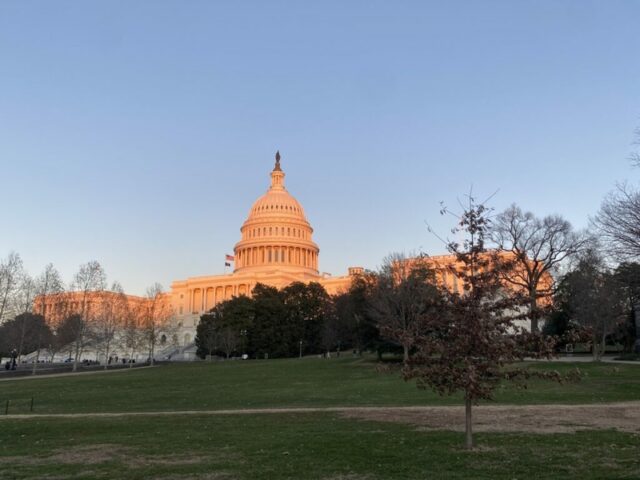
The Thanksgiving week ahead is quiet in Washington but busy at the ballot box, as Congress heads home for the holiday while voters in Georgia, Louisiana and Texas start casting ballots in runoff elections.
The Senate’s official 2026 schedule lists Nov 23 through Nov 27 as a state work period, which means senators are home in their states instead of voting in the Capitol. The House finished its votes for the week on Nov 20. When lawmakers return, the clock will be short. The temporary spending law Congress passed in the fall, known as a continuing resolution, keeps the government running only through Dec 11. A continuing resolution is a stopgap bill that funds the government at existing levels while Congress works on its full yearly budget. None of the 12 regular spending bills for the 2027 budget year has become law. If Congress does not pass another stopgap or full spending bills by Dec 11, parts of the federal government would shut down.
That deadline is tangled up with the war with Iran. Senate Democrats Michael Bennet, Tammy Duckworth, Chris Van Hollen and Bernie Sanders said on Nov 12 that they would not support another stopgap unless it blocks money for the war. Republicans control both chambers until the new Congress is sworn in on Jan 3, 2027, but most spending bills need 60 votes to get through the Senate, so Democratic votes are still needed.
The political news that affects your wallet, your rights and your vote, broken down in plain language. Free in your inbox.
The House also has a major energy bill waiting. On Nov 19 the Senate passed the Bipartisan American Affordability and Jobs Act, S. 5653, by a vote of 62 to 33. The bill would shorten federal environmental reviews for energy projects, limit court challenges to permits, and give federal regulators new power over interstate power lines, with protections meant to keep data center electricity costs from landing on household bills. House Speaker Mike Johnson has said the House will take it up after Thanksgiving.
Once the Thanksgiving week ahead is over, the Supreme Court returns on Monday, Nov 30, for its December session. That first day, the justices hear Crowther v. Board of Regents of the University System of Georgia, a case about whether school employees can sue under Title IX, the federal law that bans sex discrimination in schools that get federal money. On Tuesday, Dec 8, the court hears a case brought by the Republican National Committee against the voting rights group Mi Familia Vota over Arizona laws that require proof of citizenship to register to vote. The case turns on the National Voter Registration Act, a 1993 federal law that sets rules for how states sign up voters and clean up their voter lists. A ruling could affect what paperwork voters in many states have to show to get registered. Decisions in argued cases usually come by the end of June.
For Georgia voters in state House District 151, the Thanksgiving week ahead is the only chance to vote early in the Dec 1 runoff. Early voting runs only Nov 23 through Nov 25, shortened by the holiday, according to the Georgia secretary of state’s office. Republican Mike Cheokas finished first on Nov 3 with 47.88 percent to Democrat Ethan Wolfe’s 40.85 percent, and an independent took 11.26 percent. Georgia requires a majority to win, so the top two meet again. On Dec 1, polls are open from 7 a.m. to 7 p.m., and mail ballots must arrive by 7 p.m. Voters can confirm their polling place with their county election office or the Georgia secretary of state’s My Voter Page.
Louisiana holds elections on Saturday, Dec 12, including two congressional runoffs. In the 6th District, Democrat Banks and Republican Miguez finished separated by fewer than 700 votes on Nov 3, and in the 5th District, Democrat Pat Moore faces Republican Gabe Firment. Registration for the runoff is now closed; the Louisiana secretary of state’s office set Nov 21 as the last day to register online. Early voting runs Nov 28 through Dec 5. Voters who want a mail ballot must request it by Dec 8, and it must be received by Dec 11. Voters can confirm details with their parish registrar of voters or the Louisiana secretary of state’s office.
Texas also holds local runoff elections on Saturday, Dec 12. The registration deadline has passed, but early voting runs Monday, Nov 30, through Tuesday, Dec 8, according to the Texas secretary of state’s office. Applications for a mail ballot must reach the county early voting clerk by Dec 1. On Election Day, polls are open from 7 a.m. to 7 p.m. Voters can check which races are on their ballot with their county elections office.
In North Carolina, the state House has a window from Nov 30 through Dec 18 to vote on overriding Gov. Josh Stein’s vetoes. The bills include House Bill 958, which would cut early voting before primary elections from 17 days to 10. Overriding a veto takes a three fifths vote of the members present, and Republicans came up short of that number on Nov 17 because of absences.