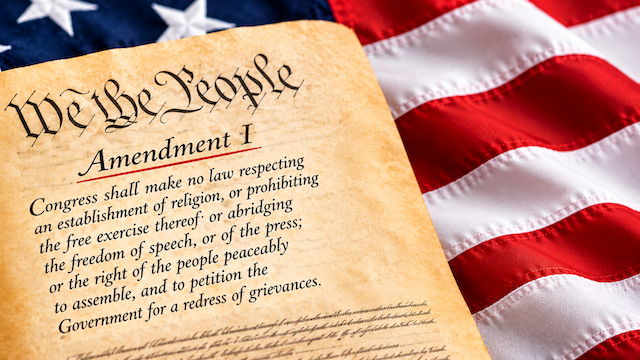
The First Amendment is the part of the U.S. Constitution that stops the government from punishing people for what they say, what they publish, how they worship, and how they gather and complain to officials.
It is only 45 words long. It was added to the Constitution in 1791 as the first of ten amendments known as the Bill of Rights. It says Congress shall make no law respecting an establishment of religion, or prohibiting the free exercise thereof; or abridging the freedom of speech, or of the press; or the right of the people peaceably to assemble, and to petition the Government for a redress of grievances.
Those words protect five freedoms. Freedom of religion means the government cannot set up an official church or favor one faith, and it cannot stop people from practicing their own beliefs. Freedom of speech covers spoken words, writing, art, protest signs and even symbols. Freedom of the press protects newspapers, TV stations, websites and anyone else who gathers and shares news. The right to assemble protects peaceful protests, marches and meetings. The right to petition protects contacting lawmakers, signing petitions and filing lawsuits against the government.
The political news that affects your wallet, your rights and your vote, broken down in plain language. Free in your inbox.
The First Amendment limits the government, not private businesses or people. The original text names only Congress, but the Supreme Court ruled in Gitlow v. New York in 1925 that the Fourteenth Amendment applies free speech protections to state governments too. Today the First Amendment covers federal agencies, state governments, city councils, police departments and public schools. It does not cover a private employer, a social media company or a restaurant owner. A private company can usually fire an employee or delete a post over something said, and that is not a First Amendment violation, though other laws may apply.
The protection is strong but not unlimited. Over the years, courts have recognized a few narrow kinds of speech that the government can punish. Those include speech meant to cause immediate violence, real threats against a person, fraud, and lies that damage someone’s reputation, which the law calls defamation. In New York Times v. Sullivan in 1964, the Supreme Court made it harder for public officials to win defamation suits, ruling that they must show a statement was false and made either knowing it was false or with reckless disregard for the truth. Courts also allow the government to set fair rules about the time, place and manner of speech, such as requiring a permit for a large march, as long as those rules do not target a particular message.
One of the most important ideas in First Amendment law is that the government cannot use its power to get back at people for their speech. Courts call this retaliation. An official does not have to arrest anyone to break the rule. Threatening a license, a contract or a benefit because of what someone said can count too, if the threat is meant to silence them. TV and radio broadcasters face extra rules because they use public airwaves licensed by the Federal Communications Commission, but the courts have held that the government still cannot punish a station for the views it airs.
A well known example involves students. In 1965, a group of students in Des Moines, Iowa, wore black armbands to school to protest the Vietnam War and were suspended. In Tinker v. Des Moines in 1969, the Supreme Court ruled for the students, writing that students do not shed their constitutional rights to freedom of speech at the schoolhouse gate. Public schools can still limit speech that seriously disrupts class, but they cannot punish a student simply for holding an unpopular opinion.
The First Amendment shows up in everyday life more often than most people notice. It is the reason people can criticize the mayor online, join a protest outside city hall, start a podcast about politics, or wear a shirt with a message on it without being jailed. It protects churches, mosques and synagogues from government control, and it protects people who choose no religion at all. It is also why reporters can investigate public officials and publish what they find.
The line between government action and private action shows up in practical ways. If a police officer orders a peaceful crowd to break up only because officials dislike its message, that raises a First Amendment question. If a boss at a private company disciplines a worker over a social media post, the answer usually depends on employment law and company policy instead. When people believe the government has punished them for speaking, they can go to court, and many of the country’s most important free speech cases started with ordinary people who did exactly that.