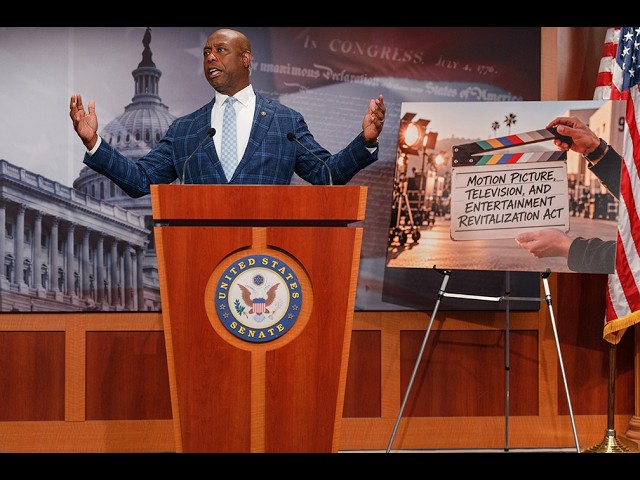
A bipartisan bill that would create a federal film tax credit, paying back 20 percent of the wages behind movies and TV shows made in the United States, is getting a late push in Congress after Donald Trump urged lawmakers to pass it before the year ends.
The film tax credit bill, formally the Motion Picture, Television, and Entertainment Revitalization Act, H.R. 10582, was introduced in the House on September 24 and sent to the Ways and Means Committee, which writes tax law. A matching Senate bill, S. 5552, is led by Sen. Tim Scott, a South Carolina Republican, and Sen. Adam Schiff, a California Democrat. House co-leads include Republicans Nathaniel Moran of Texas, David Kustoff of Tennessee, Mike Carey of Ohio and Brian Jack of Georgia, and Democrats Laura Friedman, Linda Sánchez and Judy Chu of California and Tom Suozzi of New York.
A tax credit lowers the tax a business owes, dollar for dollar. Under the bill, a production company would get a credit worth 20 percent of what it pays people for work done in the United States on a feature film, a TV pilot or a season of a TV series, according to the official Congressional Research Service summary. The rate goes up in steps of 5 percentage points, to as much as 30 percent, for independent producers, for shooting at least 30 percent of filming days in a rural opportunity zone or a federal disaster area, for bringing more work back from overseas, and for spreading production and payroll across at least 10 states.
The political news that affects your wallet, your rights and your vote, broken down in plain language. Free in your inbox.
To qualify, a project has to cost more than $1 million and shoot at least 75 percent of its main filming days in the country. Editing, sound, scoring, music editing, dubbing and visual effects work can also count. The film tax credit would not cover news, live sports, talk shows, daytime soap operas, social media content, advertising or corporate videos, and it would not count profit sharing or residual payments. Companies could sell the credit for cash to another business, and it would stack on top of state incentives instead of replacing them. It would apply to tax years starting after December 31, 2026, according to Kustoff’s office.
Trump first called for a federal incentive in a September 1 Truth Social post, writing that Congress “should approve, immediately, a Federal Production Incentive to create Entertainment Jobs in America.” In a November 13 post, he called the support for the bill “unbelievable,” TIME reported. He also claimed hundreds of thousands of blue collar workers would benefit and that the cost would be made back “tenfold” in tax revenue. TIME reported he did not explain either figure.
Supporters say the money would bring film and TV jobs back from countries that offer bigger incentives. Schiff has said 45 percent of American films and scripted TV shows were shot overseas in 2025, up from about a third in 2022, according to TIME. The actors union SAG-AFTRA, the Writers Guild of America and the Directors Guild of America back the bill. A study paid for by the Motion Picture Association projects about 143,500 additional full time jobs a year through 2035.
Critics question the price. Adam Michel of the Cato Institute, a libertarian think tank, estimated the federal film tax credit could cost $3.3 billion to $4.9 billion a year, and Tracy Gordon of the Tax Policy Center pointed out that the bill sets no cap on spending, TIME reported. Americans for Tax Reform called it “a massive subsidy for Hollywood at the expense of taxpayers,” according to The Hype Magazine.
The timing is tight. The film tax credit bill is still in committee and no vote has been scheduled. Rep. Don Beyer, a Virginia Democrat on the Ways and Means Committee who supports the credit, put the chances of any tax bill passing before the new year at “pretty low,” TIME reported. Roll Call has reported that a standalone vote is unlikely, so backers are looking to attach it to a year end spending or tax package.
If the bill does not pass before the current Congress ends in January, it dies and would have to be introduced again in the new Congress, where Democrats will control both chambers. Backers say the credit is aimed at the crews, drivers, caterers, makeup artists and small businesses that depend on productions in states like Georgia, New York and California.