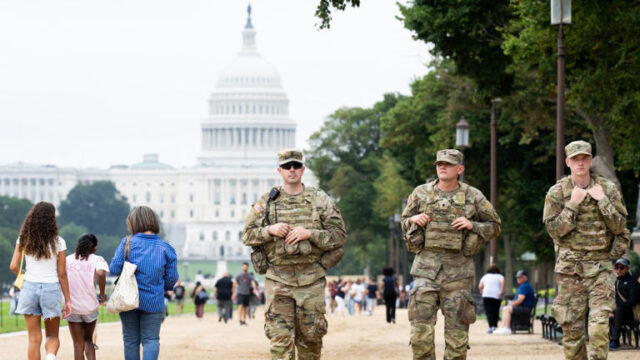
The National Guard is preparing for an expanded role in Washington, D.C., with new military vehicles, marked patrol cars, boats and additional weapons authorized for certain operations, further increasing the military’s involvement in the nation’s capital.
Defense Secretary Pete Hegseth approved the changes in two memorandums signed October 29, according to the Associated Press. The authorization allows National Guard personnel supporting the Trump administration’s law enforcement operations to use up to 60 marked military police patrol cars, tactical military vehicles, patrol boats and 20 portable lighting towers with generators.
The expanded equipment is intended to support federal and local law enforcement operations under the administration’s Make D.C. Safe and Beautiful initiative.
The political news that affects your wallet, your rights and your vote, broken down in plain language. Free in your inbox.
The new authorization also allows some Guard members participating in operations targeting gangs and drug trafficking to carry rifles in addition to their service-issued pistols. Rifles will not be permitted in Metro rail stations.
Despite the expanded equipment and operational responsibilities, the Pentagon says the maximum authorized deployment will remain at 3,500 troops. Nearly 3,100 National Guard members from Washington and several states are currently assigned to the mission.
The latest changes come more than a year after Donald Trump ordered the National Guard into Washington in August 2025, describing the deployment as an effort to address crime and improve public safety.
Since then, Guard members have participated in neighborhood patrols, supported law enforcement operations, assisted with federal facility security and taken part in city cleanup efforts.
The newly authorized patrol boats are expected to provide perimeter security near Anacostia Park during operations targeting gang leaders and drug traffickers. The boats must have a federal law enforcement officer aboard, and Guard members are not independently authorized to make arrests.
The military vehicles and patrol cars will also be subject to operational restrictions. The National Guard vehicles must be identifiable, personnel must wear military uniforms, and troops are prohibited from conducting high-speed pursuits.
Washington Officials Push Back Against Deployment
The expansion is taking place as Washington officials continue challenging the federal government’s authority to maintain the National Guard deployment.
The District of Columbia filed a lawsuit in September 2025, arguing that the Trump administration exceeded its legal authority by deploying military personnel into the city for domestic law enforcement activities without the District’s consent.
In November 2025, U.S. District Judge Jia Cobb ruled that the deployment violated federal law and issued a preliminary injunction. However, an appeals court temporarily blocked that order while the administration’s appeal proceeds, allowing the deployment to continue.
The U.S. Court of Appeals for the D.C. Circuit heard arguments in the case on October 14. The judges have not yet issued a decision.
Washington officials are also looking toward the results of this week’s elections as a possible opportunity to challenge the deployment.
D.C. Councilmember Brooke Pinto announced plans to ask incoming Democratic governors in Georgia, Iowa, Nevada, Ohio and Texas to withdraw approximately 628 National Guard members their states have sent to Washington.
Pinto said the incoming governors could recall their respective troops when they take office. She also raised concerns about the military presence near schools and the impact of armed personnel operating in residential neighborhoods.
The request would not automatically end the deployment. The Trump administration’s response to any withdrawal orders from state governors remains uncertain.
What Happens Next
For residents of Washington, the expanded authorization could mean more visible military equipment and additional National Guard patrols throughout parts of the city.
The increased use of military vehicles and boats also raises continuing questions about the boundaries between military support and civilian law enforcement.
The Pentagon maintains that the Guard is supporting authorized law enforcement activities, while District officials argue that the deployment undermines local control over public safety.
With the legal challenge still pending and incoming governors facing pressure to withdraw their states’ troops, Washington’s National Guard deployment remains a significant dispute between the federal government and the District.
For now, the Pentagon’s latest authorization allows the expanded equipment to be used without increasing the maximum number of troops assigned to the mission.