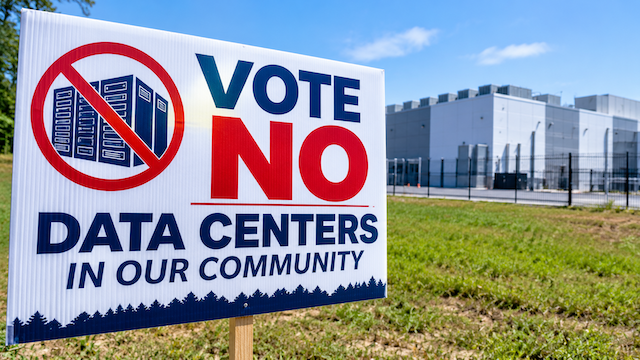
According to Ballotpedia’s November 6 election analysis, voters favored limiting data center development in 40 of 41 local ballot measure contests held November 3 across 10 states. The only exception came in Harwood, North Dakota, where voters rejected a proposed review requirement for certain industrial developments, including data centers.
The results represent one of the clearest displays of local opposition to the rapid expansion of the facilities powering artificial intelligence, cloud computing and other digital services.
The election featured a combination of outright bans, partial restrictions, development moratoriums, zoning requirements and advisory questions asking residents whether they supported bringing data centers into their communities.
The political news that affects your wallet, your rights and your vote, broken down in plain language. Free in your inbox.
Ohio had the largest number of data center-related questions, with 21 measures appearing on local ballots. Illinois followed with seven.
Communities Vote Against Data Center Expansion
The results were particularly striking because opposition came from communities facing different development proposals and different levels of potential economic investment.
Voters approved 27 measures that restricted data center development or expressed opposition to it. Five communities approved full data center bans, including one in California, one in Florida and three in Ohio.
Another 12 measures established partial bans, while three Maine communities approved six-month moratoriums that temporarily halt data center development.
In Alhambra, California, voters approved Measure DB, prohibiting data centers within the city. The measure received approximately 82% of the vote.
In Edgewater, Florida, voters approved a charter amendment prohibiting new data centers from being approved, constructed, expanded or operated within the city. Approximately 77% of voters supported the restriction.
Maine communities also sent a message to developers by approving temporary development moratoriums, giving local officials additional time to address concerns surrounding large-scale projects.
Proposals Supporting Data Centers Also Failed
The opposition extended beyond communities voting directly on restrictions.
Thirteen ballot measures that would have supported or facilitated data center development were defeated.
In Illinois, voters rejected multiple advisory questions asking whether local officials should permit new data center construction. These included questions in Chouteau Township, Granite City Township, Joliet and Nameoki Township.
In Wilmington, Ohio, voters rejected four rezoning proposals that would have changed specific properties from residential to industrial use, potentially allowing data center construction.
Voters in Boulder City, Nevada, also rejected a proposal that would have added data centers as an approved use for a particular area.
These results demonstrate that opposition was not limited to communities seeking outright bans. Voters also rejected proposals that would have made it easier for developers to secure land and move projects forward.
Electricity Bills, Water Consumption And Local Control
The growing resistance comes as communities across the country debate the costs associated with hosting large data centers.
These facilities require enormous amounts of electricity to operate thousands of computer servers. They also require cooling systems that can consume substantial amounts of water, depending on the technology used and the facility’s location.
Residents have increasingly raised concerns about whether existing electrical infrastructure can support additional demand, whether utility costs could rise and whether local governments are negotiating agreements that adequately protect taxpayers.
The questions have become particularly important as technology companies race to build the infrastructure needed to support artificial intelligence.
The concerns are also reflected in some of the specific measures voters approved.
In Grove City, Ohio, Issue 28 established voter approval requirements for certain large developments, including projects using more than 50 acres, requiring at least 20 megawatts of electricity or consuming 500,000 gallons of water daily. The measure also established community impact standards.
In Perry, Ohio, voters approved a requirement for certain hyperscale data center developers seeking tax incentives to provide financial guarantees to the community.
Those provisions illustrate how some communities are moving beyond simply opposing projects and demanding greater accountability from developers.
A Warning For The Technology Industry
The election results arrive at a critical time for the technology industry, which is investing billions of dollars in data center infrastructure to meet growing demand for artificial intelligence and cloud computing.
Reuters reported November 6 that opposition to data centers was among the notable outcomes of the election. The news organization also reported that shares of several artificial intelligence and data center-related companies declined following the election amid expectations of increased government oversight.
The results could complicate development plans for companies that depend on securing local zoning approvals, access to electricity and water, tax incentives and community support.
Although local ballot measures cannot determine national artificial intelligence policy, they can directly influence whether individual projects move forward and what conditions developers must meet.
There is also an important distinction among the measures. Some established binding restrictions, while others were advisory questions that expressed voters’ preferences without automatically changing local law.
The Fight Is Not Over
The November 3 results are not the end of the debate over data center development.
Ballotpedia is tracking additional measures scheduled for December 1 in Clarksville, Arkansas, and December 15 in Mandan, North Dakota.
For technology companies, the election results signal that securing land and financing is no longer the only challenge facing major development projects. Developers must also contend with communities increasingly demanding a say in decisions that could affect their utilities, natural resources, neighborhoods and local economies.
The message from voters was remarkably consistent: Communities want greater control over what gets built in their backyards, and they are increasingly willing to use the ballot box to demand it.