Poli Alert Politics & Civics

Related Articles



The federal government on Wednesday unveiled revised dietary guidelines that mark a notable shift in U.S. nutrition policy, elevating protein and full-fat dairy while urging Americans to sharply limit sugar and highly processed foods — a move that reflects Health Secretary Robert F. Kennedy Jr.’s broader effort to upend decades of public health orthodoxy.
“My message is clear: Eat real food,” Kennedy said at a White House briefing, declaring that he was “ending the war on saturated fats.” He framed the changes as a response to rising rates of childhood obesity, diabetes and other chronic diseases, arguing that prior guidance had failed to curb worsening health outcomes.
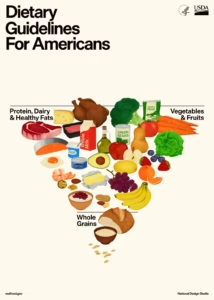
The guidelines, issued jointly every five years by the Departments of Agriculture and Health and Human Services, stop short of a wholesale rewrite. They continue to encourage fruits, vegetables and nutrient-dense foods, but they significantly reorder priorities — placing greater emphasis on meat and dairy and less on whole grains than past versions.
The changes are likely to reverberate through federal nutrition programs, including school lunches, military meals and food assistance initiatives, while reigniting long-running scientific debates over fat, protein and the role of government in shaping diets.
Protein prioritized at every meal
Under the new guidance, Americans are encouraged to center protein at each meal, with a recommended daily intake of roughly 1.2 to 1.6 grams per kilogram of body weight — a substantial increase from prior benchmarks.
FDA Commissioner Marty Makary said the update reflects a belief that earlier recommendations were too low, particularly for children. “Kids need protein,” he said.
Some nutrition experts disputed the premise. Dr. Ronald Kleinman, emeritus chair of pediatrics at Mass General Brigham, said protein deficiency is rare in the United States.
“Most children already consume well above what they need,” Kleinman said, warning that excess focus on protein could crowd out other essential nutrients.
Full-fat dairy replaces low-fat guidance
The revised guidelines also reverse decades of advice favoring low-fat or fat-free dairy, instead recommending full-fat milk, yogurt and cheese with no added sugars. The guidance calls for three daily servings of dairy, replacing the prior emphasis on volume-based consumption.
The shift could affect school meal standards, which currently limit students to low-fat options.
Supporters point to studies suggesting full-fat dairy may be more satiating and not clearly associated with higher heart disease risk. Critics argue the evidence is mixed and caution against encouraging higher-calorie options for overweight children and adults.
Alcohol guidance loosened
In another notable change, the guidelines abandon numeric limits on alcohol consumption. Instead of recommending no more than one drink per day for women and two for men, the new guidance simply urges Americans to “limit” alcohol for better health.
The softer language follows internal debate after a federal report earlier this year linked even moderate alcohol consumption to increased cancer and liver disease risks. Public health advocates said the revision benefits the alcohol industry by removing clear benchmarks.
Dr. Mehmet Oz, administrator of the Centers for Medicare & Medicaid Services, defended the change, saying the evidence supporting precise daily limits was weak.
“The implication is, don’t have it for breakfast,” Oz said.
Crackdown on sugar and ultra-processed foods
The strongest language in the new guidelines targets sugar and highly processed foods — a central focus of Kennedy’s health agenda.
The guidance calls for eliminating added sugars during infancy and early childhood and sets a strict limit of no more than 10 grams of added sugar per meal for adults. That goes beyond prior advice, which capped added sugars at 10% of daily calories.
The recommendations also urge Americans to avoid packaged, ready-to-eat foods high in salt or sugar and to limit artificial additives, dyes and preservatives. The American Medical Association praised the emphasis on ultra-processed foods, which have been linked to obesity, heart disease and cancer.
Notably absent is a direct warning against processed meats such as hot dogs and deli meats, which earlier guidelines associated with negative health outcomes.
Cooking fats spark scientific backlash
The new guidance recommends cooking with “healthy fats,” listing olive oil alongside butter and beef tallow — animal fats high in saturated fat that many health experts say should still be limited.
Kennedy has repeatedly criticized seed oils, claiming they contribute to obesity, though most nutrition researchers say the evidence does not support that conclusion and that the real concern lies with ultra-processed foods in which those oils are commonly used.
Elizabeth Jacobs, an epidemiologist with Defend Public Health, called the guidance on butter and beef tallow unsupported by science.
“These claims don’t reflect the weight of evidence,” she said, warning that the shift could confuse consumers.