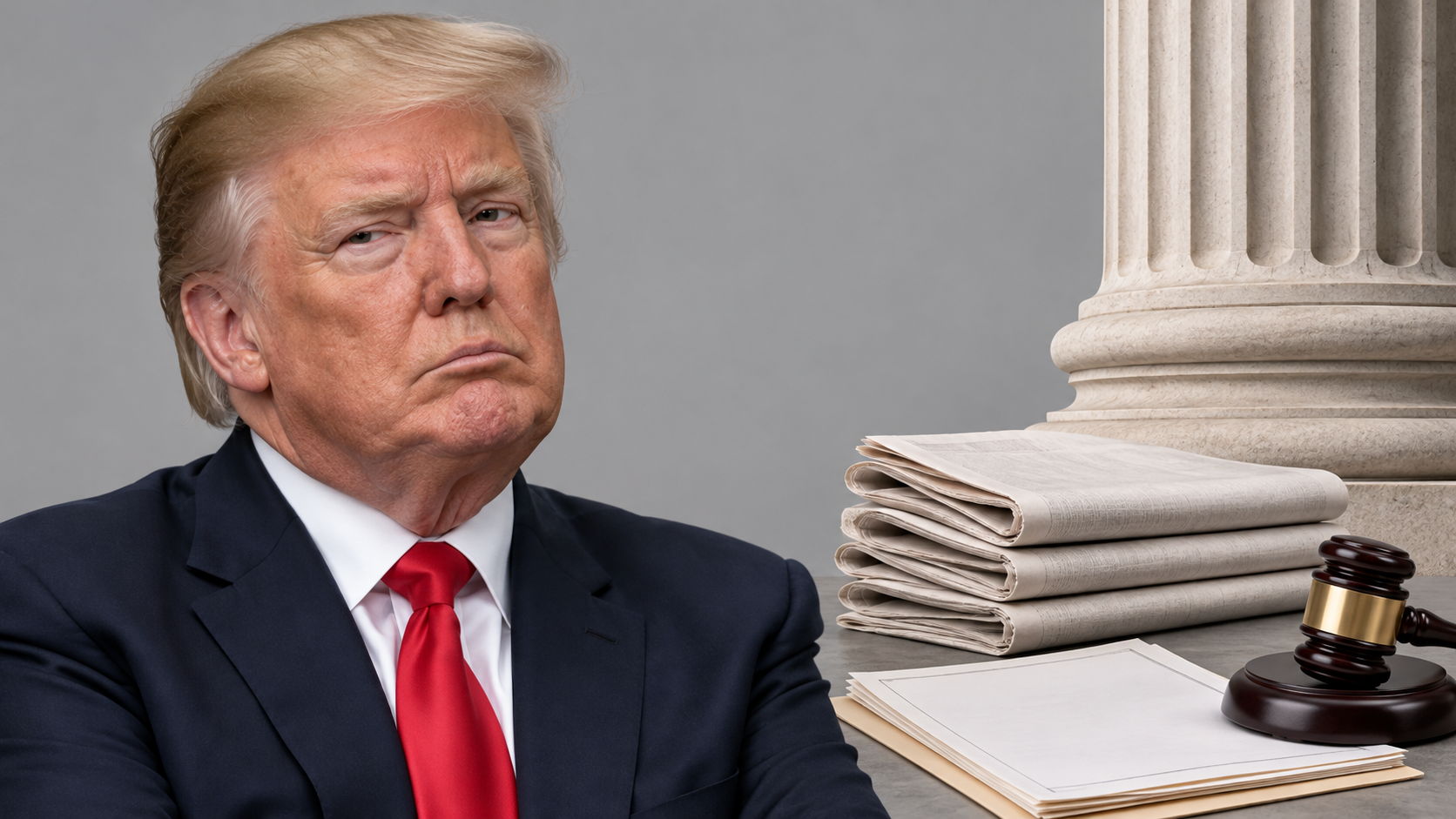
A federal judge on Saturday permanently threw out the Trump WSJ lawsuit over the paper’s reporting on a lewd birthday letter bearing Trump’s name in Jeffrey Epstein’s 50th birthday album. U.S. District Judge Darrin P. Gayles dismissed the case with prejudice, which means Trump cannot file it again. In his ruling, the judge said the lawsuit was “grasping at straws” and tried to “manufacture” flaws in the Journal’s reporting.
The case goes back to July 17, 2025, when the Wall Street Journal reported that a letter with Trump’s name on it appeared in a birthday book that friends and associates put together for Epstein in 2003. According to the Journal, the letter contained typed text of an imaginary conversation between Trump and Epstein inside the outline of a naked woman, signed “Donald.” Trump denied writing it. “This is not me,” he told the paper.
The next day, Trump sued Dow Jones, which owns the Journal, along with its parent company News Corp, media mogul Rupert Murdoch and the two reporters who wrote the story. He asked for $10 billion on each of his two claims, which is why the case is described as a $10 billion or $20 billion lawsuit depending on the outlet.
The political news that affects your wallet, your rights and your vote, broken down in plain language. Free in your inbox.
This was not Trump’s first loss in the case. Judge Gayles dismissed the original complaint in April, saying its claims came nowhere close to the legal standard required, but he gave Trump a chance to fix it. Trump refiled in May. The new version did not get any further.
The ruling centers on a legal standard called actual malice. When a public figure sues for defamation, which is a false statement that damages someone’s reputation, they must show the outlet either knew the story was false or recklessly ignored the truth. That rule comes from the 1964 Supreme Court case New York Times v. Sullivan, and the judge cited it in his decision. Gayles found that Trump had not plausibly shown actual malice by any of the people or companies he sued.
Trump argued that the Journal should have held the story once he denied writing the letter. The judge rejected that and said such a rule would violate the First Amendment. “Were that the law, any time a public figure or his team denies an accusation, journalists would be immediately blocked from publishing negative or contradictory press,” Gayles wrote. He also noted that the article did not ignore Trump’s side. It told readers that Trump called the letter a fake and denied writing it.
The birthday book itself became public in September 2025, when Epstein’s estate turned it over to Congress in response to a subpoena. The Journal said the book contained the letter bearing the drawing and Trump’s signature, just as it had reported.
Dow Jones said, “We’re pleased with the court’s decision.” A Trump spokesperson claimed Trump “will continue to press forward in his powerhouse lawsuit against the Wall Street Journal and all of the other defendants.” Because the dismissal is with prejudice, the case cannot be refiled in that court. Trump could still appeal, but no appeal had been reported as of Saturday.
The Trump WSJ lawsuit is one of several defamation cases Trump has brought against major news organizations. Epstein, a wealthy financier and convicted sex offender who was once friends with Trump, died in jail in 2019 while awaiting trial on sex trafficking charges.