Poli Alert Politics & Civics
Related Articles
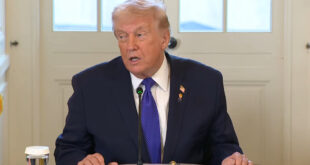
President Donald Trump announced Friday that he plans to nominate former Federal Reserve governor Kevin Warsh to return to the central bank’s board and succeed Jerome Powell as chair of the Federal Reserve, a move likely to ignite a bruising Senate confirmation battle and intensify concerns over political pressure on U.S. monetary policy.
If confirmed by the Senate, Warsh would take over as Fed chair when Powell’s term expires in May, placing him at the helm of the world’s most influential central bank at a moment of economic uncertainty and political volatility.
Trump revealed the decision in a social media post Friday morning, praising Warsh in characteristically effusive terms.
“I have known Kevin for a long period of time, and have no doubt that he will go down as one of the GREAT Fed Chairmen, maybe the best,” Trump wrote.
“On top of everything else, he is ‘central casting,’ and he will never let you down.”
Trump did not mention Powell in the announcement, though his long-running and increasingly aggressive campaign against the current Fed chair has loomed over the nomination process.
A nomination clouded by political pressure
Warsh’s confirmation prospects are already complicated by Trump’s sustained effort to pressure the Federal Reserve to sharply lower interest rates — a campaign that has alarmed lawmakers from both parties and strained relations with senators Warsh will need to secure confirmation in a narrowly divided Senate.
On Friday, Sen. Thom Tillis, R-N.C., a key member of the Senate Banking Committee, reiterated that he would not support Warsh’s confirmation until a newly opened Justice Department investigation into Powell is resolved.
Late Thursday, Senate Majority Leader John Thune, R-S.D., acknowledged that without Tillis’ backing, Warsh would “probably not” have the votes to win confirmation.
A senior administration official said that Trump formally offered Warsh the job during an Oval Office meeting on Thursday.
Warsh’s experience and shifting views
Warsh, 55, previously served as a Federal Reserve governor from 2006 to 2011, after being nominated by President George W. Bush. His tenure spanned the 2008 financial crisis, giving him firsthand experience managing one of the most severe economic collapses in modern history.
While on the Fed’s board, Warsh also represented the central bank at Group of 20 (G20) meetings, working with global counterparts from institutions such as the European Central Bank, the Bank of Japan and the Bank of England — experience that could prove critical as financial markets grapple with geopolitical and trade shocks.
Before joining the Fed, Warsh worked at Morgan Stanley, specializing in mergers and acquisitions and advising companies in manufacturing and technology.
“I hope that my prior experience on Wall Street, particularly my nearly seven years at Morgan Stanley, would prove beneficial to the deliberations and communications of the Federal Reserve,” Warsh said during his 2006 confirmation hearing.
For much of his career, Warsh has been viewed as a monetary policy hawk, favoring higher interest rates to keep inflation in check. More recently, however, he has adopted a more critical stance toward the Fed’s current leadership.
“The Fed’s hesitancy to cut rates, I think, is actually … quite a mark against them,” Warsh said in a July interview on CNBC.
Markets react and independence questioned
News that Trump was leaning toward Warsh sent stock futures lower overnight, though losses moderated by the time Trump made his formal announcement. U.S. Treasury yields rose on longer-dated bonds, a potential sign of investor concern about inflation control and the Fed’s independence.
The Federal Reserve chairmanship is one of the most consequential economic positions in the world. The Fed sets benchmark interest rates that influence everything from mortgage costs to global capital flows, and its independence from political pressure has long been seen as a cornerstone of financial stability.
Members of the Fed’s seven-person Board of Governors serve 14-year terms, allowing presidents to shape monetary policy long after leaving office.
Trump, however, has repeatedly rejected the traditional model of Fed independence, arguing that lower interest rates are essential to boosting growth. Since his first term, he has publicly criticized Fed officials, pressured them to cut rates, and accused Powell of mismanagement — including allegations related to renovations at the Fed’s Washington headquarters.
Most recently, Trump stood by as his Justice Department opened a criminal investigation involving Powell and the central bank, a move that stunned lawmakers and further inflamed tensions.
Legal battles and economic headwinds
Trump is also the first president to attempt to fire a sitting Fed governor. That effort, targeting Gov. Lisa Cook, is now before the Supreme Court after lower courts blocked her removal. The justices heard arguments Jan. 21 and are expected to rule in the coming months, potentially reshaping presidential authority over independent agencies.
Warsh’s nomination arrives as the U.S. economy shows signs of strain. Job growth has slowed since summer, while inflation remains above the Fed’s 2% target, standing at 2.7% in December after months of steady increases.
Trump’s aggressive tariff agenda and unpredictable policymaking have unsettled global markets and altered perceptions of the U.S. as a stable investment destination. The dollar fell 9% last year, its worst performance since 2017, raising costs for imports and overseas travel.
The Supreme Court is also set to rule on whether Trump had the authority to impose sweeping tariffs without congressional approval — a decision that could have far-reaching consequences for inflation, consumer spending and global trade.
Against that backdrop, Warsh faces a confirmation process defined by distrust, legal uncertainty and a fundamental debate over the future independence of the Federal Reserve.