Poli Alert Politics & Civics
Related Articles



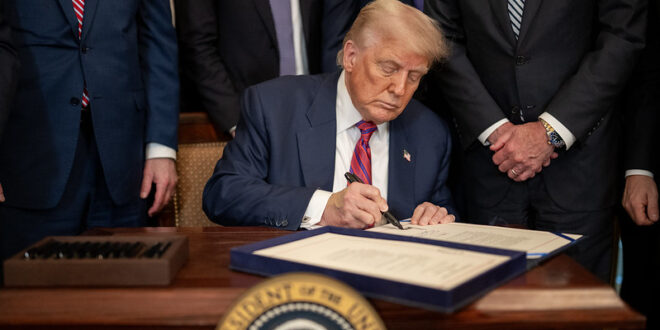
President Donald Trump signed a nearly $70 billion immigration funding package into law Wednesday, providing billions of dollars in additional funding for federal immigration enforcement agencies through the end of his term and beyond while rejecting Democratic efforts to impose new restrictions on their operations.
The legislation delivers major funding increases for Immigration and Customs Enforcement, Customs and Border Protection and the Department of Homeland Security, marking a significant victory for the Trump administration’s immigration agenda.
“The bill provides crucial funding for domestic law enforcement investigations and combating child exploitation, continuing our work to restore law and order across our nation, and to protect America’s youth,” Trump said during an Oval Office signing ceremony.
The measure passed Congress largely along party lines after negotiations between Republicans and Democrats collapsed earlier this year.
Democrats had sought new guardrails on immigration enforcement following the fatal shooting of two U.S. citizens by immigration officers in Minneapolis in January. Lawmakers pushed for requirements that officers wear body cameras, identify themselves when conducting operations and obtain judicial warrants before entering homes.
Republican leaders initially signaled a willingness to discuss some operational restrictions but ultimately excluded any new limitations from the final legislation.
Bill Provides Billions for Immigration Agencies
Under the law, ICE will receive an additional $38.53 billion, while Customs and Border Protection will gain $26.02 billion in new funding. The secretary of Homeland Security will receive another $5 billion.
The funding comes on top of the roughly $170 billion for immigration and border security included in Republicans’ previously enacted domestic policy package, as well as annual appropriations already approved for the Department of Homeland Security.
Republicans argued the funding is necessary to strengthen border security, expand deportation operations and support federal law enforcement efforts.
Murkowski Breaks With GOP
The legislation received support from nearly every Republican in Congress.
In the House, only a handful of Republicans missed the vote, including New Jersey Rep. Tom Kean Jr., who has been absent from Congress for months because of an undisclosed medical condition, and South Carolina Reps. Nancy Mace and Ralph Norman, who were participating in their state’s gubernatorial primary election.
In the Senate, Alaska Republican Sen. Lisa Murkowski was the lone GOP lawmaker to vote against the package.
Murkowski said lawmakers should have addressed immigration funding through the normal appropriations process rather than using budget reconciliation procedures that allowed Republicans to bypass the Senate’s 60-vote threshold.
“By choosing to appropriate funding for three fiscal years instead of one, this measure weakens the normal budgeting process and sets another precedent for avoiding it when we find ourselves in disagreement,” Murkowski said in a statement.
She argued the legislation reduces Congress’ ability to oversee immigration policy for the remainder of Trump’s administration and into the next presidency.
Murkowski added that she could have supported the bill if it had funded immigration programs for only one year, imposed clearer spending restrictions and eliminated any possibility of taxpayer funds being used for a proposed Justice Department compensation program.
Debate Continues Over ‘Anti-Weaponization’ Fund
One of the most contentious issues surrounding the legislation was a proposed $1.776 billion “anti-weaponization” fund that would compensate individuals who believe they were unfairly targeted or prosecuted by the Justice Department.
The proposal faced bipartisan criticism on Capitol Hill.
Acting Attorney General Todd Blanche told lawmakers earlier this month that the administration no longer planned to move forward with the fund after opposition emerged among congressional Republicans.
Trump, however, has not fully abandoned the idea.
In a recent interview with NBC News, the president said he still supports the concept and would like to see it approved if possible.
“You have to get it approved,” Trump said. “If they get it approved, that’s great. If they don’t get it approved, I’d be disappointed.”
The new immigration funding law will remain in effect through September 2029, ensuring that ICE, Border Patrol and other immigration enforcement agencies receive expanded funding regardless of future annual appropriations battles.