Poli Alert Politics & Civics
Related Articles


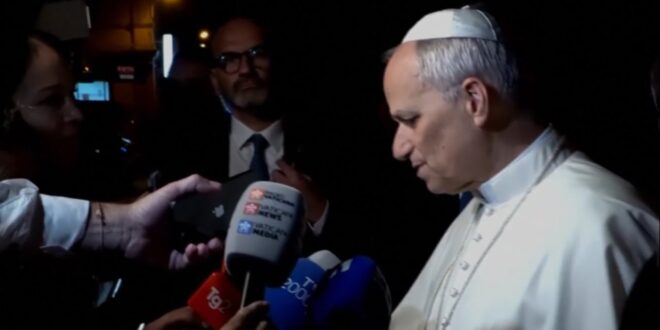
Pope Leo XIV pushed back Monday against sharp criticism from Donald Trump, saying he has “no fear” of the administration and will continue advocating for peace amid escalating global conflicts.
Speaking to reporters aboard the papal plane en route to Algeria, Leo said his stance is rooted in religious teachings rather than politics. “I have no fear of the Trump administration, or speaking out loudly of the message of the gospel,” he said, adding that his role is to act “as a peacemaker.”
The exchange marks a rapid deterioration in relations between the White House and the first American pope, who has taken an unusually direct tone on geopolitical issues, including the war involving the United States, Israel and Iran.
Trump, who initially praised Leo’s election as “a great honor” for the United States, has grown increasingly critical in recent days following the pope’s condemnation of military escalation and rhetoric targeting Iran.
In remarks to reporters at Joint Base Andrews and in posts on Truth Social, Trump accused the pope of being “WEAK on Crime” and “terrible for Foreign Policy.”
“I don’t think he’s doing a very good job. He likes crime, I guess,” Trump said. He also rejected the pope’s positions on nuclear weapons and urban crime, adding, “I’m not a big fan of Pope Leo.”
In a separate social media post, Trump suggested Leo’s election was politically motivated, writing that the pope “was a shocking surprise” and claiming his rise was tied to his American nationality and Trump’s presidency.
Leo dismissed the criticism, emphasizing the distinction between religious leadership and political governance. “We are not politicians,” he said. “We don’t deal with foreign policy with the same perspective he might understand it.”
Still, the pope has weighed in forcefully on policy-adjacent issues, including condemning attacks on civilian infrastructure as violations of international law and urging global leaders to pursue de-escalation. He has also encouraged public pressure on elected officials to prioritize peace.
The dispute drew a response from Paul Coakley, president of the United States Conference of Catholic Bishops, who criticized Trump’s remarks.
“I am disheartened that the President chose to write such disparaging words about the Holy Father,” Coakley said, adding that the pope “is not his rival” but a spiritual leader.
Trump also faced backlash from some conservative figures after posting an image depicting himself with saint-like, Christ-like attributes. Among them was Marjorie Taylor Greene, who called the post “more than blasphemy” and described it as reflecting “an Antichrist spirit.”
The clash underscores the growing intersection of religion and politics in global affairs, particularly as the Vatican under Leo adopts a more outspoken role on international conflicts and humanitarian concerns.
Leo’s criticism of military escalation and immigration policies echoes positions taken by previous popes but has drawn sharper reactions given his American background and willingness to directly address U.S. leadership.
Public opinion appears divided. A recent NBC News poll found that 42% of Americans view the pope positively, compared to 41% for Trump, while Trump’s negative ratings were significantly higher.
Upon arriving in Algiers, Leo continued his call for reconciliation, visiting a monument to Algeria’s independence from French rule and warning against compounding global conflicts.
“As conflicts continue to multiply throughout the world, we cannot add resentment upon resentment,” he said.
The pope also described the trip as personally significant, citing Saint Augustine—a native of the region—as a spiritual influence and a model for interreligious dialogue.
Leo is set to continue his 11-day your across four African nations, where he is expected to emphasize peacebuilding, interfaith cooperation and humanitarian concerns.
Meanwhile, the dispute with Trump highlights a widening divide that could shape both domestic political discourse and the Vatican’s relationship with U.S. leadership as global tensions persist.