Poli Alert Politics & Civics
Related Articles



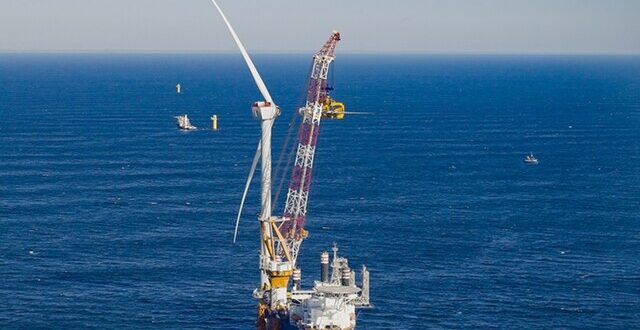
The Trump administration on Monday suspended leases for five large offshore wind projects under construction along the East Coast, citing unspecified national security risks identified by the Pentagon, in a move that escalates its effort to curb renewable energy development despite a recent federal court ruling striking down a broader wind ban.
The suspension, which took effect immediately and carries no stated end date, pauses construction and related activities for projects in Massachusetts, Rhode Island, Connecticut, Virginia and New York. Interior Department officials said the action would give the agency time to consult with the Defense Department and other federal partners to assess whether the projects pose risks to military readiness or homeland security.
“The prime duty of the United States government is to protect the American people,” Interior Secretary Doug Burgum said in a statement. He cited what he called “emerging national security risks,” including the rapid evolution of adversary technologies and vulnerabilities created by large-scale offshore wind projects near densely populated areas of the East Coast.
The administration did not specify which adversaries or technologies prompted the action, nor did it provide a timeline for completing the review.
Pause follows court loss on wind ban
The move comes two weeks after a federal judge struck down President Donald Trump’s executive order blocking wind energy projects nationwide, ruling that the administration had overstepped its authority.
U.S. District Judge Patti Saris of Massachusetts vacated Trump’s Jan. 20 order halting leasing and permitting for wind projects on federal lands and waters, calling the policy “arbitrary and capricious” and in violation of federal law. The ruling sided with a coalition of 17 state attorneys general and Washington, D.C., led by New York Attorney General Letitia James.
While Monday’s action does not formally revive the invalidated executive order, renewable energy advocates said it amounts to a narrower attempt to reach the same outcome.
Projects affected
Interior officials said leases were suspended for Vineyard Wind in Massachusetts; Revolution Wind, which spans Rhode Island and Connecticut; Coastal Virginia Offshore Wind; and two New York projects, Sunrise Wind and Empire Wind.
The department said unclassified government reports have long identified concerns that offshore wind turbines can create radar interference, known as “clutter,” due to the movement of turbine blades and the reflective nature of their towers. Such clutter, the department said, can obscure legitimate targets or generate false signals.
But national security experts and Democratic lawmakers disputed the administration’s claims, noting that the projects received permits only after years of interagency review that included the Defense Department and other military stakeholders.
Kirk Lippold, a former Navy commander and national security analyst, said the projects were approved “following exhaustive reviews by state and federal agencies,” including the Coast Guard, Air Force and Naval Undersea Warfare Center.
“The record of decision documents show the Department of Defense was consulted at every stage,” Lippold said, adding that offshore wind could enhance national security by diversifying the country’s energy supply.
Political backlash and legal threats
Sen. Sheldon Whitehouse, D-R.I., said Revolution Wind was fully vetted and permitted by the federal government, including for national security concerns.
“This looks more like vindictive harassment than anything legitimate,” Whitehouse said, accusing the administration of weaponizing national security claims to advance its opposition to renewable energy.
Connecticut Attorney General William Tong called the suspension a “lawless and erratic stop-work order” and said his office was evaluating legal options.
“Every day this project is stalled is another day of lost jobs, higher energy costs and increased fossil fuel use,” Tong said. “This will be stopped just like last time.”
Administration’s broader energy agenda
Trump has long criticized wind energy, particularly offshore projects, calling turbines unattractive, costly and harmful to wildlife. His administration has prioritized fossil fuel production and has taken steps to support coal plants that environmental groups say are outdated and expensive to operate.
Wind advocates argue offshore wind is among the most affordable and reliable sources of electricity available, particularly as energy demand surges due to data centers and electrification.
“For nearly a year, the Trump administration has recklessly obstructed clean, affordable power for millions of Americans,” said Ted Kelly of the Environmental Defense Fund. “Now it is again illegally blocking energy we urgently need.”
Industry and market impact
The pause drew praise from anti-wind groups along the East Coast, including Protect Our Coast New Jersey, which argues offshore turbines threaten aviation safety and fishing industries.
“Placing largely foreign-owned wind turbines along our coastlines was never acceptable,” said Robin Shaffer, the group’s president.
Developers of the affected projects include Denmark-based Ørsted, Norway-based Equinor and a subsidiary of Spanish energy company Iberdrola. Shares of Ørsted fell more than 11% Monday.
Dominion Energy, which is developing Coastal Virginia Offshore Wind — a project nearly 70% complete — warned that halting construction could destabilize the power grid and raise costs.
“Stopping CVOW for any length of time will threaten grid reliability, increase energy prices and jeopardize thousands of jobs,” the company said.
Energy analyst David Shepheard of consulting firm Baringa said pausing the Virginia project risks compounding affordability and reliability challenges.
“This is a new kind of nor’easter,” he said. “A Washington-borne storm where political winds stop the blades from spinning.”
What comes next
The Interior Department said it will work with the Pentagon and other agencies to assess mitigation options but offered no indication of when — or if — construction could resume. Wind developers and state officials are expected to challenge the suspension in court, setting up another legal fight over the administration’s authority to block renewable energy projects.