Poli Alert Politics & Civics
Related Articles



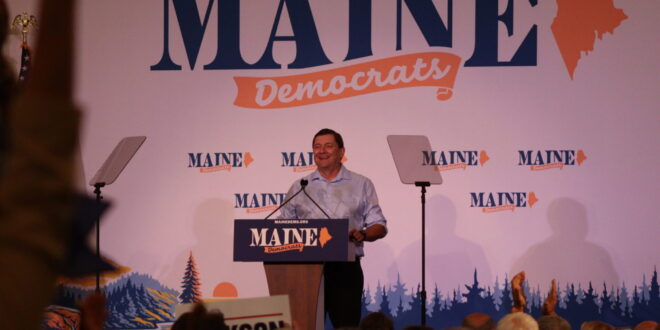
Former logger from Allagash turned politician Troy Jackson on Saturday officially became the Democratic nominee in the U.S. Senate race for longtime Republican Sen. Susan Collins’ seat.
All but one of Jackson’s opponents had suspended their campaigns over the past week, resulting in a largely ceremonious convention to replace former nominee Graham Platner, who dropped out following an accusation of sexual assault earlier this month.
“We are not from the left. We are not from the right. We’re from the bottom, and we are rising,” Jackson said in his acceptance speech, echoing Platner’s stump speech against the wealthy’s hold on the political system that had energized voters across the state.
Jackson’s domination of the quasi-improvised process that the Maine Democratic Party raced to pull together in the days after Platner’s late exit was on full display Saturday, as Jackson secured the votes of 566 delegates, many of whom began chanting “Troy” before voting began.
The only other candidate who remained in the race, Saundra Pelletier, CEO of Evofem Biosciences Inc., a woman’s pharmaceutical company, received just five votes, but used her speech to underscore that the party’s rules gave delegates free rein to back whoever they wanted Saturday.
Speaking with Maine Morning Star ahead of Saturday’s program, Pelletier said she knew she was “swinging for the fences,” but could not bypass an opportunity to get into the fight to oust Collins. Now, she plans to continue to stay involved in whatever way she can.
“I’d do anything asked of me to help, except walking nude down the street,” Pelletier told Maine Morning Star.
While 13 people had launched campaigns to replace Platner, that list significantly shrank as it became clear last weekend that the delegates each county selected to send to the nominating convention were overwhelmingly supporters of Jackson.
Of the 601 delegates, 101 were members of the state committee and 500 were elected proportionally by county committees. Ahead of the county caucuses to pick those representatives, Jackson and other campaigns worked quickly to line up slates of supportive delegates to increase their odds of securing the nomination.
While not obligated to vote for him, 95% of the county delegates chosen were already aligned with Jackson heading into the convention, demonstrating the organizing prowess of his campaign just off of his June 9 loss in the Democratic gubernatorial primary, where he came in third.
Momentum behind Jackson’s campaign was also underscored earlier this week by the more than $1 million his campaign says it has raised since launching his Senate bid. However, it is still a far cry from the $11 million cash on hand Collins reported, as of the last filing deadline.
What energized delegates
Sporting a Platner t-shirt, Zachary Shomler, who had volunteered for the oyster farmer’s campaign, became a delegate “to continue the work we started,” he said.
The Democrat from Calais had never previously volunteered for a campaign but after seeing Platner’s launch video last August immediately contacted his team. While the charismatic video drew him in, it was Platner’s detailed policy plans — which Shomler described as “a list of every grievance I have with our country” — that kept him in the fight.
From knocking doors in Washington County, Shomler has become well acquainted with the unique challenges of energizing Democratic and independent voters in Maine’s small towns, where doing business is dependent on having good relationships.
With limited time heading into the general election, Shomler hopes to make use of the volunteer infrastructure he helped build in Washington County to help Jackson, who he’d voted for as his first choice in the Democratic primary for governor.
Jackson, who had campaigned alongside Platner, holds many of the same progressive policy stances as the former nominee, including Medicare for all, abolishing U.S. Immigration and Customs Enforcement and fighting back against the wealthy’s hold on the political system, to name a few. He reiterated these views during both his speech to delegates ahead of the vote and after results were announced on Saturday, before turning to critiques of Collins.
“Concern does not lower the cost of groceries or gas,” Jackson said, a nod to the oft-repeated critique of Collins being “concerned” about issues but not casting votes to rectify them.
Saturday was the second time Michael Leconte of Portland served as a party delegate, the first being during one of independent U.S. Sen. Bernie Sanders of Vermont’s bids for president. Sanders’ bid had also been the first time Leconte, who identifies as a Democratic socialist, became invested in electoral politics.
The 41-year-old had been hesitant about backing Platner as a candidate, and abstained from voting in the primary, but fully supported his policies.
“You don’t follow after a demagogue,” Leconte said. “You let those ideals be championed by whoever is willing to step up and do it. So it was Platner, now it’s Jackson.”
Far more Mainers than were permitted had wanted to be a part of the convention, as 3,700 Democratic voters competed for the 500 spots. Independent voters — who have historically been consequential in Maine elections and were able to vote in the semi-open primary in which Platner had been selected — were not allowed to participate.
Some of the Mainers not selected as delegates still volunteered their time Saturday, including David Statman of Rockland, who said he feels the high number of people who have wanted to be a part of the process demonstrates that “the party is really coming together.”
Other Mainers attended as guests to observe the unprecedented proceedings, including Democratic U.S. House nominee and state treasurer Matt Dunlap.
Amy Fried, an alternate for Penobscot County, was one of few delegates who hadn’t vowed to support any particular candidate in advance, though said ahead of voting Saturday, “I don’t plan to support people with no experience,” which had been a concern she’d had with Platner, too.
That’s been a tension in this race, a key contrast between Platner and Gov. Janet Mills when she’d been in the running. While Platner was a political newcomer plucked by activists to launch a bid, Jackson has nearly two decades of experience working in state politics.
Morgan Urquhart of Bangor has been witness to that first hand, having worked for Jackson when he was president of the Maine Senate.
With her 10-year-old daughter in tow Saturday, Urquhart said she had voted for Platner in the primary but, similar to many delegates, said that for her it was never about one candidate.
“People are ready for change,” Urquhart said. “For me, I think that’s what a lot of the excitement in the primary was about. Troy’s been in the same fight for a long time.”
Jackson’s track record
During Jackon’s time as a legislator, his political views have publicly evolved. Jackson first unsuccessfully ran for his local state House of Representatives seat in 2000 as a Republican, before winning as an independent in 2002. He joined the Democratic Party in 2004.
As a legislator, Jackson voted against marriage equality in 2009 and for several anti-abortion measures through 2013 (though he told Maine Public in 2022 he continued to struggle with abortion).
But as president of the Maine Senate from 2018 to 2024, when he termed out, Jackson voted for several bills to expand abortion access — earning 100% ratings from Planned Parenthood’s Maine chapter and the LGBTQ+ rights group Equality Maine.
His shifting views on abortion were already the focus of opposition ads during his bid for governor this year.
As a legislator, Jackson also championed bills to reduce drug prices, expand child care, provide free school meals and strengthen labor standards, including providing loggers and haulers the right to bargain together, among others. He has also claimed to hold the state record for most bills vetoed, which he touts as evidence of fighting for progressive policies despite pushback.
Though Jackson first ran for office in 2000, he traces his political start to a 1998 border blockade, an origin story he’s often repeated, including while rallying alongside Platner as a gubernatorial candidate.
In protest of timber landowners bypassing local workers to hire cheaper temporary Canadian labor, Jackson led a week-long blockade in northern Maine. The standoff ended with Jackson and others being escorted away by police.
“I didn’t get involved in politics because I wanted the title,” Jackson before recounting that story again Saturday. “I got involved because the people that I worked beside were getting screwed, and nobody, no one in power, seemed to care.”
With 101 days before the November election, Maine Democratic Party Chair Charlie Dingman urged attendees to exit the convention carrying “the fantastic energy in this room and the imagination that brought us all here together, determined to protect our beautiful state and its people.”
by Emma Davis, Maine Morning Star
Maine Morning Star is part of States Newsroom, a nonprofit news network supported by grants and a coalition of donors as a 501c(3) public charity. Maine Morning Star maintains editorial independence. Contact Editor Lauren McCauley for questions: [email protected].