Poli Alert Politics & Civics
Related Articles



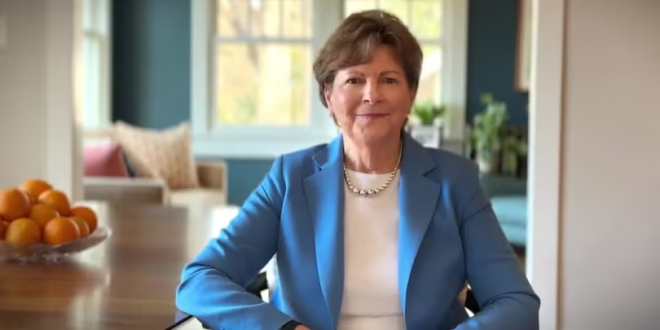
New Hampshire’s Democratic U.S. Sen. Jeanne Shaheen announced Wednesday she won’t run for reelection in 2026, which will end an 18-year tenure in Washington, D.C. The decision sets the stage for a competitive election in a cycle where Democrats are concerned about their ability to take back a majority in the Senate.
In a video announcing her decision, Shaheen, 78, called her time in the U.S. Senate — as well as previous stints in the state Senate and as New Hampshire’s governor — “an incredible honor.”
“I have made the difficult decision not to seek reelection to the Senate in 2026,” she continued. “It’s just time.”
Shaheen said this isn’t the end of her public service career, though she didn’t specify what she plans to do next.
“While I’m not seeking reelection, believe me, I am not retiring,” she said. “I am determined to work every day over the next two years and beyond to continue to try and make a difference for the people of New Hampshire and this country.”
A potentially competitive race to replace her
Republicans hold a 53-47 majority (which includes the two independents who caucus with the Democrats) in the Senate, and Shaheen is the Senate’s third sitting Democrat — in addition to Sens. Gary Peters of Michigan and Tina Smith of Minnesota — to announce retirement from the Senate. While Democrats hope to take advantage of the fact that political parties out of power typically do better in midterms, the party will now have to defend multiple open seats and attempt to flip several Republican-held seats in order to earn a majority.
Because of this, the race to replace Shaheen will likely be closely watched. There are several figures in New Hampshire politics that might join the race.
Both of New Hampshire’s two Democratic members of the U.S. House of Representatives are reportedly considering bids for the seat.
A source familiar with U.S. Rep. Chris Pappas’ thinking said he is “strongly considering” a 2026 campaign for U.S. Senate, and another familiar with U.S. Rep. Maggie Goodlander’s thinking said she’s also considering a run.
Pappas has represented New Hampshire’s 1st Congressional District, which includes Manchester, Laconia, and the Seacoast, since 2018. The Manchester native is the first openly gay man to represent New Hampshire in Congress and was named the most bipartisan Democrat in Congress by the Lugar Center in 2023. During his time in the House, he was one of six House Democrats to vote against making marijuana federally legal through the Marijuana Opportunity Reinvestment and Expungement Act over concerns about provisions in the bill to expunge federal convictions, and earlier this year he voted in favor of the Laken Riley Act, an immigration and law enforcement bill passed in the wake of the death of a Georgia resident. He would become the first openly gay male U.S. senator if elected.
Goodlander has been in office for just a few months. She won election for the first time in November to represent New Hampshire’s 2nd Congressional District, which includes Concord, Nashua, and the North Country. Perhaps her most notable vote so far has been in support of the Laken Riley Act. Prior to joining Congress as an elected official, the Nashua native served as a foreign policy adviser to U.S. Sens. John McCain and Joe Lieberman and worked as counsel to the House Judiciary Committee during President Donald Trump’s first impeachment. She has a military background, having served as an intelligence officer in the U.S. Navy Reserve.
In accepting her role in the House, Goodlander succeeded Annie Kuster, a Democrat who represented the 2nd Congressional District until she retired from the role this year. Kuster told Politico that if Pappas doesn’t run, she’ll take a “serious look” at running for the seat herself.
On the Republican side, Chris Sununu, the popular former New Hampshire governor, told The Washington Times earlier this week before Shaheen’s announcement that “I have not ruled (running for U.S. Senate) out completely.” This is a reversal of previous statements he made claiming he would not run for the seat. Sununu left the governorship this year with high approval ratings after deciding not to seek reelection. A moderate, Sununu often strayed from the policies and agendas of the first Trump administration. During his tenure, he notably implemented the “Doorway” program, which works to better centralize and distribute substance use disorder treatment options, and ushered a reduction of regulations and tax cuts. He comes from a family of New Hampshire politicians, including his father John H. Sununu, also a former governor and President George H.W. Bush’s chief of staff, and his brother John E. Sununu, a former U.S. congressman.
Scott Brown, who ran against and lost to Shaheen during her 2014 reelection campaign, also could run again for the seat. He served as ambassador to New Zealand and Samoa during the first Trump administration. After Shaheen’s announcement Brown thanked the senator on social media for her “service to our state and for her support and vote for me as NH’s Ambassador to NZ and Samoa.”
30 years of elected office
Shaheen has been a mainstay of New Hampshire politics for decades.
She was first elected to the U.S. Senate in 2008. There, she now sits on the Senate Armed Services, Small Business, and Appropriations committees.
Prior to joining the Senate, Shaheen was New Hampshire’s first female governor — she is the first woman in the country to be elected both a senator and governor — serving three terms from 1997 to 2003. As governor, she implemented expanded kindergarten in New Hampshire public schools and repealed a ban on abortion — though the Supreme Court’s Roe v. Wade decision had not yet been overturned at this point, making the move less impactful at the time.
A moderate, she pledged not to implement income or sales taxes as governor and in the U.S. Senate reached across the aisle to work with the late Sen. John McCain, an Arizona Republican, to create a visa program for Afghans during the U.S. war there.
She was also heavily involved in the late President Jimmy Carter’s 1976 White House victory.
“Jeanne Shaheen is a trailblazer who has defined and personified New Hampshire politics — and progress — for decades,” Sen. Maggie Hassan, Shaheen’s colleague in the Senate and the junior senator from New Hampshire, said in a statement. “She is an extraordinary public servant who built the New Hampshire Democratic Party into what it is today, served in the State Senate, three terms as governor, and now three terms as Senator — with outstanding accomplishments at every level of her work. I am grateful for her years of service, for the legacy that she leaves to the people of our state, and for her mentorship and friendship.”
Pappas and Goodlander both also released statements on the news.
Pappas said the senator and former governor is “a trailblazer who has dedicated her career to putting New Hampshire first and working hard each day to protect our communities, strengthen our economy, and keep our nation safe.”
Goodlander called Shaheen a “true New Hampshire hero,” saying, “Her super power is her ability to listen — truly listen — to the people of New Hampshire, understand their needs, and deliver for them.”
by William Skipworth, New Hampshire Bulletin
New Hampshire Bulletin is part of States Newsroom, a nonprofit news network supported by grants and a coalition of donors as a 501c(3) public charity. New Hampshire Bulletin maintains editorial independence. Contact Editor Dana Wormald for questions: [email protected].