Poli Alert Politics & Civics
Related Articles



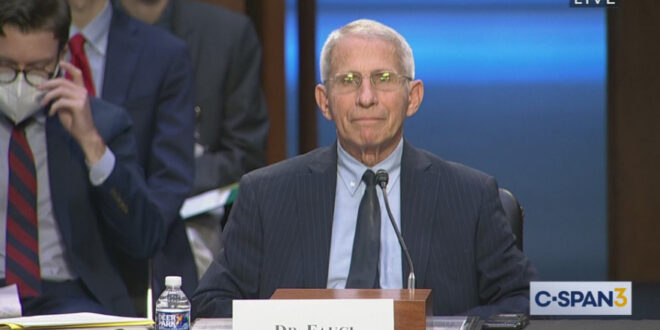
A Republican-led Senate committee voted Thursday to hold Dr. Anthony Fauci in contempt of Congress after the former top U.S. public health official refused to answer questions during a hearing on the origins of the COVID-19 pandemic, escalating a yearslong political battle over the federal government’s response to the outbreak.
The Senate Homeland Security and Governmental Affairs Committee approved the contempt resolution along party lines, with Republicans voting to refer Fauci to the Justice Department for possible prosecution. Committee members argue Fauci violated a congressional subpoena by repeatedly invoking his Fifth Amendment right against self-incrimination during a July 29 hearing.
Committee Chairman Sen. Rand Paul, R-Ky., said Fauci’s refusal to testify was unjustified because former President Joe Biden issued him a sweeping pardon covering potential federal offenses from 2014 through 2025.
“We are voting on whether a witness who has received the benefit of a sweeping federal pardon can be ordered by this committee to answer questions and then defy that order without consequence,” Paul said during Thursday’s meeting.
Fauci invoked the Fifth Amendment 111 times during last week’s hearing, declining to answer questions ranging from substantive inquiries about the pandemic to simple questions about his necktie color and the day of the week — questions Republicans said were designed to test whether he intended to answer anything at all.
Democrats accuse GOP of setting a legal trap
Democrats on the committee strongly opposed the contempt resolution, arguing that Fauci had legitimate constitutional grounds to remain silent despite Biden’s pardon.
Sen. Maggie Hassan, D-N.H., said the pardon would not shield Fauci from prosecution if he made inaccurate statements during congressional testimony.
“The goal was to wait for Dr. Fauci to make any kind of misstatement and then have a weaponized Department of Justice file criminal charges for that new statement that would not have been covered by the pardon, leaving Dr. Fauci little choice but to invoke his constitutional right to not walk directly into a trap,” Hassan said.
During the July 29 hearing, Fauci accused Paul of attempting to manufacture criminal exposure.
“The only conclusion I can reach is that the sole reason he is calling me before this committee is to get me to say something — anything — that could vindicate his repeated public pledges that I end up, in his words, ‘behind bars,'” Fauci said in his opening statement.
Dispute over Senate procedure
The committee’s top Democrat, Sen. Gary Peters of Michigan, also criticized the process Republicans are using to pursue the contempt referral.
Peters objected to Paul’s plan to send the resolution directly to federal prosecutors without first obtaining approval from the full Senate, arguing that congressional contempt powers belong to the chamber as a whole rather than an individual committee.
“No individual senator and no committee speaks for the entire Senate,” Peters said. “Institutional powers belong to the full body.”
He warned that bypassing a full Senate vote could weaken future congressional investigations by encouraging witnesses to challenge committee authority.
Years of scrutiny over pandemic response
The hearing marked the first time Fauci refused to answer congressional questions since the COVID-19 pandemic began.
As director of the National Institute of Allergy and Infectious Diseases, Fauci served under presidents from both parties for nearly four decades. He became one of the nation’s most recognizable public health officials during the pandemic, serving on President Donald Trump’s coronavirus task force before later becoming chief medical adviser to President Biden.
Since early 2020, Fauci has testified before Congress roughly two dozen times, frequently defending the government’s pandemic response, vaccine development efforts and public health guidance.
Republicans have continued investigating the origins of COVID-19 and the federal government’s response, arguing that officials made decisions that unnecessarily harmed the economy and individual freedoms.
Sen. Ron Johnson, R-Wis., who chaired the committee in 2020, said Thursday that lawmakers still need answers about how key decisions were made.
“It’s been six years since the pandemic began,” Johnson said. “We have not had a reckoning of what happened.”
What happens next
The committee’s vote is a recommendation rather than a final determination. Whether the Justice Department pursues any contempt action remains uncertain, particularly given the unresolved legal questions surrounding Fauci’s Fifth Amendment protections and the scope of Biden’s pardon.
The dispute is likely to continue as congressional Republicans maintain their broader investigation into the pandemic’s origins and the government’s handling of the public health crisis.