Poli Alert Politics & Civics
Related Articles


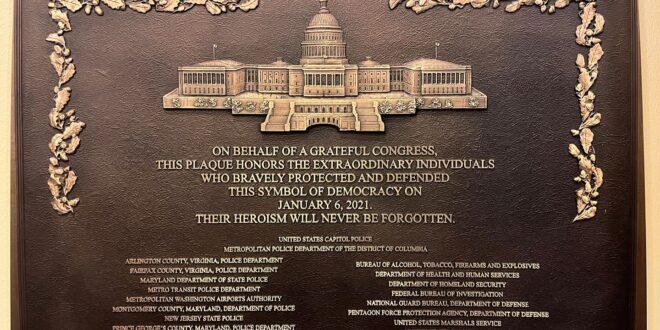
The Senate on Thursday unanimously approved a resolution to display a plaque honoring the law enforcement officers who defended the U.S. Capitol during the Jan. 6, 2021 attack, stepping around House Speaker Mike Johnson after he refused to install the memorial despite a federal law requiring it.
The resolution directs the Architect of the Capitol to “prominently display” the plaque in a publicly accessible area of the Senate wing until a permanent location is agreed upon by both chambers.
The bipartisan measure was introduced by Sen. Jeff Merkley, D-Ore., and Sen. Thom Tillis, R-N.C., after Johnson declined to carry out a 2022 law mandating the plaque’s installation. Johnson’s office has argued the law was “not implementable,” claiming a technical discrepancy between the statute — which referenced the names of officers — and the plaque itself, which lists the law enforcement agencies that responded to the attack.
The Senate action amounts to a rare institutional rebuke of a sitting House speaker, asserting its authority to honor Capitol defenders amid continued political efforts to minimize or recast the Jan. 6 assault.
A workaround after House refusal
The resolution passed by unanimous consent, meaning no senator objected and no roll call vote was required. Because it applies only to Senate space, it does not require House approval or President Donald Trump’s signature.
“This is a fast way to get it up,” Tillis told reporters, describing the move as a temporary fix after Johnson’s refusal. “It will stay up until a final permanent place is found.”
Tillis said senators are considering locations where visitors regularly pass, including the first-floor security checkpoint area and the third-floor route used by Capitol tour groups.
Merkley said the Senate acted because waiting on the House had become untenable.
“What this resolution is saying is that we in the Senate will put it up here in a publicly available space until a deal can be reached with the House of Representatives,” Merkley said on the Senate floor. “That we can do on our own.”
Political backdrop
Johnson, R-La., played a central role in Trump’s effort to overturn the 2020 election, leading a legal brief supporting a lawsuit aimed at invalidating Biden’s victories in four swing states. The Supreme Court rejected the effort in December 2020.
The Senate’s vote comes as the Trump administration has escalated efforts to rewrite the history of Jan. 6, including recasting the pro-Trump mob as “peaceful protesters” and portraying law enforcement as provocateurs. Trump’s federal criminal cases tied to the attack were dropped after his election in 2024.
Former special counsel Jack Smith has since told lawmakers that Trump was “the most culpable and most responsible person” in the conspiracy to interfere with the 2020 election and that prosecutors had assembled proof “beyond a reasonable doubt” of a criminal scheme to overturn the results.
In earlier filings, Smith wrote that Trump “inspired his supporters to commit acts of physical violence” and knowingly spread false claims about election fraud.
Legal fight continues
Brendan Ballou, a former Justice Department prosecutor now representing Capitol officers in litigation over the plaque, said the Senate’s action is welcome but incomplete.
“The plaque will ensure that the officers who defended those inside are honored,” Ballou said. “That said, until the plaque has a permanent home, as required by law, our litigation will continue.”
Former House Speaker Nancy Pelosi, D-Calif., said earlier this week that the plaque will be permanently installed if Democrats retake the House in the 2026 midterms.
“Just wait 10 more months,” Pelosi said. “Hakeem Jeffries will be speaker and we will place it in the place of honor.”