Republicans spent more than a year trying to reshape congressional districts to protect their narrow hold on power in Washington. But after voters went to the polls Tuesday, November 3, several of those efforts failed, with Democratic candidates winning seats that Republican lawmakers had specifically redrawn to favor their party.
The results exposed the limits of partisan gerrymandering, the practice of drawing electoral district boundaries to give one political party an advantage. Despite changing district lines in multiple states, Republicans failed to convert several Democratic-held seats into Republican victories.
According to NPR, Democrats won in several districts that Republicans had redrawn specifically to improve their chances of winning before the 2026 midterm elections.
The political news that affects your wallet, your rights and your vote, broken down in plain language. Free in your inbox.
The redistricting campaign began after Trump urged Republican-led states to redraw congressional maps ahead of the midterms. Republican lawmakers pursued new boundaries in states including Texas, Florida, North Carolina and Alabama, hoping to increase the number of seats their party could win.
But Tuesday’s results produced a different outcome.
In Florida, Republicans failed to capture the targeted districts. Democratic Reps. Kathy Castor and Jared Moskowitz won reelection, while Democratic candidate Pia Dandiya also won a newly redrawn district. Democrat Darren Soto retained his seat as well.
According to Axios, Republicans went zero for four in the Florida districts they had hoped to turn into Republican victories.
Texas delivered another significant setback for the Republican redistricting strategy. Republican lawmakers had redrawn five congressional districts with the goal of gaining additional seats. Instead, Democrats won three of those targeted districts and were leading in a fourth after Republican Alex Mealer conceded to Democrat Leticia Gutierrez, according to the Houston Chronicle.
Democrats also defeated Republican Rep. Monica De La Cruz, further complicating the GOP’s effort to expand its congressional delegation.
The results were particularly notable in South Texas, where Republicans had counted on support from Latino voters who had moved toward Trump in the 2024 election. That support did not hold at the same level in 2026.
In North Carolina, Democratic Rep. Don Davis held onto his 1st Congressional District seat despite Republican lawmakers redrawing the boundaries to make the district more favorable to the GOP. According to NPR, Trump would have carried the newly drawn district by nearly 12 percentage points in 2024.
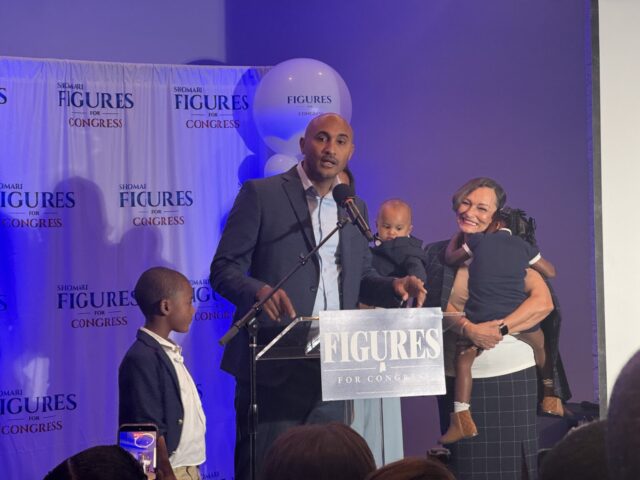
In Alabama, Democratic Rep. Shomari Figures also retained his seat in the 2nd Congressional District, even though Republicans had redrawn the district to improve their electoral position.
The Alabama redistricting effort followed a Supreme Court decision that weakened a key provision of the Voting Rights Act, the federal law designed to protect voters from racial discrimination in elections.
The Republican strategy was built around the assumption that voting patterns from 2024 would continue into the midterms. However, the 2026 results demonstrated that changing district boundaries does not guarantee that voters will support the party those maps were designed to benefit.
The results also came during a much larger Democratic victory. The Associated Press reported that Democrats won control of both chambers of Congress, flipping more than two dozen House districts and at least seven Senate seats.
That shift means Democrats will have the power to block Trump’s legislative agenda, investigate his administration through congressional oversight and reject certain administration nominees.
Republicans still achieved some redistricting victories, including gaining a Democratic-held congressional seat in Tennessee. The overall results, however, showed that their efforts to create additional Republican-friendly districts did not deliver the gains party leaders had sought.
For voters, the battle over congressional maps is about more than party competition. District boundaries determine which communities are grouped together, whose votes carry greater influence and how effectively residents can elect representatives who reflect their interests.
The next major fight over redistricting will continue in state legislatures and the courts, where disputes over racial representation, voting rights and partisan mapmaking remain unresolved.