
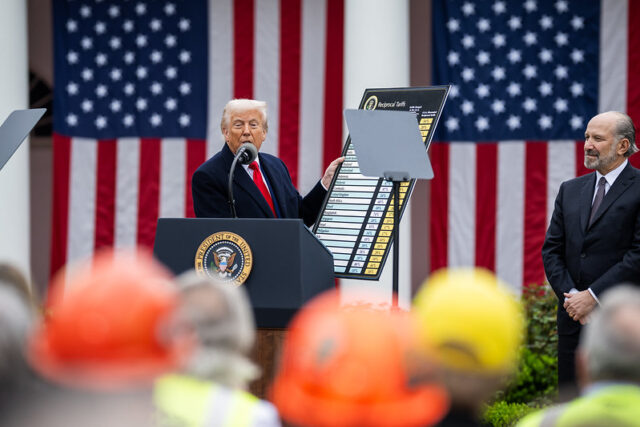
The Trump administration announced Thursday that new tariffs targeting imports from 60 foreign economies will take effect Friday, replacing the temporary 10% import duty that expires at midnight Eastern time.
The Office of the U.S. Trade Representative said the new tariffs, ranging from 10% to 12.5%, are the result of months-long investigations into the trade practices of dozens of U.S. trading partners. The duties officially took effect at 12:01 a.m. Friday under Section 301 of the Trade Act of 1974, marking a significant shift in the legal authority the administration is using to impose tariffs.
The latest action follows a Supreme Court decision in February that struck down many of President Donald Trump’s earlier tariffs imposed under the International Emergency Economic Powers Act, ruling the administration exceeded its authority.
Under the new tariff schedule, some of the United States’ largest trading partners—including Canada, Mexico, India and the United Kingdom—will face a 10% tariff.
The United Kingdom’s rate closely mirrors the trade agreement reached last year between Trump and then-Prime Minister Keir Starmer, which lowered tariffs on British exports to the United States to 10%.
Meanwhile, imports from Taiwan and the European Union—the United States’ largest overall trading partner—will face tariffs of up to 12.5%. That rate is lower than the 15% ceiling Trump and European Commission President Ursula von der Leyen agreed upon last year.
Administration cites forced labor concerns
The U.S. Trade Representative’s Office said its investigations concluded that the affected economies failed to adequately prohibit or enforce restrictions on goods produced with forced labor.
“The United States has had a forced labor import ban for nearly a century, and rigorously enforces it; it’s well past time for our trading partners to do the same,” U.S. Trade Representative Jamieson Greer said in a statement.
The investigations began in mid-March as administration officials searched for an alternative legal pathway to maintain Trump’s broader tariff agenda after the Supreme Court ruling limited the use of emergency powers.
Several major trading partners, including the European Union, rejected the administration’s allegations before Thursday’s final determination, arguing their existing labor protections already meet international standards.
Exemptions cover key industries
Despite the broad scope of the tariffs, the administration carved out numerous exemptions intended to reduce pressure on sectors already facing higher costs.
Excluded from the new duties are certain fertilizers, some fuel products, automobiles, metals, pharmaceuticals and select food products.
The exemptions come as energy prices remain elevated amid the ongoing conflict involving Iran, which has contributed to higher fuel costs worldwide.
Trump also announced earlier this week that generic pharmaceuticals imported into the United States will remain tariff-free for two years.
“All Generic Drugs being brought into the United States will continue to have a TARIFF of ZERO PERCENT for a two year period of time,” the president wrote on social media Tuesday.
Broader trade strategy
The new tariffs represent another phase of Trump’s effort to reshape U.S. trade relationships and encourage domestic manufacturing through higher import costs.
By relying on Section 301 rather than emergency authorities, the administration aims to insulate its trade policy from future legal challenges while continuing to pursue what officials describe as reciprocal and fair trade practices.
The new tariff schedule is expected to affect hundreds of billions of dollars in imported goods, though the exemptions are intended to soften the impact on industries considered strategically important or already facing inflationary pressures.
Meta Description:
SEO Keywords: Trump tariffs, Section 301 tariffs, U.S. trade policy, foreign import tariffs, Jamieson Greer, trade war, forced labor imports, global trade
Focus Keyphrase: Trump tariffs