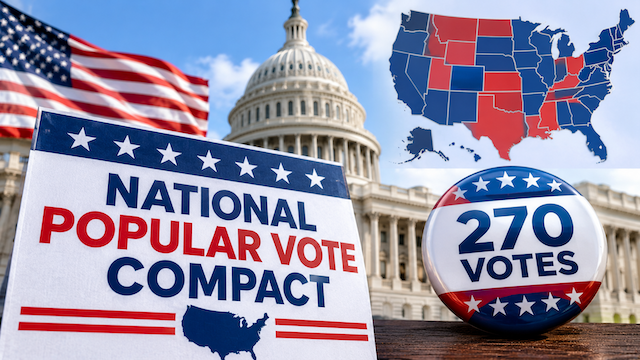
The National Popular Vote Interstate Compact currently has 19 participating jurisdictions, including 18 states and Washington, D.C. Together, those jurisdictions control 222 electoral votes, leaving the agreement 48 votes short of the 270 needed to activate it.
Virginia became the latest state to join in April 2026 after Gov. Abigail Spanberger signed legislation authorizing the state’s participation. The development brought the compact closer to its activation threshold and renewed attention to a movement that has been building for nearly two decades.
Now, the results of the 2026 midterm elections have introduced a new political dimension to the effort.
The political news that affects your wallet, your rights and your vote, broken down in plain language. Free in your inbox.
According to Axios, Democratic victories in Pennsylvania, Michigan, Arizona, Wisconsin and Nevada have created potential legislative opportunities for supporters of the compact. Democrats secured new governing majorities across these states, giving lawmakers who support the agreement additional opportunities to introduce or advance legislation.
However, winning control of state government does not automatically mean those states will join. Each state must still pass legislation and enact the compact into law.
How The National Popular Vote Compact Works
The United States currently elects its president through the Electoral College, a system in which states receive electoral votes based on their representation in Congress. There are 538 electoral votes nationwide, and a presidential candidate generally needs 270 to win.
In most states, the candidate who wins the state’s popular vote receives all of its electoral votes. Maine and Nebraska use a different system that distributes some electoral votes by congressional district.
The National Popular Vote Interstate Compact would change how participating states distribute those votes.
Under the agreement, participating states would commit to awarding all their electoral votes to the presidential candidate who receives the most votes nationwide, regardless of which candidate wins their individual state.
The agreement would not eliminate the Electoral College or require a constitutional amendment to change the presidential election system. Instead, it uses the authority states already have under the Constitution to determine how their electoral votes are awarded.
The compact would only become active after participating jurisdictions collectively control at least 270 electoral votes.
Why The 2026 Midterm Elections Could Matter
The compact’s next phase could depend heavily on what happens in state legislatures.
Pennsylvania, Michigan, Arizona, Wisconsin and Nevada are among the states receiving renewed attention because of their political changes following the midterms.
Each represents an opportunity for supporters to pursue legislation that could move the compact closer to the required threshold.
The National Popular Vote organization has also identified several states where the proposal has previously advanced through at least one legislative chamber.
Those states include Arizona, Michigan, Nevada, North Carolina, Oklahoma and Arkansas.
The National Popular Vote organization reports that legislation has passed at least one chamber in these six states, representing a combined 61 electoral votes. That does not mean those electoral votes are committed to the agreement. The legislation must still complete the remaining steps and become law.
The distinction is important because the compact cannot activate based on legislative support alone. States must formally enact the agreement.
What It Could Mean For Black Voters
The debate over the Electoral College has significant implications for Black voters, particularly in states where presidential campaigns concentrate their resources on a relatively small number of competitive communities.
Under the current system, presidential campaigns frequently prioritize battleground states because winning those states can determine the outcome of the Electoral College.
That approach can leave voters in states considered safely Democratic or Republican with less attention from presidential campaigns.
A national popular vote system would create a different incentive. Every vote would contribute to the nationwide total used to determine which presidential candidate receives the electoral votes of participating states.
For Black voters in heavily Democratic states, that could mean their votes would be counted toward the national outcome rather than being treated as part of an already predictable state result.
It could also change campaign strategies, encouraging candidates to compete for votes in communities across the country rather than concentrating so heavily on a handful of battleground states.
Supporters argue that the arrangement would give every vote equal weight in determining the national popular vote winner. Opponents have raised concerns about how the system could affect state representation, election administration and the balance of political power.
The Constitutional Questions Still Remain
Although the compact relies on states’ constitutional authority over the appointment of presidential electors, legal questions remain.
One major issue is whether Congress must approve the agreement under the Constitution’s Compact Clause, which addresses agreements between states.
Some constitutional scholars argue that congressional approval would be necessary because the agreement could influence the operation of the federal government and presidential elections. Others maintain that the compact falls within the states’ existing authority to determine how their electoral votes are awarded.
The U.S. Constitution gives state legislatures significant authority over the appointment of presidential electors. The National Archives also explains that no constitutional provision or federal law requires states to award their electors based on the winner of their individual statewide popular vote.
However, the legal questions surrounding a nationwide agreement among states have not been definitively resolved by the U.S. Supreme Court.
What Happens Next?
The immediate focus will be on whether lawmakers in the states that experienced political changes during the 2026 elections decide to pursue the compact.
If enough states enact the agreement to reach 270 electoral votes, participating jurisdictions would be required to award their electoral votes to the nationwide popular vote winner under the compact’s terms.
The agreement includes a timing provision requiring it to be in effect in jurisdictions holding at least 270 electoral votes by July 20 of a presidential election year to govern that election.
That means the next presidential election cycle could become an important test of whether the compact gains enough support to move from a state-level agreement to an active national election arrangement.
For now, the Electoral College remains the system used to elect the president. But with 222 electoral votes already committed and new legislative opportunities emerging after the 2026 midterms, the National Popular Vote Interstate Compact is once again becoming a significant part of the national debate over presidential elections.