Poli Alert Politics & Civics
Related Articles



The closely watched Democratic primary for Michigan’s open U.S. Senate seat remained too close to call early Wednesday, capping an election night that exposed growing ideological divisions within the Democratic Party while setting the stage for several competitive House races in November.
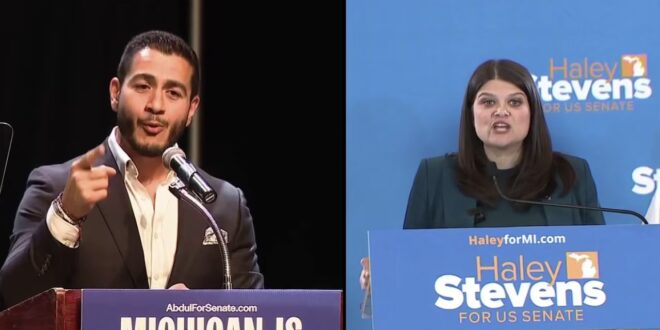
With ballots still being counted, Rep. Haley Stevens, a centrist backed by much of the Democratic establishment, and former public health official Abdul El-Sayed, a progressive favorite, remained locked in a race that election officials had not called.
The winner will face Republican former Rep. Mike Rogers in November for one of the nation’s most competitive Senate seats, a contest viewed as critical to Democrats’ efforts to regain control of the Senate. Rogers narrowly lost a Senate bid in 2024 and has secured President Donald Trump’s endorsement for this year’s race.
Michigan race highlights Democratic divisions
The Michigan Senate contest became a referendum on the Democratic Party’s ideological direction.
Stevens campaigned as a pragmatic moderate focused on appealing to independents and swing voters, while El-Sayed argued that a more progressive agenda would energize younger voters and the Democratic base.
The race also underscored divisions over U.S. policy toward Israel.
El-Sayed called Israel’s military campaign in Gaza a genocide and advocated ending U.S. military aid to Israel. Stevens, a longtime supporter of Israel, benefited from more than $30 million in outside spending by the super PAC affiliated with the American Israel Public Affairs Committee (AIPAC), further fueling debate within the party over campaign spending and Middle East policy.
Progressives notch House victory in Michigan
While the Senate race remained unresolved, Michigan progressives secured a major victory in the state’s 7th Congressional District.
Sunrise Movement co-founder William Lawrence defeated former U.S. Ambassador to Ukraine Bridget Brink and retired Navy SEAL Matt Maasdam in the Democratic primary. Lawrence will now challenge Republican Rep. Tom Barrett in one of the nation’s most competitive House districts.
Another Michigan race also remained unresolved Wednesday morning as incumbent Democratic Rep. Shri Thanedar and progressive challenger Donavan McKinney awaited final results in the 13th Congressional District.
Virginia sets key House matchups
Virginia Democrats selected nominees in several competitive congressional districts ahead of November.
Former Rep. Elaine Luria won the Democratic nomination in the 2nd Congressional District, setting up a rematch with Republican Rep. Jen Kiggans after losing the seat in 2022.
In the 1st Congressional District, prosecutor Shannon Taylor secured the Democratic nomination and will challenge Republican Rep. Rob Wittman.
Former Rep. Tom Perriello also won the Democratic nomination in Virginia’s 5th Congressional District and will face Republican Rep. John McGuire in a district President Donald Trump carried comfortably in 2024.
Bell defeats Bush again in Missouri
In Missouri, Democratic Rep. Wesley Bell defeated former Rep. Cori Bush for the second consecutive election cycle, extending a series of setbacks for the party’s progressive wing.
Bell again received significant financial backing from AIPAC, which spent roughly $3 million supporting his campaign after heavily investing in his successful 2024 challenge against Bush.
The victory positions Bell as the overwhelming favorite in the heavily Democratic St. Louis-area district.
Washington battleground takes shape
Washington state’s open primary also produced a closely watched general election matchup.
Incumbent Democratic Rep. Marie Gluesenkamp Perez and Republican John Braun advanced to November in one of the country’s most competitive congressional districts. Gluesenkamp Perez defeated a progressive primary challenger, while Braun entered the race with Trump’s endorsement.
GOP-backed ballot measures rejected
Voters in Kansas and Missouri rejected Republican-backed ballot initiatives aimed at changing state governing rules.
Kansas voters defeated a proposal that would have replaced the state’s merit-based judicial selection process with direct elections for Supreme Court justices. Opponents argued the measure would have increased political influence over the judiciary, including decisions involving abortion rights.
Missouri voters also rejected a proposal that would have made it more difficult for citizen-led constitutional amendments to pass, following recent ballot initiatives expanding abortion access and legalizing marijuana.
The defeats marked setbacks for Republican lawmakers seeking to reshape state governance through constitutional changes.
Looking ahead
Michigan’s unresolved Senate primary is expected to remain under close scrutiny as vote counting continues. The eventual Democratic nominee will enter one of the nation’s premier Senate battlegrounds, while competitive House races in Michigan, Virginia and Washington are expected to attract significant national attention as both parties battle for control of Congress.