


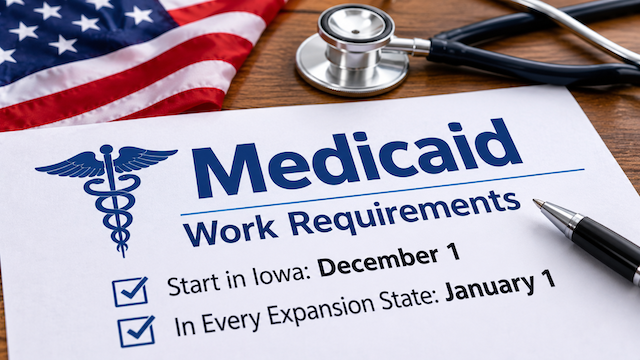
Medicaid work requirements begin for adults in Iowa by December 1 and must be in place in every state that expanded Medicaid by January 1, 2027, under a tax and spending law Trump signed in 2025. Medicaid expansion is the option, taken by most states, to cover adults with low incomes who would not otherwise qualify.
The Centers for Medicare and Medicaid Services, the federal agency that runs Medicaid, released an interim final rule on June 1, 2026. An interim final rule is a rule that takes effect before the public comment period ends. Ballotpedia reported that it covers adults ages 19 to 64 in expansion states, who must show they are working, doing community service or an approved work program, or enrolled at least part time in school. Beneficiaries must prove compliance when they apply and every six months after that.
Exemptions include parents or caretakers of children under 13, some former foster care youth, some American Indians and Alaska Natives, and people who are medically frail. States must try to confirm frailty using claims data or other reliable information, and people can self-report it through 2027. Iowa’s Department of Health and Human Services lists additional exclusions, including pregnant and postpartum women and people in drug or alcohol treatment.
The political news that affects your wallet, your rights and your vote, broken down in plain language. Free in your inbox.
Some states moved ahead of the deadline. Ballotpedia reported that Nebraska began May 1, 2026, and that Montana planned to start July 1. Iowa’s Department of Health and Human Services says certain members of the Iowa Health and Wellness Plan must meet monthly requirements “by December 1, 2026.” A June 2025 analysis by the Congressional Budget Office, as summarized by Ballotpedia, estimated that about 18.5 million people would be subject to the rules once every expansion state is running them.
CMS Administrator Mehmet Oz said the policy aims to “support their path to independence.” America’s Physician Groups warned of a “nearly endless cycle of doctors’ visits” for patients with chronic conditions, and patient advocacy groups said the rule could burden the sickest patients and goes beyond the text of the law, Ballotpedia reported. A KFF survey of states conducted from January to March 2026 found that 29 states named too little time as their most common barrier.
Medicaid members who think the rules apply to them should confirm their status with their state Medicaid agency. Iowa members can check eligibility at hhsservices.iowa.gov or call the Income Maintenance Customer Service Center at 1-877-347-5678.




