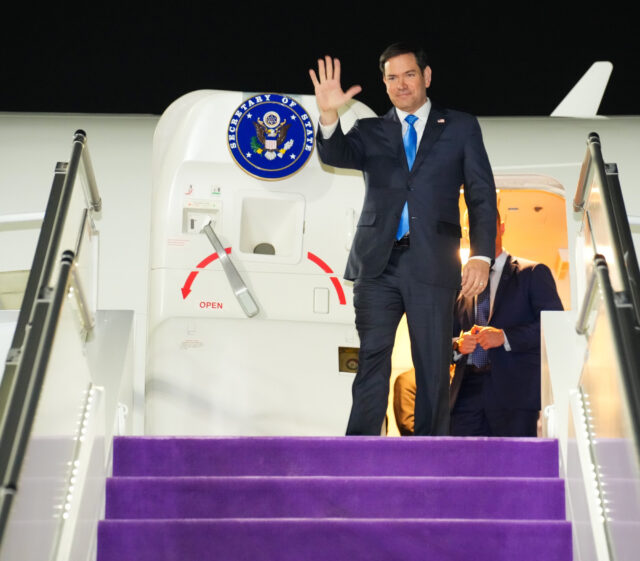
Secretary of State Marco Rubio is facing scrutiny after a Washington Post investigation revealed that his frequent trips aboard government aircraft to attend his son’s college football games have cost taxpayers an estimated $1.2 million, raising questions about government spending and the use of military planes for personal travel.
The investigation, published Wednesday, Nov. 11, found that Rubio traveled to Gainesville, Florida, aboard government aircraft at least 23 times since taking office in January 2025. The State Department classified 15 of those trips as exclusively personal, while seven combined personal and official business. The classification of one additional trip was not disclosed.
Rubio has attended at least 10 University of Florida football games over the past two seasons, including at least five this fall. His son, Anthony Rubio, is a senior walk-on running back for the Florida Gators.
The political news that affects your wallet, your rights and your vote, broken down in plain language. Free in your inbox.
Although federal security protocols require the secretary of state to travel aboard government aircraft, the frequency and expense of Rubio’s trips have prompted government ethics experts to question whether he is exercising appropriate judgment in his use of public resources.
According to the Post’s analysis of flight records and Defense Department aircraft operating rates, approximately $770,600 was associated with the 15 exclusively personal trips. Another $443,900 was attributed to seven trips involving both official and personal activities, bringing the estimated total to more than $1.2 million.
Rubio typically travels aboard Gulfstream C-37 military jets, which cost approximately $9,100 per flight hour under Defense Department billing rates. On three occasions, he used a larger Boeing C-32A aircraft, which carries an estimated hourly rate of $18,600.
The figures represent estimated aircraft operating costs, not necessarily the additional expense taxpayers would have avoided if Rubio had remained in Washington. The total also includes flights classified as partly official.
While Rubio is required to reimburse the government for personal travel, federal rules generally calculate those payments using the cost of comparable commercial economy-class airfare rather than the actual expense of operating military aircraft.
The Post estimated that comparable round-trip commercial tickets between Washington and Gainesville averaged approximately $820 on game days. Based on that figure, Rubio’s reimbursements for Gainesville travel could amount to roughly $18,000, substantially less than the estimated cost of the flights.
However, the State Department declined to disclose Rubio’s reimbursement records, leaving the precise amount he has repaid unknown.
Rubio defended his travel in a statement to The Washington Post, emphasizing the importance of maintaining family commitments despite the demands of his position.
“I have and will continue to try and make it to as many events that are important to me personally and to my family as possible,” Rubio said.
Assistant Secretary of State Dylan Johnson also defended the arrangements, explaining that Rubio must maintain access to secure communications and remain available to carry out his national security responsibilities.
Johnson said the secretary would continue attending family events, including his son’s football games, whenever his official duties permit.
The White House similarly rejected criticism of the trips, arguing that Rubio’s travel complies with federal requirements and that attending his son’s games should not be portrayed as misconduct.
Under a longstanding policy formalized in a 1993 White House memorandum, certain senior national security officials are required to use government aircraft even when traveling for personal reasons. The policy is intended to ensure their safety, access to classified communications and ability to respond immediately to national emergencies.
Government ethics specialists acknowledge that Rubio’s use of military aircraft appears to comply with those requirements. However, they distinguish between whether the flights are legally permitted and whether their frequency represents responsible management of taxpayer money.
Cynthia Brown, senior ethics counsel at Citizens for Responsibility and Ethics in Washington, told the Post that the controversy was primarily a matter of public accountability rather than an established violation of federal rules.
Brown described the situation as “more of an optics issue than a violation,” while emphasizing that officials still have a responsibility to consider the public expense associated with their personal decisions.
The investigation also highlighted differences between Rubio’s travel patterns and those of previous secretaries of state.
Former State Department officials told the Post that Antony Blinken, who served under President Joe Biden, generally used government aircraft for personal travel only a couple of times annually. Rubio’s trips to Gainesville alone have occurred substantially more frequently.
The comparison has drawn additional attention because Rubio previously called for scrutiny of government aircraft use by former Transportation Secretary Pete Buttigieg.
In 2023, while serving as a Republican senator from Florida, Rubio sought an investigation into Buttigieg’s use of government aircraft, raising concerns about whether taxpayer resources were being appropriately managed.
A subsequent inspector general review found that Buttigieg’s use of government aircraft complied with applicable federal requirements.
The earlier dispute underscores a recurring question surrounding senior federal officials from both parties: whether compliance with travel regulations sufficiently addresses concerns about the cost of personal trips.
Rubio is not the first Trump administration official whose use of government aircraft has attracted scrutiny. FBI Director Kash Patel has also faced questions about personal travel aboard government planes, including trips connected to sporting events.
The FBI has maintained that Patel reimburses the government for personal travel, although detailed reimbursement records have not been publicly released.
Ethics experts say the circumstances of each official’s travel differ, particularly when family obligations are involved, but argue that greater disclosure could help taxpayers evaluate whether public resources are being used appropriately.
For Rubio, the controversy comes as he serves in two of the administration’s most consequential national security positions: secretary of state and national security adviser.
His responsibilities require frequent international travel, continuous access to sensitive information and the ability to respond to rapidly developing foreign policy crises.
The State Department argues those obligations justify the use of government aircraft regardless of whether a particular trip involves official or personal business.
Nevertheless, the department’s refusal to release detailed reimbursement information has left unanswered questions about how much of the estimated $1.2 million ultimately remains a taxpayer expense.
The Washington Post reported that its attempts to obtain the records through Freedom of Information Act requests were unsuccessful.
Government transparency advocates argue that disclosing the classification of individual trips, reimbursement amounts and associated expenses would provide a clearer accounting of how public money is being spent.
Liz Hempowicz, deputy executive director of American Oversight, told the Post that the substantial cost and frequency of Rubio’s travel warrant public examination.
The broader issue, watchdog groups say, is not whether a Cabinet secretary should be allowed to attend family events, but how the government balances those personal commitments against the financial obligations of public office.
For now, Rubio has indicated that he intends to continue attending his son’s football games when his schedule allows. With no finding that the trips violated federal travel rules, the remaining questions center on transparency, reimbursement and the appropriate limits of taxpayer-funded personal travel.