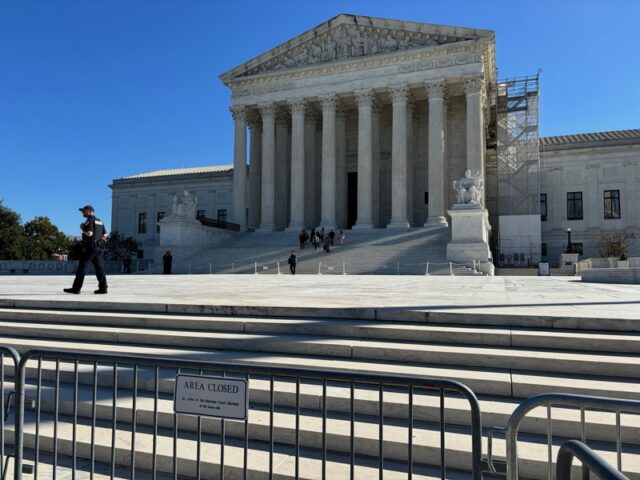
The Supreme Court hears arguments Tuesday on whether the Labor Department can order farms to pay money over migrant farmworker conditions without first taking the case to a federal court. The case, Department of Labor v. Sun Valley Orchards, is set for 10 a.m. Eastern.
Sun Valley Orchards is a New Jersey farm that employs workers on H-2A visas, a program for temporary and seasonal agricultural workers. According to the Center Square, the Labor Department accused the farm of failing to provide adequate housing, meals, transportation and work hours to those workers, and assessed hundreds of thousands of dollars in liabilities. The Labor Department and Secretary of Labor Lori Chavez-DeRemer are the ones asking the Supreme Court to decide the case, after it came up through the Third Circuit Court of Appeals.
The justices agreed on April 27 to answer two questions. The first is whether Article III of the Constitution, the part that gives federal courts the job of deciding legal disputes, bars the Labor Department from running its own proceedings to collect money from employers accused of breaking the terms of employment for H-2A workers and for U.S. workers doing similar jobs. The second is whether a federal immigration law, 8 U.S.C. 1188(g)(2), actually gives the department the power to hold those proceedings.
The political news that affects your wallet, your rights and your vote, broken down in plain language. Free in your inbox.
The farm argues the department went beyond its authority by imposing charges without a court proceeding, according to the Center Square. The government argues that having the agency decide these disputes helps make sure employers follow the terms of the program. The Labor Department is part of the Trump administration.
The Labor Department’s opening brief was filed June 18, Sun Valley’s brief followed on July 27 and the department filed a reply on August 26. Many outside groups also filed briefs. A decision is expected in 2027.
The ruling could affect farms across the country that hire immigrant workers, and it could change how workers who say they were shortchanged on housing, pay or hours get a remedy, whether through an agency or a federal court.