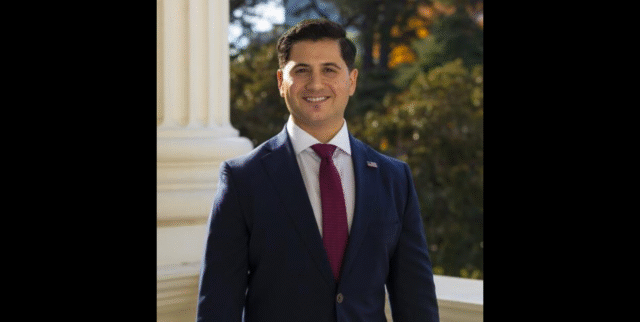
A federal judge ruled Tuesday that Bill Essayli, a Republican former California lawmaker appointed by President Donald Trump’s administration, is unlawfully serving as the top federal prosecutor in Los Angeles, adding to a series of legal challenges over the administration’s efforts to bypass Senate confirmation.
U.S. District Judge J. Michael Seabright wrote that Essayli “is unlawfully serving as a ‘de facto’ United States Attorney.” The order will not take effect until the court rules on the government’s request to pause the decision while it appeals.
Essayli disputed the ruling, arguing that the president and attorney general have the authority to select supervisors within the Justice Department.
“Ultimately, this question will be decided by the Supreme Court, and I look forward to serving in my current role until then,” Essayli said in a statement.
The case centers on the Trump administration’s efforts to retain acting U.S. attorneys beyond the 120-day limit established by federal law. The limit is intended to prevent temporary appointments from becoming a way to avoid the Senate confirmation process required for permanent U.S. attorneys.
Dispute Over Essayli’s Appointment
The Trump administration appointed Essayli last year to serve as acting U.S. attorney for the Central District of California, which includes Los Angeles. Essayli previously served as a federal prosecutor and a Republican member of the California Legislature.
Before his 120-day term expired, then-Attorney General Pam Bondi appointed him first assistant U.S. attorney, a position commonly abbreviated as FAUSA.
In October 2025, Seabright disqualified Essayli from overseeing several criminal cases, concluding that he had continued in the acting U.S. attorney role beyond the period allowed by law. The judge permitted Essayli to remain a first assistant U.S. attorney.
The administration did not appoint another acting U.S. attorney, however, leaving Essayli effectively in charge of the office’s federal prosecutions.
The arrangement came under renewed scrutiny after an August ruling by the 9th U.S. Circuit Court of Appeals in a separate case involving Sigal Chattah, the Trump administration’s initial choice to lead federal prosecutions in Nevada.
The appeals court found that Chattah had been unlawfully appointed to the position. Seabright said Bondi’s appointment of Essayli as a special attorney and his designation as first assistant were identical to the arrangements the appeals court had rejected in Chattah’s case.
Although Attorney General Todd Blanche later issued a revised designation that narrowed some of Essayli’s responsibilities, Seabright said the changes did not materially distinguish the arrangement from the one found improper by the appeals court.
Broader Legal Challenges to Trump’s Prosecutor Appointments
Essayli’s case is part of a broader dispute over the Trump administration’s use of interim U.S. attorneys.
Federal law generally allows an attorney general to appoint an acting U.S. attorney for an initial period of up to 120 days. If the position remains vacant after that period, the law provides a role for the federal district court to appoint an interim prosecutor. The statutory framework has become a point of contention as the administration has sought to keep its preferred candidates in place without securing Senate confirmation.
Courts have challenged similar arrangements elsewhere.
A federal judge in New Jersey disqualified Alina Habba from serving as acting U.S. attorney. In January, another judge ruled that John Sarcone was not lawfully serving as acting U.S. attorney for the Northern District of New York.
The cases raise questions about the limits of executive authority over federal prosecutorial appointments and the role of the Senate and federal courts in filling those positions.
The Justice Department can challenge adverse rulings through the appeals process, and the final legal outcome may depend on how higher courts interpret the relevant appointment statutes.
Essayli’s Role in California Political Disputes
Essayli has become a prominent figure in the administration’s clashes with California officials over immigration enforcement, alleged health care fraud and election administration.
As a state lawmaker, he championed conservative causes and criticized California’s COVID-19 restrictions. He has also opposed state policies designed to protect immigrants living in the country illegally and has pursued criminal cases involving protests against the Trump administration’s expanded immigration enforcement across Southern California.
The federal government has also challenged California over election procedures, including efforts to prevent officials from counting ballots associated with as many as 20,000 people the administration suspects are not U.S. citizens. California has pushed back against those efforts.
The judge’s ruling does not resolve those separate disputes. Instead, it focuses on whether Essayli can lawfully exercise the authority of the district’s top federal prosecutor under the appointment structure used by the administration.
For now, the order’s practical effect remains uncertain because it will not take effect until the court addresses the government’s request for a stay pending appeal.
The case could ultimately reach the Supreme Court, as Essayli has predicted, with broader implications for how presidents appoint and retain interim federal prosecutors when Senate confirmation is not secured.