Poli Alert Politics & Civics
Related Articles


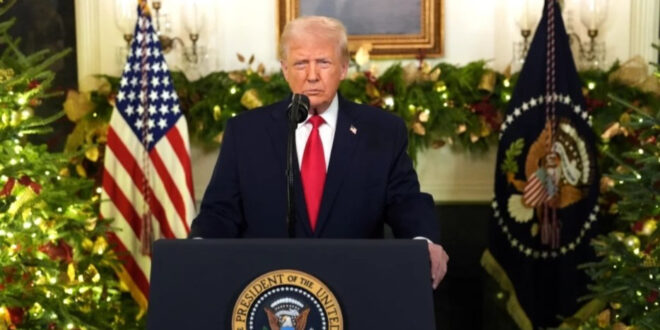
President Donald Trump used an 18-minute prime-time address Wednesday to deliver a rapid-fire review of the first year of his second term, offering sweeping claims about wages, inflation, immigration, energy prices and drug costs. Some of his assertions aligned partially with available data, but others were misleading or plainly incorrect, according to government statistics and independent analyses.
Here we review some of the central claims in Trump’s speech that illustrate how the president blended selective facts with exaggerations as he sought to frame his economic and policy record heading into the second year of his term.
A first-year report card
The address marked Trump’s most comprehensive accounting yet of his second term, coming as inflation has cooled from post-pandemic highs, the labor market has slowed and immigration remains a central political issue. The administration has emphasized price declines in energy and food and has promoted foreign investment pledges as evidence of renewed confidence in the U.S. economy.
Economic progress and disputed claims
Trump presented his administration as having reversed economic decline, strengthened the military and restored border security. While wages have continued to outpace inflation and gasoline prices have declined, multiple claims — including those on immigration numbers, food prices and investment totals — overstated or misstated reality, based on federal data and expert reviews.
Economic claims under scrutiny
Wages and inflation
Trump said wages are rising “much faster than inflation.” Data from the Bureau of Labor Statistics show wages are indeed outpacing inflation, but the margin has narrowed. Wage growth slowed from 4.1% in January to 3.5% by November, while inflation stands at about 3.0% and has risen modestly since spring.
Eggs, turkeys and consumer prices
Trump said egg prices were down 82% since March and that Thanksgiving turkey prices fell 33% from last year. Both figures are inaccurate. Government data show egg prices declined about 44% over that period, while turkey prices fell by roughly 3.7%, according to the Wells Fargo Agri-Foods Institute. Overall Thanksgiving meal costs dropped about 2% to 3%.
Gasoline prices
Trump’s claim that gasoline has fallen sharply is broadly accurate, but his figures were overstated. National averages remain near $2.90 a gallon, according to AAA and the Energy Information Administration. Prices near $1.99 exist at only a handful of stations nationwide.
Immigration and labor force assertions
Trump repeated a long-standing claim that 25 million people “invaded” the U.S. under former President Joe Biden. Customs and Border Protection data show about 7.4 million undocumented crossings outside legal checkpoints during the Biden administration, rising to roughly 10.2 million when including certain legal entry categories — far below Trump’s figure.
Trump also claimed that all net job creation under Biden went to “foreign migrants” and that all job gains under his presidency have gone to native-born workers. Labor economists note such comparisons are misleading, relying on population estimates rather than direct job counts. Unemployment rates show foreign-born workers have seen slightly better outcomes than native-born workers over the past year.
Government response: Investment and drug pricing
Trump said he secured $18 trillion in investment commitments. The White House’s own website lists about $9.6 trillion, and outside analyses put the figure closer to $7 trillion, much of it based on nonbinding pledges.
On prescription drugs, Trump claimed price cuts of 400% to 600%. No announced agreements approach those levels. Drugmakers including Pfizer and Novo Nordisk cited average reductions closer to 40%–50%, often contingent on future platforms or unresolved terms. Experts say there is limited evidence so far that consumers have seen major savings.
Broader context: Tariffs and trade-offs
Trump’s push to lower drug prices has coincided with higher tariffs on pharmaceutical imports from Europe, complicating claims of across-the-board savings. While a recent deal restored tariff-free imports from the U.K., many European Union drug imports still face tariffs of up to 15%, potentially offsetting negotiated discounts.
With additional inflation data set to be released following delays caused by the government shutdown, economists say a clearer picture of price trends will emerge in the coming months. Lawmakers from both parties are also pressing for greater transparency on foreign investment pledges and drug pricing agreements as Trump continues to frame his second term as an economic reset.