Poli Alert Politics & Civics
Related Articles


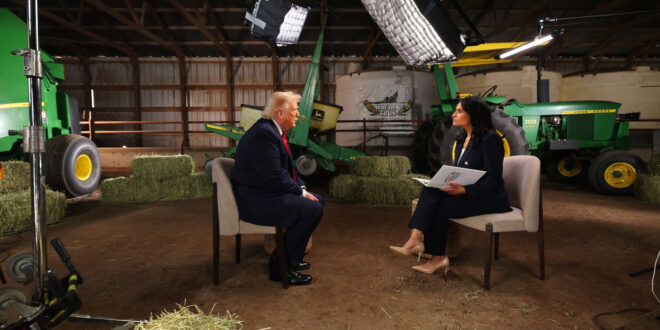
President Donald Trump defended his handling of the Iran conflict, the Jan. 6 Capitol riot and his administration’s controversial “anti-weaponization” fund during a wide-ranging interview with NBC News’ Kristen Welker on “Meet the Press.” But several of the president’s statements conflicted with intelligence assessments, government reports and publicly available evidence.
The interview, which aired Sunday, touched on the war with Iran, rising gas prices, California’s election system and the administration’s plans to compensate people who say they were unfairly targeted by federal investigations.
Trump overstates Iran threat and military success
Trump argued that his decision to strike Iran’s nuclear facilities prevented Tehran from obtaining a nuclear weapon and potentially launching a catastrophic attack.
He claimed Iran would already possess a nuclear weapon if not for U.S. military action and said American strikes had “totally obliterated” the country’s nuclear program.
However, U.S. intelligence assessments before the strikes concluded that Iran had not made a decision to build a nuclear weapon, despite maintaining a growing stockpile of highly enriched uranium. Subsequent assessments also found that while some nuclear facilities suffered extensive damage, others remained operational.
Trump also claimed Iran’s navy, air force and air defense systems had effectively been eliminated.
Military officials have reported significant damage to Iran’s conventional military capabilities, but analysts say portions of its naval forces — particularly the smaller vessels operated by the Islamic Revolutionary Guard Corps — remain intact and capable of operating in the region.
Campaign pledge contradicted by comments on war
When Welker asked Trump about his campaign promise not to start new wars, the president responded that he never guaranteed there would be no conflicts during his presidency.
Trump repeatedly campaigned in 2024 on promises to avoid new military entanglements and frequently told voters he would end wars rather than begin them. He also pledged during his victory speech that he would not start new wars.
Gas prices unlikely to fall immediately
Trump predicted that gasoline prices would quickly decline if a deal is reached to end the conflict in the Middle East.
Energy industry leaders, however, have warned that disruptions to oil supplies and shipping routes could continue affecting prices for weeks or months even after hostilities end. Analysts have said global inventories would need time to recover before fuel markets fully stabilize.
Questions remain about Jan. 6 compensation plan
The president also defended a proposed $1.8 billion Justice Department fund intended to compensate people who believe they were politically targeted by the federal government.
Asked whether individuals convicted of assaulting police officers during the Jan. 6, 2021 Capitol attack should receive compensation, Trump said he would need to review individual cases.
He also repeated claims that many Jan. 6 defendants pleaded guilty only because they were afraid and suggested some had been encouraged into the Capitol by federal agents.
There is no evidence that FBI agents directed rioters into the Capitol. A Justice Department inspector general report found that FBI informants were present in Washington that day but were not instructed to enter the building or incite the attack.
Trump’s comments also omitted the fact that some of the most serious Jan. 6 convictions involved individuals who assaulted police officers outside the Capitol rather than inside the building. Several defendants received lengthy prison sentences for violent attacks against law enforcement.
Trump revives election fraud claims in California
The president also claimed California’s recent primary elections were “rigged” and suggested the state’s lengthy vote-counting process was evidence of fraud.
Trump did not provide evidence to support those allegations.
California routinely takes longer than many states to finalize election results because the vast majority of voters cast ballots by mail. State law allows ballots postmarked by Election Day to arrive and be counted in the days afterward, extending the counting process.
Election officials and independent experts have repeatedly said there is no evidence of widespread voter fraud in California. Political analysts note that Democratic candidates often gain ground as late-arriving mail ballots are counted because Democratic voters are more likely to vote by mail.
The interview marked the latest instance in which Trump defended his administration’s policies while reviving claims that critics and fact-checkers say are unsupported by available evidence.