


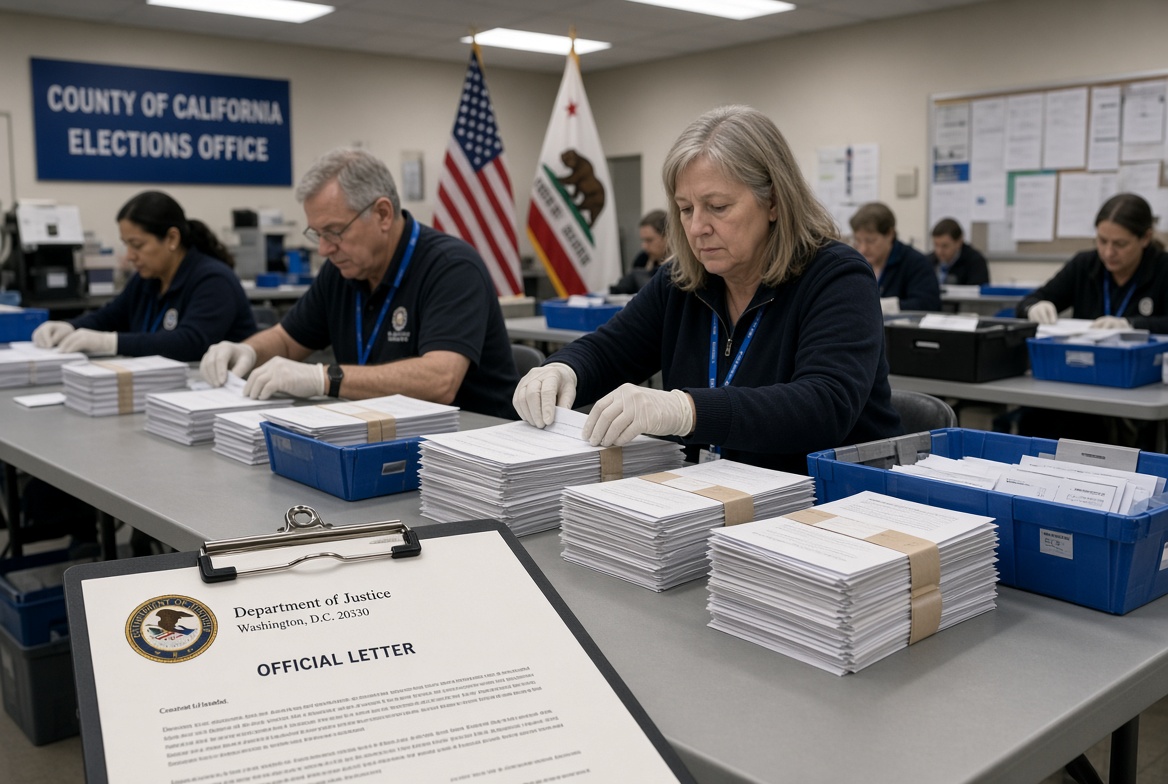
The Justice Department is threatening California election workers with criminal exposure if they count California ballots that the Trump administration has flagged as belonging to noncitizens. On Friday, federal prosecutors sent letters to 57 of the state’s 58 counties. The letters give local election officials 48 hours to commit to helping the federal government figure out who on its list is a citizen and who is not. Los Angeles County was left out of Friday’s batch only because it had received its own letter the week before.
The letters came from the U.S. Attorney’s Office in Los Angeles. In the version sent to San Bernardino County, First Assistant U.S. Attorney Bilal Essayli attached a list of 1,133 people the government calls “likely aliens.” He asked the registrar to work with the DOJ and the Department of Homeland Security (DHS) to check each name. For anyone whose citizenship cannot be confirmed, Essayli told counties to “segregate, not cancel” their mail ballots. Segregating a ballot means pulling it from the pile and holding it uncounted until the voter’s status is settled.
The warning attached to that request is what has election officials alarmed. Essayli wrote that any official who knowingly processes a noncitizen’s ballot is “opening themselves to legal jeopardy.” The letters also note that a noncitizen voting in a federal election commits a federal crime, and so does anyone who knowingly helps it happen. In plain terms, county workers handling California ballots are being told they could be prosecuted if a name on the government’s list turns out to be ineligible.
The DOJ also wants personal records. Counties were told to hand over the Social Security number, a copy of the state ID, and a copy of the voter registration application for every person on the list.
Friday’s letters escalate a fight that started earlier this month. On October 13, acting Deputy Attorney General Trent McCotter sent letters to Secretary of State Shirley Weber and Los Angeles County Registrar Dean Logan. He demanded that they review a list of names within 48 hours and set aside ballots from anyone they could not confirm. Weber refused, telling the federal government that voting was already underway. Two days later, the administration sued California, asking a federal court to block the state from counting roughly 20,000 California ballots it claims went to likely noncitizens.
That 20,000 figure is the administration’s number, and state officials say they have never been shown how it was built. Weber has said she would welcome the chance to review real evidence and the methodology behind it, but the federal government has not provided either. She has also pointed to court findings that federal citizenship records are unreliable. Those databases can lag behind people who became naturalized citizens, which is one way an eligible voter could end up on a list like this.
Attorney General Rob Bonta has been blunter. In a court filing, he called the lawsuit a reckless political stunt and wrote that DHS has offered no evidence to support its claims that noncitizens may be registered in the state. Federal officials have announced charges against 28 people accused of illegally registering and, in some cases, voting in California elections. Bonta pointed out that the number is a tiny sliver of the state’s 23 million registered voters, and he has said he expects the case to be thrown out.
The administration’s push goes back to July. That month, Homeland Security Secretary Markwayne Mullin sent letters to California, Nevada, New Jersey and Pennsylvania alleging that as many as 250,000 noncitizens were registered across those four states. Weber and other election officials questioned that claim at the time.
Local clerks are now caught between the state and the federal government. Santa Cruz County Clerk Tricia Webber leads the California Association of Clerks and Election Officials. She called the 48 hour deadline in the earlier round of letters completely unreasonable, and members of her association spent Friday working out how to respond to the new one.
What the DOJ is asking for also runs into a practical problem. California mails a ballot to every registered voter, and counties began sending them out earlier this month. When a returned ballot arrives, election workers first check the signature on the envelope against the voter’s file. After that, the ballot is separated from its envelope and counted with everyone else’s. State lawyers have told the court there is no way to pull a specific person’s vote back out of California ballots that have already been processed. They also argued that the demands threaten to delay certification, the official sign off on election results.
The court fight is moving quickly. A federal appeals court ordered California to respond to the DOJ’s emergency request by noon Saturday. Essayli has described the request as modest, saying the government only wants the state to sequester the flagged ballots. Election Day is November 3.
