Poli Alert Politics & Civics
Related Articles



Members of Congress sharply criticized the Justice Department on Thursday after reports that officials were tracking lawmakers’ search activity as they reviewed unredacted Jeffrey Epstein files on department computers.
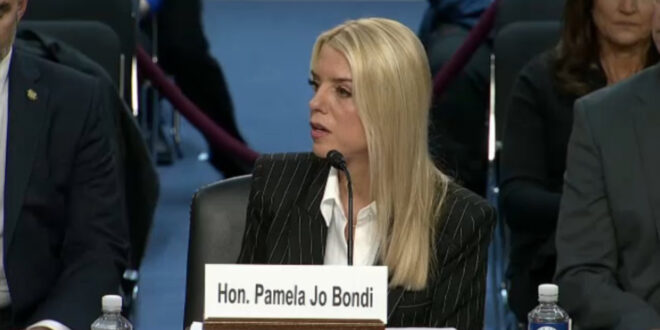
The controversy erupted after a Reuters photograph captured Attorney General Pam Bondi at a House Judiciary Committee hearing holding a document labeled “Jayapal Pramila Search History.” The document appeared to list specific Epstein files accessed by Rep. Pramila Jayapal, D-Wash., during her review.
The Justice Department began allowing lawmakers this week to view unredacted Epstein records in person at DOJ headquarters. In a letter to Congress, the department said it “will keep a log of the dates and times of all members’ reviews.”
A DOJ spokesperson said logging searches is standard practice.
“DOJ has extended Congress the opportunity to review unredacted documents in the Epstein files. As a part of that review, DOJ logs all searches made on its systems to protect against the release of victim information,” the spokesperson said.
‘Spying on members’
Jayapal called the tracking “totally inappropriate” and said it violated separation of powers principles.
“Bondi showed up today with a burn book that held a printed search history of exactly what emails I searched,” Jayapal wrote on X. “That is outrageous and I intend to pursue this and stop this spying on members.”
She said that she confirmed with House Speaker Mike Johnson, R-La., that the document reflected her search history and called the monitoring unacceptable.
In an NPR interview published Thursday, Jayapal said she believes there is bipartisan agreement that lawmakers should be able to review the files without being surveilled.
Johnson said he did not believe it was appropriate to track lawmakers’ searches.
“My understanding is that there are computers set up where the DOJ was allowing access to the files, and I think members should obviously have the right to peruse those at their own speed and with their own discretion,” Johnson told reporters. “And I don’t think it’s appropriate for anybody to be tracking that.”
He suggested the situation may have been an oversight and said he would raise concerns with the department.
Rep. Jamie Raskin of Maryland, the top Democrat on the House Judiciary Committee, accused Bondi and DOJ officials of “spying on Members of Congress conducting oversight” and demanded that the department “immediately cease tracking any Members’ searches.” He said he would request that the DOJ inspector general open an inquiry.
Bipartisan concern
Criticism was not limited to Democrats.
Rep. Nancy Mace, R-S.C., who has been vocal about transparency surrounding the Epstein files, said DOJ personnel monitored lawmakers during their review sessions.
“There is someone or two people from the DOJ monitoring you as you sit on those computers,” Mace said in an NPR interview. “They are tracking all of the documents that members of Congress open, and they’re tracking everything that you do in that room.”
Rep. Jared Moskowitz, D-Fla., called it “suspicious” that each member was required to log in using unique credentials and said lawmakers should have been informed if their activity would be tracked.
“To do it secretly is problematic,” he told reporters.
Ongoing scrutiny
The dispute adds to mounting criticism over the Justice Department’s handling of Epstein-related records. At Wednesday’s Judiciary Committee oversight hearing, Bondi faced bipartisan questioning about redactions and the disclosure of survivors’ information.
The DOJ maintains that logging access to sensitive materials is necessary to prevent the improper release of victim information. Lawmakers, however, argue that tracking individual searches during a congressional oversight review raises constitutional concerns and could chill legislative inquiry.
It remains unclear whether the Justice Department will alter its procedures as scrutiny intensifies.