


Zachary Roth
There’s a growing feeling, among both experts and ordinary Americans, that our democracy isn’t functioning well — and even that it’s under threat.
“American democracy is cracking,” the Washington Post reported August 18.
“I’m terrified,” one democracy expert told the paper. “I think we are in bad shape, and I don’t know a way out.”
Forty-nine percent of respondents to a recent Associated Press poll said U.S. democracy isn’t working well, and 56% said the Republican party is doing a bad job of upholding democracy. For the Democratic party, the figure was 47%.
And just 16% of respondents to a 2022 CNN poll said they were very confident that U.S. election results reflected the will of the people.
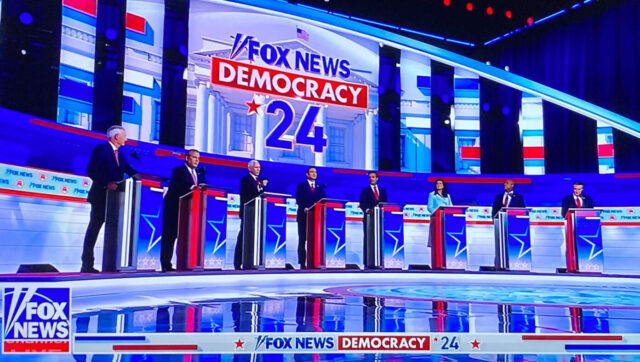
But viewers of Wednesday night’s GOP primary presidential debate on Fox News wouldn’t have guessed any of this.
Though the network’s on-screen banner and backdrop read “Fox News Democracy 24,” the eight candidates onstage weren’t asked about elections, voting, or democracy throughout the two-hour production. Former President Donald Trump, the front runner, refused to participate and opted for a separate online interview with fired Fox News host Tucker Carlson.
The debate moderators, Fox’s Brett Baier and Martha MacCallum, did find time to get the candidates’ views not only on the economy, education, immigration, and the war in Ukraine, but also about transgender girls playing high school sports and even the evidence for UFOs.
The debate did touch on a few issues that have implications for democracy.
Both entrepreneur Vivek Ramaswamy and Sen. Tim Scott, R-S.C., railed against what they called the “weaponization” of the Department of Justice for prosecuting Trump over his attempt to stay in power after losing the election, and his effort to hold onto classified government documents after he left office.
And several candidates, including Scott, former New Jersey Gov. Chris Christie, former U.N. ambassador Nikki Haley, and (grudgingly) Florida Gov. Ron DeSantis said when asked by the moderators that former Vice President Mike Pence, another candidate on stage, did the right thing when he resisted Trump’s pressure not to certify the 2020 results.
“Mike Pence stood for the Constitution,” said Christie. “And he deserves not grudging credit, he deserves our thanks as Americans for putting his oath of office and the Constitution of the United States before personal, political, and unfair pressure.”
But there was no discussion at all of elections or voting policy. That omission was all the more noticeable because, on the state level, the last two-and-a-half years have seen a rush to pass lawsthat make major changes to the election process — often, on the GOP side, the result of intense pressure from party activists and voters, who believed Trump’s lies about fraud in the 2020 election and demanded that lawmakers tighten the rules.
Many of these new measures, which have overhauled everything from how votes are cast to how they’re counted to how elections offices are funded, were drafted with help from the growing network of Washington-based think tanks and advocacy groups focused on election issues, several featuring high-profile GOP former elected officials.
And last month, U.S. House Republicans used a public hearing in Atlanta to release a sweeping 224-page elections bill which Democrats called the most restrictive in decades. That legislation was passed 8-4 by the U.S. House Administration Committee in July but has not yet received a vote in the full House.
One possible reason that elections policy was absent entirely from Wednesday night’s debate: In April, Fox News paid over $787 million to settle a defamation lawsuit filed by the voting machine company Dominion, in connection with the broadcaster’s promotion of lies about the 2020 election. Since then the network has mostly steered clear of the issue.
While the moderators asked the questions, any of the candidates could have chosen to bring up elections issues on their own, but didn’t.
And that choice may reflect a new reality about the politics of the issue: Though Republican voters strongly support stricter voting rules, after Jan. 6 the anti-voter-fraud crusade that Trump sought to lead has perhaps become too controversial for presidential candidates to put at the center of their pitch to voters.
Of course, it’s a long campaign, and the candidates will have a second chance to talk to voters about democracy when they debate again on Sept. 27 at the Ronald Reagan Presidential Library in California.
