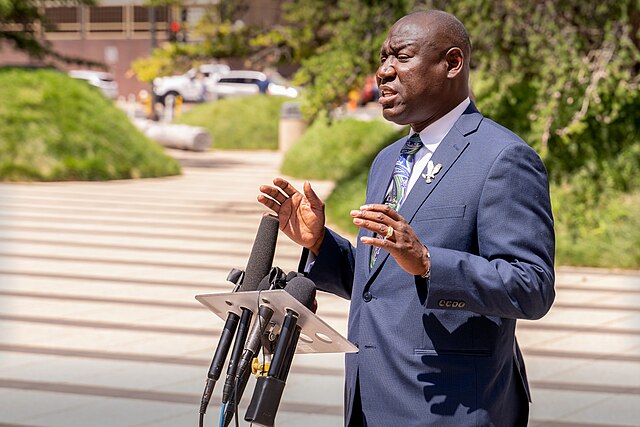
In Ben Crump’s new legal thriller, November 4, 2008, was supposed to symbolize progress. America elected its first Black president. The country talked about change. History was made.
In Worse Than a Lie, that same night becomes something else. A Black man is shot ten times during a traffic stop, and his story is rewritten before the truth has a chance to surface.
That contrast is deliberate.
The political news that affects your wallet, your rights and your vote, broken down in plain language. Free in your inbox.
In his debut novel, civil rights Attorney Benjamin Crump introduces Hollis Montrose, a fifty-three-year-old Black former police officer gunned down by four white men after a stop gone wrong. Hollis survives. But survival is not justice. The system moves quickly. A narrative forms. Law enforcement positions itself. Hollis, not the shooters, faces prison with excessive bail.
The central question is not only what happened.
It is who controls what happened.
That question feels less fictional than familiar.
Crump is not a casual observer of systemic distortion. He is one of the nation’s most prominent civil rights attorneys, widely referred to as “Black America’s Attorney General” for his role in shaping public understanding of police violence and racial injustice. He has represented the families of Trayvon Martin, Michael Brown, Breonna Taylor, Ahmaud Arbery, and George Floyd, using legal advocacy and public pressure to demand accountability.
Listed among TIME’s 100 Most Influential People, Ebony’s Power 100 Most Influential African Americans, and The National Trial Lawyers Top 100 Lawyers, Crump’s influence extends far beyond the courtroom. His work has helped shape national conversations on excessive force, systemic bias, and civil rights reform. When he writes about distorted narratives and institutional self-preservation, he writes from lived experience.
That background matters because Worse Than a Lie is not a routine crime thriller. It is a story about narrative power. It is about institutions protecting credibility before confronting the truth. It is about perception hardening into fact before investigations catch up. It is about how fragile justice becomes when systems defend themselves first.
Lee Child calls the novel “a sensationally good crime and legal thriller” that leaves readers breathless with both suspense and fury. That fury is intentional. It is rooted in recognition.
Beau Lee Cooper, the attorney determined to uncover the truth, represents belief in the law as a force for fairness. Inspired by To Kill a Mockingbird and shaped by his upbringing in 1970s Texas, Beau believes justice is worth fighting for. But belief collides with resistance when power is forced to account for itself. As he digs deeper into Hollis’s case, the story exposes what many Americans understand. Uncovering the truth inside entrenched systems is rarely simple or welcome.
The title carries weight.
A lie is destructive. Something worse suggests distortion with structure. Narratives shaped not by mistake but by preservation. When truth becomes secondary to institutional protection, the damage multiplies. Freedom narrows. Trust erodes. Accountability weakens.
The setting sharpens the tension. America can celebrate milestones while inequities persist beneath the surface. Progress can be symbolic without being structural. The novel does not deny change. It questions whether change guarantees justice.
Don Cheadle calls the book great and gritty. Will Packer places it in the tradition of acclaimed legal thrillers while emphasizing that it carries a voice uniquely Crump’s own. Sunny Hostin describes Beau as a new kind of superhero lawyer. Representative Jasmine Crockett suggests the novel could inspire a generation of civil rights advocates. That praise reflects something larger than entertainment. It reflects cultural impact.
And that is where the book moves beyond genre.
We are living in an era where public statements often precede investigations, narratives form in minutes, and truth competes with spin. In that environment, a story about distorted justice feels diagnostic rather than distant.
Crump understands that justice is defended not only in courtrooms but also in culture. Stories shape expectations. Expectation shapes demand. Demand shapes reform.
Worse Than a Lie is not simply about one traffic stop gone wrong. It is about what happens when truth becomes negotiable.
When truth becomes negotiable, justice becomes conditional.
And once justice is conditional, democracy is strained.
Truth is not optional.
This novel makes that clear.
Political Analyst Tezlyn Figaro
@tezlynfigaro