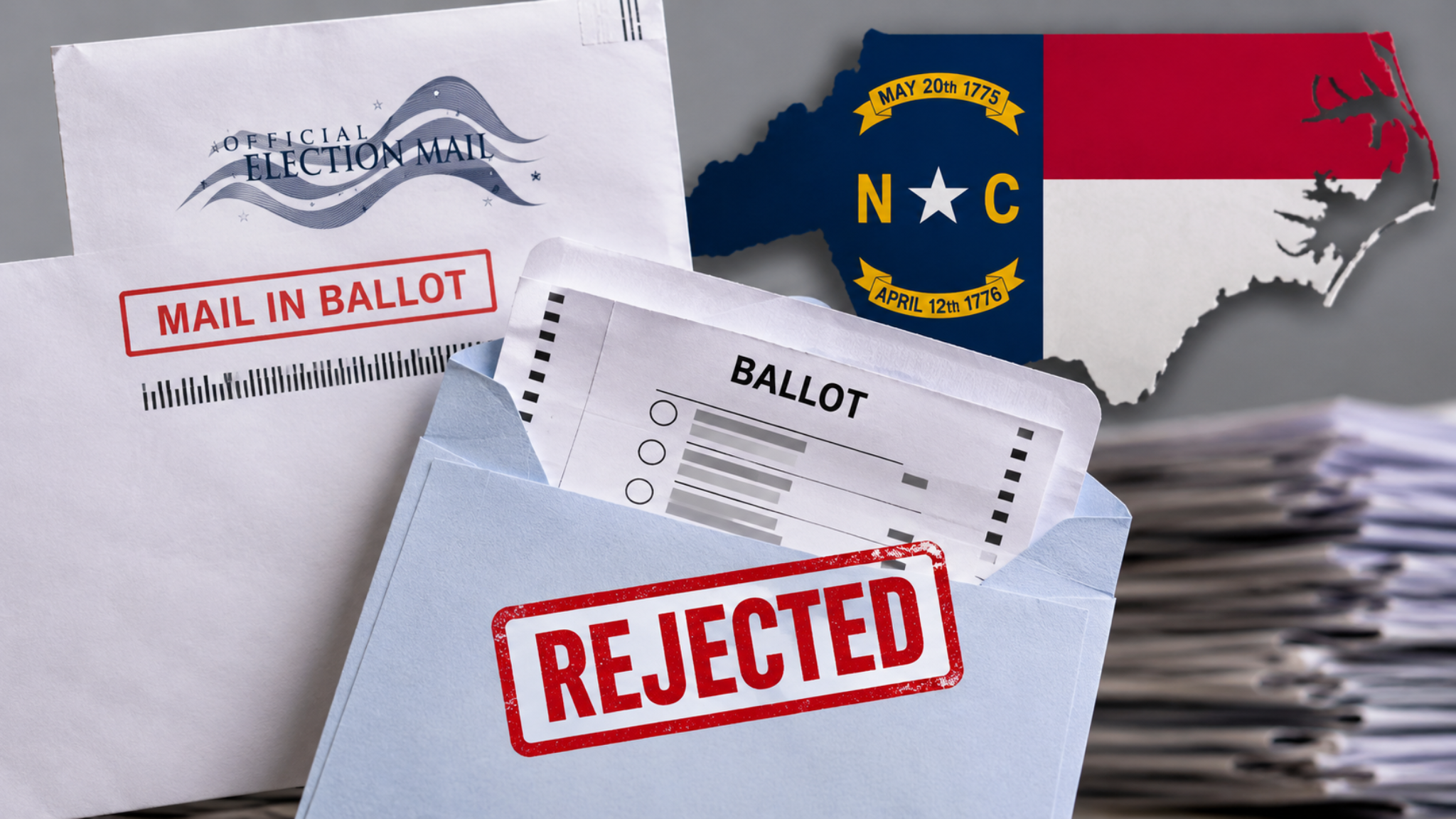
Nearly 6% of North Carolina mail ballots are at risk of not counting in the midterms, driven largely by a new rule that rejects any ballot whose inner envelope arrives unsealed.
That figure comes from newly released statewide data compiled and analyzed by Common Cause North Carolina. It puts the rejection rate at 5.85%, which works out to 3,672 ballots currently flagged as problem ballots. Some of the state’s most rural counties are seeing rejection rates between 16% and 30%. For comparison, North Carolina’s mail ballot rejection rate in the 2022 midterms was 2.2%, and the national rate that year was 1.5%.
“The nearly 6% rate really translates into thousands of ballots that could make the difference in many key races here in the state, local and statewide,” Sailor Jones, Common Cause North Carolina’s state director, told Democracy Docket.
Here’s how the rule works. A North Carolina mail ballot comes with two envelopes. Voters place their completed ballot, along with a copy of their photo ID, in a smaller inner envelope, seal it, and then place that inside an outer envelope. In past elections, if a voter forgot to seal the inner envelope, election officials could still accept the ballot as long as the outer envelope was sealed. That is no longer the case. Under the new guidance, an unsealed inner envelope is treated as a deficiency, and the ballot gets rejected.
The Republican majority State Board of Elections approved the rule in a party line vote. It issued the guidance on September 4, the same day mail ballots started going out to voters. The North Carolina Alliance for Retired Americans and others challenged it in court, but a federal judge declined to block it this close to the election.
The rule is doing most of the damage in the state’s largest counties. In Wake County, unsealed inner envelopes caused 53% of all mail ballot rejections. In Mecklenburg County, nearly 260 ballots had been rejected for the same reason as of last week. Voting advocates say the requirement is especially hard on older voters and people with mobility challenges, who may struggle to get a ballot into the small inner envelope and seal it.
The State Board of Elections defends the rule as a security measure. Board spokesperson Jason Tyson told WFAE it adds a layer of protection against tampering. In theory, he said, someone other than the voter could open the outer envelope, change a ballot sitting in an unsealed inner envelope, and reseal the outer one. When asked for an example of that happening, Tyson did not provide one. The board has also pushed back on the size of the increase, saying earlier this month that its preliminary data showed rejections running about half a percentage point higher than at the same point in 2022. Brooks Fuller, policy director for Common Cause North Carolina, called the rule “a solution in search of a problem.”
Gov. Josh Stein has urged North Carolinians to vote in person if they can, warning that the last minute changes are leading to thousands more mail ballots being rejected.
A flagged ballot is not automatically a lost vote. North Carolina allows voters to fix certain mistakes on mail ballots, a process called curing. When a ballot is rejected for an unsealed inner envelope, the county elections board spoils it and sends the voter a new ballot. The voter can also choose to vote in person instead. Voters can check whether their ballot was accepted or flagged using BallotTrax, the state’s free online ballot tracking tool.
Time is the problem. Jones said that anything after October 30 becomes “purgatory” for fixing these ballots, because voters are relying on the mail to receive a replacement and send it back. Common Cause’s figure counts flagged ballots through the latest data. Any of those that do not get fixed before the deadline will not count.
North Carolina has competitive races up and down the ballot this year, including a hotly contested U.S. Senate race, in a state known for razor thin margins. Election Day is November 3. For anyone still holding a mail ballot, the instruction from election officials and advocates is the same: seal both envelopes, get the witness signature, and check BallotTrax after it’s sent.