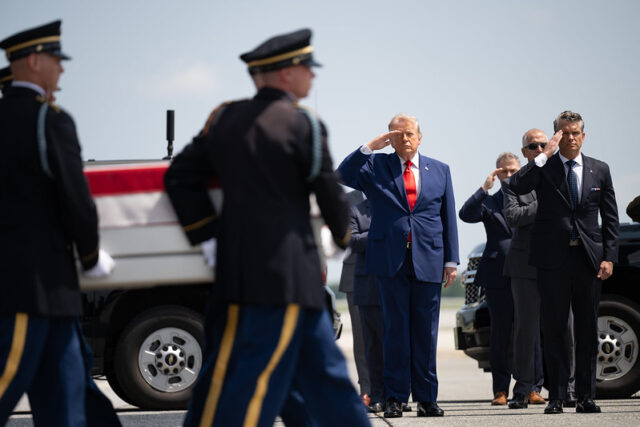
Donald Trump claimed Thursday that no American troops have died in the Iran war over the past five months, despite Pentagon records documenting military fatalities during that period.
During a November 12 interview with conservative radio host Hugh Hewitt, Trump declared that the United States had gone five months without losing a single service member in the conflict.
“Nobody’s been killed in the last five months,” Trump said. “We haven’t lost a soldier in five months.”
The political news that affects your wallet, your rights and your vote, broken down in plain language. Free in your inbox.
But according to The Washington Post, Pentagon casualty records show American service members died in July, September and October, directly contradicting Trump’s account.
The Pentagon has recorded 23 American military deaths associated with operations during the conflict, including 11 attributed to enemy fire and 12 classified as nonhostile deaths. Those figures include deaths outside the five-month period Trump referenced.
The distinction between combat and noncombat fatalities is important when evaluating Trump’s statements. The Pentagon classifies deaths caused by enemy attacks as hostile fatalities, while nonhostile deaths can include accidents, medical emergencies and other incidents not directly caused by enemy action.
Both categories represent American service members who died while serving during military operations.
Among the deaths reported during the period Trump referenced were three American soldiers killed in a July attack on a military installation in Jordan. Additional fatalities were recorded in September and October, according to The Washington Post.
Trump did not qualify his statement by referring exclusively to combat deaths or deaths resulting from direct engagements with Iranian forces. Instead, he repeatedly asserted that no American soldiers had died during the preceding five months.
His broader statement that nobody had been killed also went beyond American military casualties. The Pentagon figures cited by The Washington Post address U.S. service members and do not provide a comprehensive accounting of Iranian military or civilian deaths.
The remarks came as Trump continued to describe the military campaign against Iran as a major American victory, despite the conflict’s continuing consequences.
During the Hewitt interview, Trump also made claims about American control of the Strait of Hormuz, a critical shipping passage connecting the Persian Gulf to international waters. The strait is one of the world’s most important routes for transporting oil, making disruptions there a concern for global energy markets and American consumers.
Trump suggested that the United States maintained the military capability to launch additional strikes against Iran if necessary.
His comments followed a Veterans Day appearance at Arlington National Cemetery on November 11, where he declared that the United States had already won the war but wanted a more decisive outcome.
“We want a total victory, not a 93% victory,” Trump said.
He also expressed hope that the United States would not have to destroy additional targets inside Iran, while suggesting that the decision to end the conflict remained largely in American hands.
The administration’s characterization of the war has drawn attention as lawmakers and the public seek answers about its military objectives, financial costs and human consequences.
Accurate casualty reporting is particularly significant for military families whose loved ones have been deployed during the conflict. Official Defense Department records provide information about service members killed during military operations, including whether their deaths resulted from hostile action.
Congress also has oversight responsibilities concerning American military engagements. Lawmakers can request casualty information, examine military expenditures and question defense officials about the administration’s strategy.
The War Powers Resolution, enacted in 1973, establishes procedures intended to involve Congress in decisions about sending American forces into hostilities. Questions about the legal authority for continued military operations remain separate from the accuracy of the administration’s public statements about casualties.
The Pentagon’s reported casualty figures establish that American service members died during the five-month period Trump described as free of military deaths. However, the available figures do not establish that all 23 reported fatalities occurred within that period.
Trump has not publicly provided evidence supporting his claim that the United States went five months without losing a soldier in the Iran war.
The discrepancy leaves an unresolved question about why Trump’s description of American military losses differs from the casualty information maintained by his own administration.