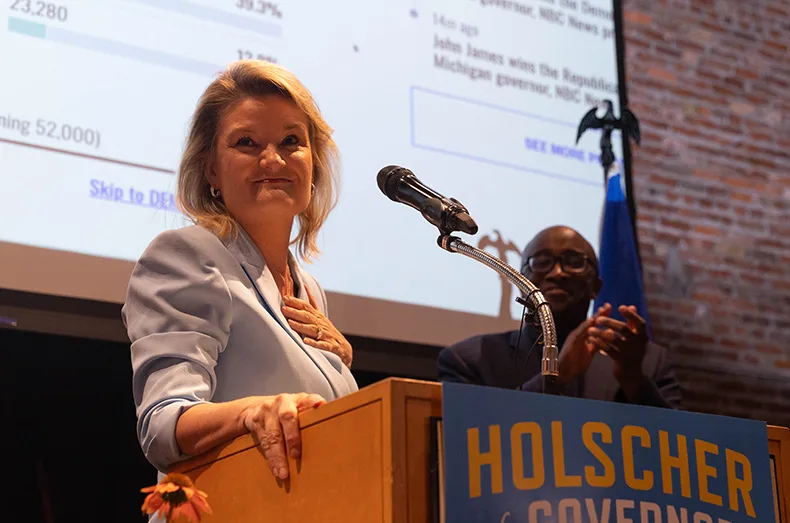
Kansas voters are still waiting for a definitive outcome in one of the country’s most closely watched gubernatorial contests, where Democratic state Sen. Cindy Holscher holds a narrow lead over Republican state Senate President Ty Masterson.
The race to replace outgoing Democratic Gov. Laura Kelly remained uncalled following the November 3 election, with the latest reported vote totals showing Holscher ahead by approximately 7,300 votes.
The contest has drawn national attention because a Republican victory would give the GOP control of both the governor’s office and the Republican-dominated Legislature. A Holscher victory would allow Democrats to retain the governorship in a state that supported President Donald Trump by more than 16 percentage points in 2024.
The political news that affects your wallet, your rights and your vote, broken down in plain language. Free in your inbox.
According to election coverage from Kansas television station KWCH, Holscher maintained her lead as additional ballots were counted through November 6. Neither candidate’s position in the race should be confused with a certified final result.
Holscher’s lead grows as additional votes are counted
The latest available figures, updated November 7, show Holscher with approximately 551,243 votes compared with 543,599 for Masterson. That gives the Democratic candidate a lead of 7,644 votes in a contest that has attracted more than 1 million voters.
Although the margin has grown since election night, the Associated Press has not declared a winner. The race remains subject to Kansas’ election verification and certification procedures.
Masterson previously said the narrow margin warranted another review of the results, emphasizing that voters deserved confidence in the final count. Holscher, meanwhile, declared victory on November 4 and began discussing the transition into the governor’s office.
The distinction between a candidate claiming victory and election officials certifying the result is important. Kansas must complete its county-level canvassing and statewide certification process before the outcome becomes official.
Why the race is so important
The election represents a significant test of the political landscape in Kansas.
Republicans have maintained strong advantages in presidential and legislative elections across much of the state. However, Democrats have periodically won the governor’s office, most recently with Laura Kelly’s victories in 2018 and 2022.
Masterson’s candidacy offered Republicans an opportunity to end that Democratic hold on the governorship and establish unified Republican control of the state’s executive and legislative branches.
Holscher’s lead, meanwhile, has kept Democrats positioned to retain the office despite the state’s Republican-leaning voting history.
The national political environment also added another dimension to the contest. President Donald Trump endorsed Masterson and appeared at campaign events supporting his candidacy. Holscher received Kelly’s endorsement after defeating the governor’s preferred candidate, state Sen. Ethan Corson, in the Democratic primary.
The issues that defined the campaign
Both candidates made affordability and property taxes central issues, but they offered different approaches to addressing Kansas residents’ concerns.
Property taxes and the cost of living: Masterson campaigned on limiting increases in taxable property values and reducing government spending. Holscher also promised property tax relief while emphasizing broader efforts to lower household costs.
Education: Holscher called for fully funding special education and strengthening public schools. Masterson emphasized literacy improvements and pointed to Mississippi’s reading instruction model.
Data center development: Holscher called for a pause on new data center projects, making the issue part of her broader argument about development, energy demands and the interests of Kansas communities.
Health care: Holscher supported expanding Medicaid, a longstanding point of disagreement between Kansas Democrats and the Republican-controlled Legislature.
Recreational marijuana: Holscher also supported legalizing recreational marijuana, an issue that has remained unresolved in the state.
These differences could become particularly consequential if Holscher takes office while Republicans retain control of the Legislature.
What happens next?
The immediate focus is the completion of the election review and the certification process.
Kansas has procedures for reviewing close election results, and Masterson has indicated he wants the count examined before accepting the outcome. A full recount is also possible under state law. The deadline for requesting one is November 17, following county certification.
The state-funded machine recount threshold is a margin of 0.5% or less; a recount outside that threshold may require the requesting candidate to pay the costs.
If Holscher’s victory is ultimately certified, she will become Kansas’ next governor, taking office January 11, 2027. Her victory would also preserve Democratic control of the governor’s office for a third consecutive term.
For now, Kansas remains at the center of the national political conversation as the final results of the 2026 midterm elections continue to take shape.