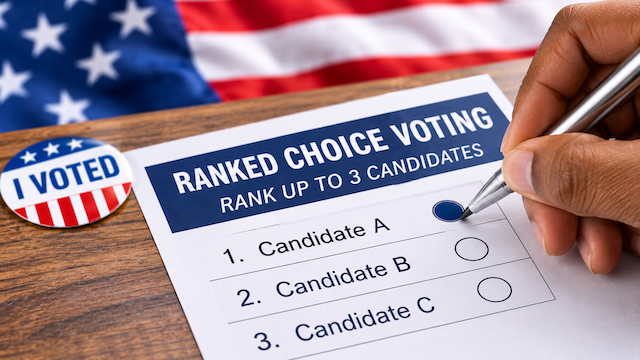
Ranked choice voting is a way of voting where you rank candidates in order of preference, and if no one wins a majority of first choices, the candidate with the fewest votes is dropped and those ballots count for the next choice on each one.
In most American elections you pick one candidate, and the person with the most votes wins, even if that is well short of half. That system is called plurality voting. Ranked choice voting changes the question on the ballot. Instead of marking one name, you can mark a first choice, a second choice, a third choice and so on. The number of rankings allowed depends on the rules where you live. DC, for example, lets voters rank up to five candidates in its November election, WJLA reported.
Here is how the count works. Election officials first tally every voter’s first choice. If one candidate has more than half of the ballots, that candidate wins and the count stops. If nobody does, the candidate with the fewest first choice votes is eliminated. Each ballot that listed that candidate first is not thrown out. It moves to whichever candidate that voter ranked second. The totals are tallied again, and the process repeats, one elimination at a time, until a candidate crosses the majority line. Because the count happens in rounds, it is sometimes called an instant runoff, since it produces the result of a runoff election without asking voters to come back for a second Election Day.
The political news that affects your wallet, your rights and your vote, broken down in plain language. Free in your inbox.
A ballot can run out. If every candidate you ranked has been eliminated, your ballot has nothing left to move to and stops counting in later rounds. That is one reason many election offices encourage voters to rank as many candidates as the ballot allows, though ranking is optional and a vote for just one candidate is still a valid vote. Ranking a second choice never hurts your first choice. Your second choice is only looked at after your first choice has been eliminated.
A real example comes from Alaska. In August 2022, Alaska used ranked choice voting in a special election for its seat in the U.S. House of Representatives. No candidate reached a majority in the first round, so the third place finisher was eliminated and those ballots were redistributed to the voters’ next choices. Mary Peltola finished first after the redistribution and won the seat. Maine has used ranked choice voting for federal elections since 2018, and New York City uses it in its primary and special elections for city offices. Other places use it for some or all of their local races, and the rules differ from one place to the next.
Because the rules are set by states and cities, the details can vary. Some places use ranked choice voting only in primaries, some only in general elections, and some cap the number of rankings at three or five. The state or local election office is the place to confirm exactly how a ballot works where you vote, including how to fill it out so it counts.
For everyday voters, the biggest change is at the ballot box and after it. The ballot may look like a grid, with a row for each candidate and a column for each ranking, and marking two candidates in the same column or the same candidate twice can cause part of the ballot to be set aside. Counting can also take longer than in a single choice contest, since officials may need to run several rounds, and in some places the rounds are run only after all ballots are in. A candidate who leads on election night can lose once later rounds are tallied, so the first numbers reported are not always the final answer. Official results are final only after election officials certify them.