

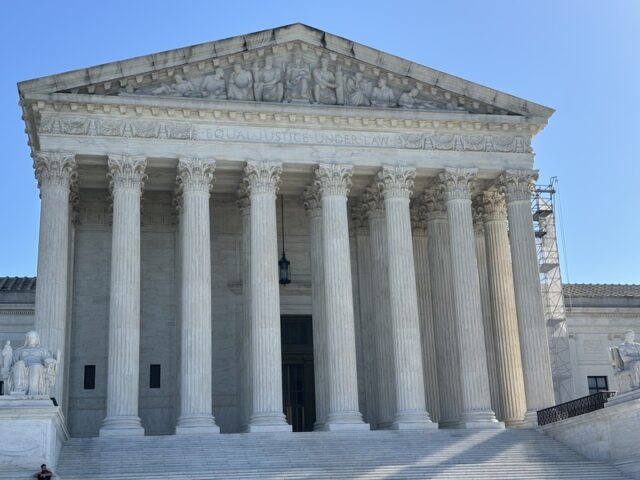
A Supreme Court oral argument is the one public hearing where lawyers for each side of a case stand before the nine justices, explain why they should win, and answer the justices’ questions.
The Supreme Court does not hold trials. There are no witnesses, no jury and no new evidence. By the time a case reaches the court, the facts have already been sorted out by lower courts. What the justices decide is a question of law, such as what a federal statute means or whether a government action fits the Constitution. Oral argument is their chance to test each side’s reasoning out loud.
Most of the work happens on paper first. Each side files a written brief laying out its arguments. Outside groups, states and the federal government often file their own briefs too, called friend of the court briefs, to share their view. The justices and their law clerks read these before argument day, so the hearing is not a speech for people who know nothing about the case. It is closer to a tough job interview for an idea.
The political news that affects your wallet, your rights and your vote, broken down in plain language. Free in your inbox.
The court hears arguments in sessions from October through April, usually on Mondays, Tuesdays and Wednesdays. Court convenes at 10 a.m. Each case typically gets about an hour total, split between the two sides. The side that lost in the lower court, called the petitioner, goes first. The side that won below, called the respondent, goes second. The petitioner then gets a short rebuttal at the end. When the federal government has a stake in a case, a lawyer from the Office of the Solicitor General, the Justice Department office that represents the United States before the court, often argues as well.
Lawyers rarely get far into their prepared remarks. The justices interrupt often, asking about hypothetical situations, pressing on weak spots, and sometimes speaking to each other through their questions. After the open questioning, the chief justice gives each justice a turn, in order of seniority, to ask anything more. Observers watch every Supreme Court oral argument closely for hints about how a justice is leaning, but questions do not always predict a vote. A justice may push hard on the side he or she plans to support, just to see if the argument holds up.
Cameras are not allowed in the courtroom. Since 2020, though, the court has streamed live audio of arguments, and recordings and written transcripts are posted on the court’s website, supremecourt.gov, so anyone can listen.
A few days after a case is argued, the justices meet in a private conference with no staff in the room. They discuss the case and take a first vote. If the chief justice is in the majority, he decides who writes the main opinion. If not, the most senior justice in the majority makes that choice. Drafts then circulate for weeks or months, and justices can change their minds before the decision is final. Justices who disagree can write dissents, and those who agree with the result for different reasons can write concurring opinions. Decisions in argued cases usually come out by the end of June or early July.
Here is a real example. The court has scheduled a Supreme Court oral argument for Dec 8, 2026, in a case brought by the Republican National Committee against the voting rights group Mi Familia Vota. The case asks how far Arizona can go in requiring people to show proof of citizenship when they register to vote, under the National Voter Registration Act, a 1993 federal law that sets rules for voter sign ups. Lawyers for each side will get their time at the lectern to persuade the justices, and the ruling that follows will shape what voters in many states have to show to get on the rolls.
Oral argument matters to everyday life because the cases heard there touch nearly everything: how you vote, what your job can require of you, what police can search, what schools can teach and what health care you can get. Rulings from the Supreme Court apply nationwide, and they often stand for decades. Listening to a Supreme Court oral argument is one of the few ways ordinary people can hear, in real time, how the most powerful court in the country thinks through the questions that end up shaping their lives.