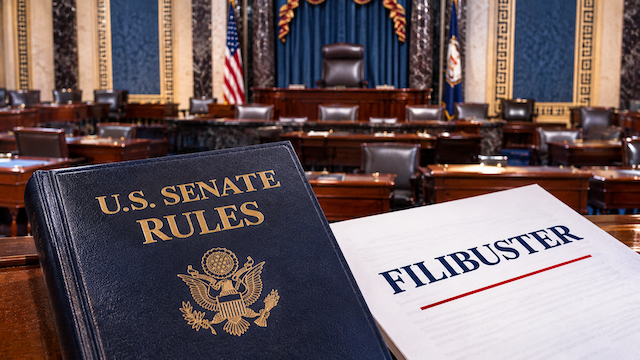
The Senate filibuster is not a federal law, is not required by the U.S. Constitution and can be changed by senators without approval from the House of Representatives or the White House. Yet the procedural rule remains one of the biggest obstacles to passing legislation in Congress, allowing a minority of senators to prevent bills from reaching a final vote.
The filibuster is a Senate procedure that allows lawmakers to delay or block action on legislation by extending debate or threatening to do so. Under current Senate rules, ending debate on most legislation requires 60 votes, even though passing the legislation itself generally requires only a simple majority.
That means a bill could have the support of 59 senators and still fail to advance because opponents refuse to allow debate to end.
The political news that affects your wallet, your rights and your vote, broken down in plain language. Free in your inbox.
But the 60-vote requirement is not written into the Constitution.
The Constitution generally allows each chamber of Congress to establish its own rules and requires a supermajority only for certain actions, such as overriding a presidential veto, convicting an official in an impeachment trial and approving treaties in the Senate.
For most ordinary legislation, a simple majority is sufficient for final passage once the Senate reaches a vote.
The filibuster creates an additional procedural obstacle before that vote can happen.
The Senate did not always operate under the modern filibuster system. In 1806, senators eliminated a procedural mechanism that had allowed a simple majority to cut off debate. That change eventually made prolonged debate possible, although the filibuster did not immediately become the routine legislative weapon it is today.
In 1917, the Senate adopted a procedure known as cloture, which allows senators to end debate. Initially, invoking cloture required a two-thirds majority of senators present and voting.
In 1975, the Senate lowered the threshold for ending debate on most matters to three-fifths of all senators duly chosen and sworn, ordinarily 60 votes in a full Senate.
The result is the system Americans recognize today, where most major legislation effectively needs support from 60 senators to overcome a filibuster.
However, not every Senate action is subject to that requirement.
Federal judicial nominees and executive branch nominees generally can advance with a simple majority. In 2013, Senate Democrats established a precedent allowing most presidential nominations to move forward without the traditional 60-vote threshold. In 2017, Senate Republicans extended that precedent to Supreme Court nominations.
Both changes were accomplished without passing a federal law.
The Senate also uses a process called budget reconciliation, which allows certain legislation involving federal spending, revenues and debt limits to pass with a simple majority under special procedures.
These exceptions demonstrate that the filibuster is not an unavoidable requirement of American government.
The Senate has already changed how the filibuster operates, and it has the institutional authority to do so again.
One method involves changing Senate precedent through a maneuver commonly called the nuclear option.
Under this approach, senators can establish a new interpretation of Senate procedure through a majority vote, even when the written rules would otherwise impose a higher threshold.
This is different from formally rewriting the Senate’s standing rules, a process that can itself face a filibuster. Under Rule XXII, ending debate on a proposal to change Senate rules generally requires the support of two-thirds of senators present and voting.
The distinction explains why senators seeking to weaken or eliminate the legislative filibuster often discuss changing Senate precedent rather than attempting a conventional rules amendment.
The filibuster also has a significant history in the struggle for civil rights.
For decades, Southern senators used extended debate and other parliamentary tactics to obstruct federal legislation intended to protect Black Americans from racial discrimination, segregation and racial violence.
Anti-lynching legislation repeatedly encountered resistance in the Senate, despite efforts to establish federal protections against mob violence.
In 1964, senators opposing the Civil Rights Act mounted a lengthy filibuster against the legislation. After weeks of debate, the Senate voted 71 to 29 to invoke cloture, allowing the bill to move toward final passage.
The Civil Rights Act of 1964 ultimately prohibited discrimination in public accommodations and employment, among other major protections.
The historical use of the filibuster against civil rights legislation remains central to contemporary debates over voting rights and federal protections against discrimination.
Proposals to strengthen voting rights, including legislation addressing voting access and congressional redistricting, have encountered the 60-vote barrier in recent years.
In January 2022, Senate Democrats attempted to change filibuster procedures to advance voting rights legislation. The effort failed when Democratic Sens. Joe Manchin of West Virginia and Kyrsten Sinema of Arizona joined Republicans in opposing the proposed rules change.
The Senate subsequently rejected the proposed voting rights legislation.
The debate over the filibuster involves competing views about the role of the Senate.
Lawmakers who favor retaining the legislative filibuster argue that requiring broader agreement encourages compromise and prevents narrow majorities from making sweeping policy changes without bipartisan support.
Lawmakers who favor eliminating or weakening it argue that the 60-vote threshold allows a minority to prevent action on legislation that has enough support to pass.
The consequences extend beyond voting rights.
Legislation addressing the federal minimum wage, labor protections, gun safety, reproductive rights and other major issues can encounter the same procedural obstacle.
Even when one political party controls the White House and both chambers of Congress, a Senate majority may be unable to advance ordinary legislation if it cannot secure enough votes to end debate.
Eliminating the legislative filibuster would not automatically guarantee passage of those bills. Lawmakers would still need sufficient votes for final approval, and legislation would still have to pass the House and satisfy other constitutional requirements.
It would, however, remove the procedural requirement that often prevents the Senate from reaching a final vote.
The filibuster has survived because senators have repeatedly chosen to preserve it, despite making exceptions for nominations and certain budget legislation.
No constitutional amendment is necessary to change that system. No federal statute must be repealed. And no president has the authority to prevent senators from changing their own chamber’s procedures.
The decision rests with the Senate itself.