


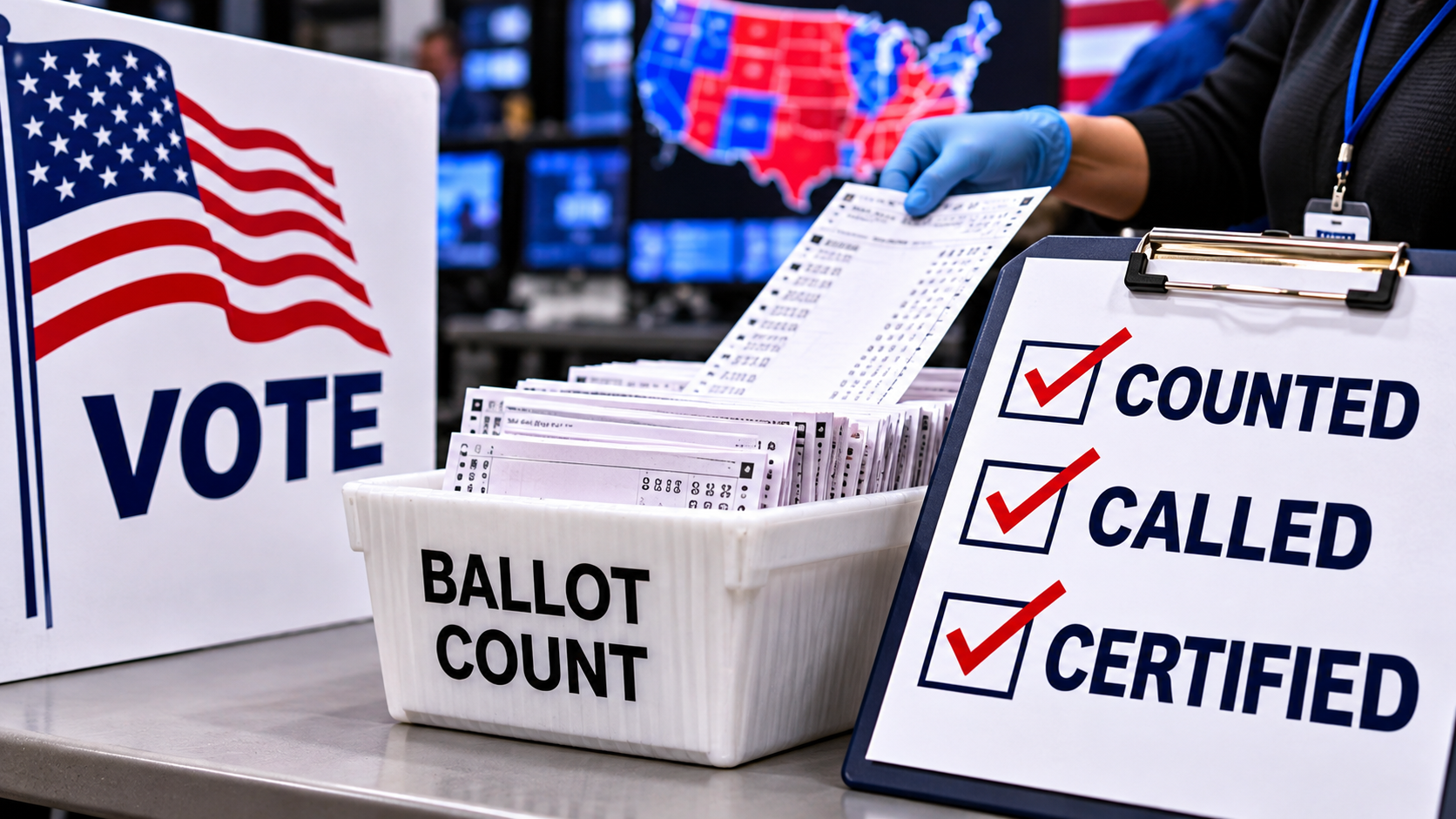
Election results are counted by local election officials, reported as unofficial totals on election night, projected by news organizations once a winner is clear, and made official later through a process called certification.
After polls close, local election officials, usually at the county level, count the ballots cast in person that day along with those cast early or by mail. Each state sets its own rules about when mail and early ballots can be processed and how long after Election Day a mail ballot can arrive and still count. That is why some states report nearly all of their votes within hours while others take days. Totals released on election night are unofficial, meaning they can still change as more ballots are counted and checked.
When people say a race has been called, they mean a news organization has projected the winner. Election officials do not call races. Media outlets and the Associated Press, a news cooperative, study the votes already counted, the votes still outstanding and where those votes are coming from. They announce a winner when they conclude the trailing candidate can no longer catch up. A call is a projection, not a legal result. A candidate may also concede, which means publicly accepting the loss, but a concession does not make a result official either.
The political news that affects your wallet, your rights and your vote, broken down in plain language. Free in your inbox.
The official step begins with the canvass, a review of the count by local officials. They compare the number of ballots with the number of voters recorded, add valid ballots that were not counted on election night, and correct errors. Provisional ballots are one example. A provisional ballot is given to a voter whose eligibility cannot be confirmed at the polling place, and officials check it afterward and count it if the voter qualified. Many states also give voters a short window to fix, or cure, a problem such as a missing signature on a mail ballot.
Once the canvass is finished, local officials certify the results, meaning they sign off that the count is accurate and complete. County results then go to the state, where an official or board, often the secretary of state, certifies the statewide results. Each state sets its own deadlines, and they range from days to weeks. State laws spell out what officials must do and when, and disputes over results are generally taken to courts.
If a race is extremely close, a recount may follow. Some states trigger an automatic recount when the margin falls under a set threshold, and others let a candidate request one. Many states also run post election audits, in which officials check a sample of ballots against the machine count to confirm the totals.
The 2020 presidential race shows the gap between a call and an official result. Election night ended without a projected winner, and news organizations did not project Joe Biden as the winner until Saturday, November 7, four days after Election Day, once enough mail ballots in Pennsylvania had been counted. States then certified their results over the following weeks, and Congress counted the electoral votes on January 6, 2021.
For everyday life, this process explains why the leader on your screen Tuesday night can change by Friday and why a slow count is common. It also means a ballot is still being handled after a voter leaves the polling place. Anyone who voted by mail or provisionally can ask their state or county election office whether the ballot was counted and how to check its status.

