


Candice Norwood
Originally published by The 19th
With the pending Supreme Court retirement of Justice Stephen Breyer, President Joe Biden is poised to make good on his pledge to nominate the first Black woman to the nation’s highest court.
There’s a lot we don’t know: who Biden’s choice will be, the speed at which this whole process will work, or what questions will emerge as senators consider the nomination. But we do know this Supreme Court confirmation will largely work the same as others. Here’s a guide on what to expect and what we’ll be looking at for potential nominees and the months ahead.
What will Biden do next on the nomination?
In a news conference with Breyer on January 27, Biden said he intends to announce his choice for Supreme Court nominee before the end of February, which would set the Senate up to begin hearings before Breyer officially steps down. Breyer’s retirement will take effect when the court recesses in June or July, assuming that his successor has been nominated and confirmed.
At the White House, designated staffers typically handle the recommending and vetting of court nominees, and presidents also consult with senators in their party before announcing the choice.
As of 2017, Supreme Court nominees are confirmed by a simple majority. With the Senate evenly split between the two major parties, getting all the Democrats on board will be crucial for the success of Biden’s nominee.
How does the Senate confirmation process work?
The Senate Judiciary Committee will be charged with collecting documents, records and background information to prepare for one or more days of confirmation hearings.
Senate Majority Leader Chuck Schumer and Senate Judiciary Chairman Dick Durbin have not given an outline of the process for Biden’s first nomination yet. Durbin told NBC’s “Meet the Press” there will be a “timely” confirmation process, though it will depend on who the nominee is.
“If the person has been before the committee seeking approval for a circuit court, then the committee knows quite a bit about that person, and that can be taken into consideration,” he said.
During the proceedings, the nominee will answer questions about their work experiences, judicial record and interpretation of constitutional law. Witnesses both for and against the nominee will also appear. The Judiciary Committee then votes on whether to recommend that the full Senate confirm the nominee, reject them, or proceed with no recommendation either way. The full Senate will then debate the nomination before proceeding to a vote.
The average length of time from nomination to confirmation is a little more than two months, according to the Congressional Research Service. Justice Amy Coney Barrett was confirmed within 27 days of her nomination, making her one of the fastest confirmations.
The short list: What do we know about potential Supreme Court nominees?
In his news conference with Breyer, Biden reiterated his intention to nominate a Black woman to the nation’s highest court.
“I’ve made no decision except one: The person I will nominate will be someone with extraordinary qualifications, character, experience and integrity. And that person will be the first Black woman ever nominated to the United States Supreme Court,” Biden said.
Three names have emerged as the most likely candidates: Ketanji Brown Jackson, Leondra Kruger and J. Michelle Childs.
Jackson, 51, who was confirmed to the U.S. Court of Appeals for the D.C. Circuit in June, is widely considered the front-runner. Before this position she was a federal district judge in Washington, D.C., for eight years. She also served on then-President Barack Obama’s Sentencing Commission from 2010 until 2014 and worked as an assistant federal public defender for two years.
Kruger, 45, is an associate justice with the California Supreme Court who has served in that role since 2014. Prior to that, she worked under the Obama administration as an assistant to the U.S. solicitor general from 2007 until 2013, where she argued 12 cases before the U.S. Supreme Court on behalf of the federal government. She also worked as a deputy assistant attorney general.
Childs, 55, is a federal district judge whose qualifications have been touted by House Majority Whip Jim Clyburn, a powerful Democratic figure in South Carolina politics whose endorsement of Biden during the 2020 presidential campaign helped propel him to victory in the state’s primary. Republican Sen. Lindsey Graham, also of South Carolina, sang Childs’s praises, telling CBS’s “Face the Nation,” “I can’t think of a better person for President Biden to consider to the Supreme Court.” Childs has been a district judge in South Carolina since 2010 and was a state circuit judge from 2006 to 2010.
In recent history, the overwhelming majority of Supreme Court justices have been selected from federal appeals courts, giving Jackson an edge over Kruger and Childs, but there is no requirement for Biden to follow this trend. Other names that have been circulated for the vacancy include Sherrilyn Ifill, the president and director-counsel of the NAACP Legal Defense and Educational Fund Inc., and Melissa Murray, a law professor at New York University.
-
More from The 19th on Biden’s expected nomination
Biden poised to nominate first Black woman to Supreme Court
Biden’s past Black women nominees pave way for a potential Supreme Court pick
What is the significance of nominating a Black woman to the court?
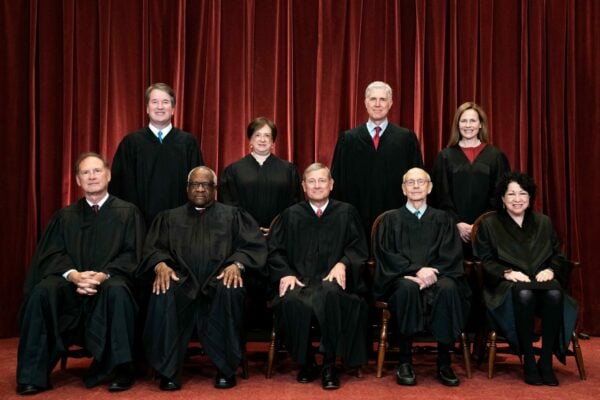
There has never been a Black woman nominated to the Supreme Court. Justice Sonia Sotomayor, a Latina, is the only woman of color to serve on the high court. Justice Clarence Thomas and the former justice Thurgood Marshall, both Black men, are the only other people of color to serve on the court.
The lack of racial and professional diversity on the court has led to growing demands for change. In addition to being overwhelmingly White, justices tend to be Ivy League-educated and former prosecutors or corporate lawyers. Beyond the Supreme Court itself, the traditional pipelines to the court, including prestigious judicial clerkships and federal judicial appointments also lack diversity.
Of the 793 full-time federal judges, 40 are Black women. Biden has made diversifying the federal bench a top priority since he took office. Seventy-eight percent of his confirmed judges so far have been women, and about 57 percent have been people of color, representing the most diverse selection of judicial appointees of any presidency.
What else do we know about Justice Stephen Breyer’s retirement?
Since Biden took office, Justice Stephen Breyer, the court’s oldest justice, has faced unprecedented pressure by lawmakers, activists and members of the public calling for him to retire so that Biden could appoint a new justice as soon as possible. Many feared that without Breyer’s retirement, the court’s next vacancy might occur during a Republican presidency, which would make the court’s conservative super majority even stronger.
In public statements, Breyer initially resisted the political demands for him to step down, but on January 26 news broke that he would indeed retire after 28 years on the court. The next day, Breyer released a letter of resignation and appeared with Biden in a press conference to officially make the announcement.
Amanda Becker contributed reporting.
