


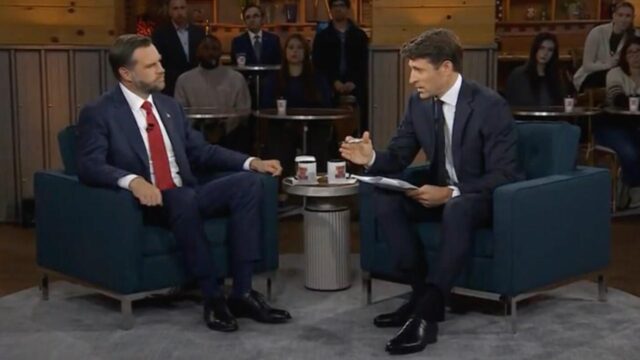
Vice President JD Vance faced a barrage of pointed questions from voters about the Trump administration’s Iran war, rising gasoline prices, immigration enforcement and allegations of corruption during a CBS News town hall that aired Saturday night.
Some questioners said they had voted for President Donald Trump and Vance in 2024 but had grown disillusioned with the administration. Their concerns offered a preview of the political challenges Vance could face if he seeks the Republican presidential nomination in 2028.
Vance acknowledged during the town hall that he might not run for president, saying there was “of course” a chance he would not. But the exchange underscored the difficulty of defending the administration’s policies while voters grapple with the consequences of decisions made in Washington.
One of the most striking moments came when Joey Amor, whose wife, Master Sgt. Nicole Amor, was among six U.S. service members killed in an Iranian drone strike in Kuwait on March 1, questioned Vance about what he called a failure of leadership.
“This literally is the first time I’ve heard of this,” Vance said, appearing surprised by the account. He later acknowledged that military mistakes had occurred and said he wanted to speak with Amor to learn more.
Vance acknowledges military mistakes as gas prices rise
Amor asked what failures led to the deaths of the six service members and how military and administration officials would be held accountable.
Vance said there had been problems with troop positioning that officials subsequently recognized as serious mistakes.
“There were issues with where troops were located that we realized was a huge mistake that we could do better on, and we have changed that,” he said.
Vance also acknowledged that he did not always receive information directly, describing the vice presidency as a position in which officials can become insulated from events outside their immediate circle.
“This job is an amazing honor, but you live in a bit of a bubble and sometimes information doesn’t filter up,” he said.
The exchange came amid broader questions about the administration’s strategy in the war with Iran and the costs of the conflict for Americans.
A Michigan voter who said he supported Trump and Vance in 2024 but now planned to vote for Democratic Senate candidate Abdul El-Sayed challenged the vice president over high gasoline prices associated with the conflict.
Vance conceded that fuel prices were too high and said the administration was working to bring them down. He attributed the increases to instability in the Middle East and accused Iran of threatening global energy supplies.
“We’ve never had a situation like this where you have effectively, the largest state sponsor of terrorism that’s trying to choke off world energy supply,” Vance said.
He did not acknowledge in that response that the crisis followed Trump’s decision to launch the war.
Vance also blamed former President Joe Biden, arguing that the United States had weakened its refining capacity during Biden’s administration. When pressed about the current administration’s responsibility, Vance shifted the discussion toward solutions rather than assigning blame.
“Fundamentally, we are where we are,” he said, asking what El-Sayed would do to address the problem. “It’s easy to criticize something that happened seven months ago.”
Immigration enforcement draws questions from voters
Vance also faced criticism over the administration’s immigration crackdown, including the separation of children from parents detained during enforcement operations.
A nun who spoke about her shared Catholic faith with the vice president questioned whether the administration’s tactics aligned with its stated values.
“We’re trying to strike the right balance,” Vance said.
When CBS moderator Tony Dokoupil asked whether the administration was failing to strike that balance, Vance acknowledged that the issue remained unresolved.
“I think that is constantly a work in progress,” he said.
Vance conceded that some immigration enforcement officers had made mistakes, saying that “sometimes you have some people who really screw up.”
Asked for specific examples, he said the administration had investigated cases that led to additional training or disciplinary action. He added that officials did not always publicize those cases because investigations needed to proceed.
Another voter, who said she immigrated to the United States five years ago and voted for Vance after becoming a citizen, challenged his recent description of H-1B visa holders as “foreign indentured servants.”
She accused him of scapegoating immigrants for problems the administration was supposed to solve.
Vance accepted some responsibility for how he had expressed his position.
“To the extent that my rhetoric has been imperfect here, that’s on me,” he said.
He argued that his criticism was directed at companies that hire foreign workers, rather than the workers themselves.
Vance condemns selling White House access
The town hall also raised questions about whether Trump and members of his administration were using their positions for personal financial gain.
Dokoupil asked Vance about Trump’s cryptocurrency businesses, which a federal filing reportedly showed generated nearly $1.2 billion for the president last year, as well as allegations involving former U.S. Ambassador to Greece Kimberly Guilfoyle.
Guilfoyle resigned amid allegations that she leveraged her position for personal benefits, which she has denied.
Vance said he had never witnessed conduct by Trump that made him uncomfortable and rejected the suggestion that he had seen evidence of corruption by the president or his administration.
He acknowledged reading reports about alleged misconduct but said he had investigated claims himself and concluded they were unfounded.
However, Vance drew a clear line when asked about the possibility of people selling access to the White House for personal gain.
“If somebody’s selling access to the White House, that’s disgusting and despicable and they should suffer consequences,” he said.
His response left open questions about how the administration would address specific allegations involving people connected to the president.
A preview of Vance’s political challenges
The town hall highlighted the range of issues Vance could be forced to defend as the administration approaches the 2026 midterm elections and the next presidential campaign cycle.
Questions about the Iran war and gasoline prices connected foreign policy decisions to household costs. Immigration questions tested the administration’s enforcement agenda against concerns about family separation and the treatment of immigrants. Questions about cryptocurrency profits and access to the White House put the administration’s ethical standards under scrutiny.
For Vance, who has not committed to a 2028 presidential run, the exchanges illustrated the challenge of maintaining support among voters who backed the Republican ticket but are now questioning its decisions.
His answers offered some acknowledgments of mistakes and imperfect rhetoric, while largely defending the administration’s broader approach. Whether those responses satisfy skeptical voters could become an increasingly important political question as the midterms approach.
