Poli Alert Politics & Civics
Related Articles



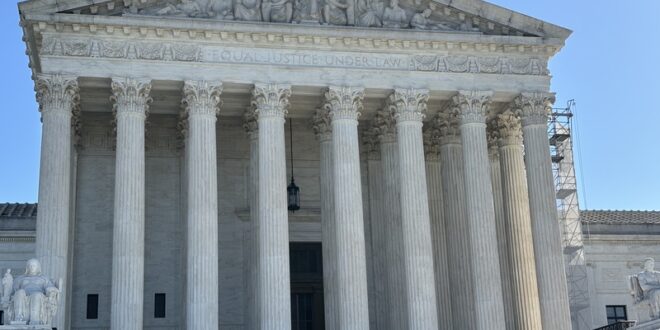
The Supreme Court opens its new term Monday with a docket that could reshape the law on immigration, gun rights, religious freedom and climate liability, while setting the stage for additional fights over President Donald Trump’s agenda and the November midterm elections.
The justices will consider challenges to state bans on AR-15-style rifles, Trump administration policies on immigration detention and deportations, and the ability of religious institutions to participate in public programs. Other disputes involving voting rules, presidential authority and the separation of church and state could reach the court in the months ahead.
The term begins with a major climate case involving efforts by energy companies to block a lawsuit brought by Boulder, Colorado. The outcome could affect dozens of similar cases seeking to hold fossil-fuel companies accountable for climate-related damage.
The court’s decisions will unfold against a consequential political backdrop. The midterms could determine which party controls Congress, potentially shaping the future of the court and the administration’s ability to advance its policies.
Here are five issues to watch.
Trump’s Immigration Crackdown Heads to the High Court
The justices have agreed to review two significant Trump administration immigration policies, setting up potentially far-reaching decisions on the federal government’s deportation and detention powers.
One case concerns the administration’s authority to deport immigrants to countries other than their own, known as third-country removals. The other challenges a policy requiring detention without bond hearings for broad categories of immigrants awaiting removal proceedings.
Both policies are central to Trump’s immigration crackdown. The cases could determine how much discretion the executive branch has to detain and remove noncitizens, as well as what procedural protections immigrants are entitled to.
The court could also consider other disputes involving Trump’s policies, including the administration’s restrictions on transgender military service and its efforts to install U.S. attorneys without Senate confirmation.
Challenges involving the president’s tariffs and renewed efforts to restrict birthright citizenship could also return to the court, although it remains uncertain which additional cases the justices will agree to hear.
Election Fights Could Put Justices at the Center of the Midterms
The November elections will determine control of the House and Senate, but the Supreme Court could also play a role in disputes over voting access and election administration.
The court has already issued consequential rulings involving election rules and voting rights. More challenges could follow as states prepare for the midterms, particularly if close races produce disputes over ballot counting, voter eligibility or election procedures.
Trump has repeatedly alleged widespread voter fraud, claims that have fueled political and legal battles over election administration. Any challenges reaching the Supreme Court would put the justices at the center of another election cycle.
Democratic attorneys general in roughly 20 states have discussed how to respond if federal agents are deployed to polling places or voters are prevented from casting ballots. Such disputes could move quickly through the courts, potentially reaching the Supreme Court on an emergency basis.
The justices’ handling of any election-related cases could have immediate consequences for voters and election officials.
Justices Prepare to Draw a New Line on Assault-Style Rifles
The Supreme Court is preparing to take up a major Second Amendment dispute: whether states can prohibit AR-15-style semiautomatic rifles.
The court agreed to hear challenges involving bans in Illinois and Connecticut. The cases could establish the limits of state authority to restrict firearms that gun-control advocates describe as especially dangerous and gun-rights supporters argue are constitutionally protected.
Connecticut enacted its ban after the 2012 shooting at Sandy Hook Elementary School, where a gunman killed 20 children and six educators.
The cases follow a series of Supreme Court decisions that have expanded protections for gun ownership. In New York State Rifle & Pistol Association v. Bruen in 2022, the court struck down New York’s restrictions on carrying firearms in public and established a historical-tradition test for evaluating gun laws.
The new cases will test how that standard applies to restrictions on particular types of weapons. A ruling against the bans could limit the ability of states to prohibit semiautomatic rifles, while a decision upholding them could preserve a significant tool for gun regulation.
Religious Liberty Faces Another Test in Public Schools
Religious rights will be another major focus, with the court considering disputes over whether religious institutions can be excluded from public programs and how far governments can go in displaying religious material in public schools.
One case, St. Mary Catholic Parish v. Roy, involves a Catholic preschool in Colorado that says it was unfairly excluded from a state-funded prekindergarten program because it does not admit children of gay and transgender parents.
The case could further define when religious organizations can claim exemptions from government requirements while receiving public funding.
The court is also being asked to review a Texas law requiring the Ten Commandments to be displayed in public school classrooms. The dispute could revive a longstanding constitutional debate over religious displays in public schools and the First Amendment’s prohibition of government establishment of religion.
The court’s conservative majority has repeatedly ruled in favor of religious plaintiffs in disputes involving public benefits, religious expression and exemptions from generally applicable rules.
A decision in either case could have implications for schools, religious organizations and state governments nationwide.
Democrats Set Their Sights on a Supreme Court Overhaul
Democrats have advanced proposals to change the Supreme Court’s structure and oversight, including imposing term limits, expanding the number of justices from nine to 13 and establishing an enforceable ethics code.
The proposals reflect longstanding criticism of the court’s decisions and concerns about its ethics rules and public legitimacy. They could become a larger focus if Democrats gain control of Congress in November.
But major structural changes would face steep obstacles. Legislation would need to clear the Senate, where most bills are subject to a 60-vote threshold unless that rule is changed. Expanding the court would also face intense political opposition.
The debate comes as the justices continue to exercise substantial influence over national policy, from presidential power and immigration to guns, voting and religious liberty.
A Term With Consequences Beyond the Courtroom
The Supreme Court’s docket is likely to grow as additional cases work their way through lower courts. Disputes over Trump’s executive actions, federal authority and election rules could add to an already consequential term.
The justices will also face questions about the scope of their own power, including how their decisions affect the balance between the federal government and the states.
With major cases already scheduled and the midterms approaching, the court’s rulings could shape public policy well beyond the courtroom—and influence the legal and political landscape heading into 2027.